
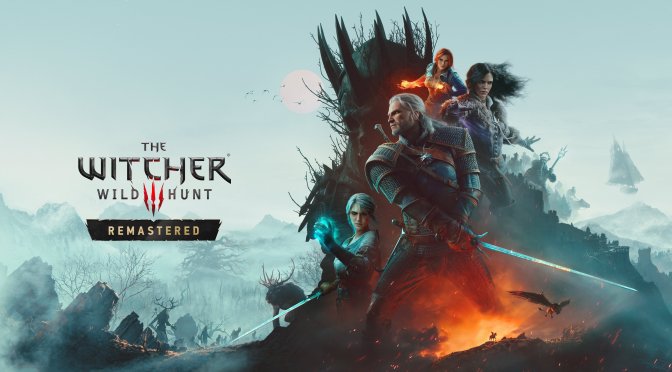
Over the past few weeks, CDPR has been sharing comparison clips between the original and remastered versions of The Witcher 3. And, thankfully, YouTube’s GameV has put all of these comparison clips into one video. As such, we now have a 10-minute comparison video between these two versions.
Before continuing, I should note that these are early WIP comparisons. As CDPR has stated in those clips, the remastered version is not final. In other words, it does not fully represent its quality.
We also do not know which version CDPR used for these comparisons. Take the first comparison, for example. The remaster does not seem to have true reflections in that scene. However, we do know that the PC version will support Path Tracing. With Path Tracing, the fire may also be reflected in the water. So, the final PC version could look better than what we see here.
Anyway, the biggest change between the original and the remaster is the color palette. Some players may like it, while others may not. Other than that, the missing fire reflection in the first comparison is the only thing that makes the remaster look worse than the original. So, let’s hope the maxed-out PC version will look even better.
Alongside Path Tracing, the PC version will support NVIDIA DLSS 4.5, AMD FSR 4.0, and Intel XeSS 2.0. It will also take advantage of DLSS 4.5 Ray Reconstruction.
CDPR will release The Witcher 3 Remastered on September 29. This will be a free update for all owners of the Complete Edition.
Enjoy the video and stay tuned for more!


John is the founder and Editor in Chief at DSOGaming. He is a PC gaming fan and highly supports the modding and indie communities. Before creating DSOGaming, John worked on numerous gaming websites. While he is a die-hard PC gamer, his gaming roots can be found on consoles. John loved – and still does – the 16-bit consoles, and considers SNES to be one of the best consoles. Still, the PC platform won him over consoles. That was mainly due to 3DFX and its iconic dedicated 3D accelerator graphics card, Voodoo 2. John has also written a higher degree thesis on the “The Evolution of PC graphics cards.”
Contact: Email