
Intro
I’ve always been a big fan of the original Star Wars movies, so whenever we get a new game set in this universe, I’m interested to see what developers can do with it. This time around, we have Star Wars Zero Company, a turn-based tactical game developed by Bit Reactor.
The studio is made up of developers with plenty of experience in this particular genre, and Zero Company certainly wears its XCOM influences on its sleeve. However, it also tries to add its own Star Wars flavour with a cinematic story, character interactions, exploration sections, and a management system between missions.
After playing through the campaign, which took around 40 hours, here are my thoughts.
Story
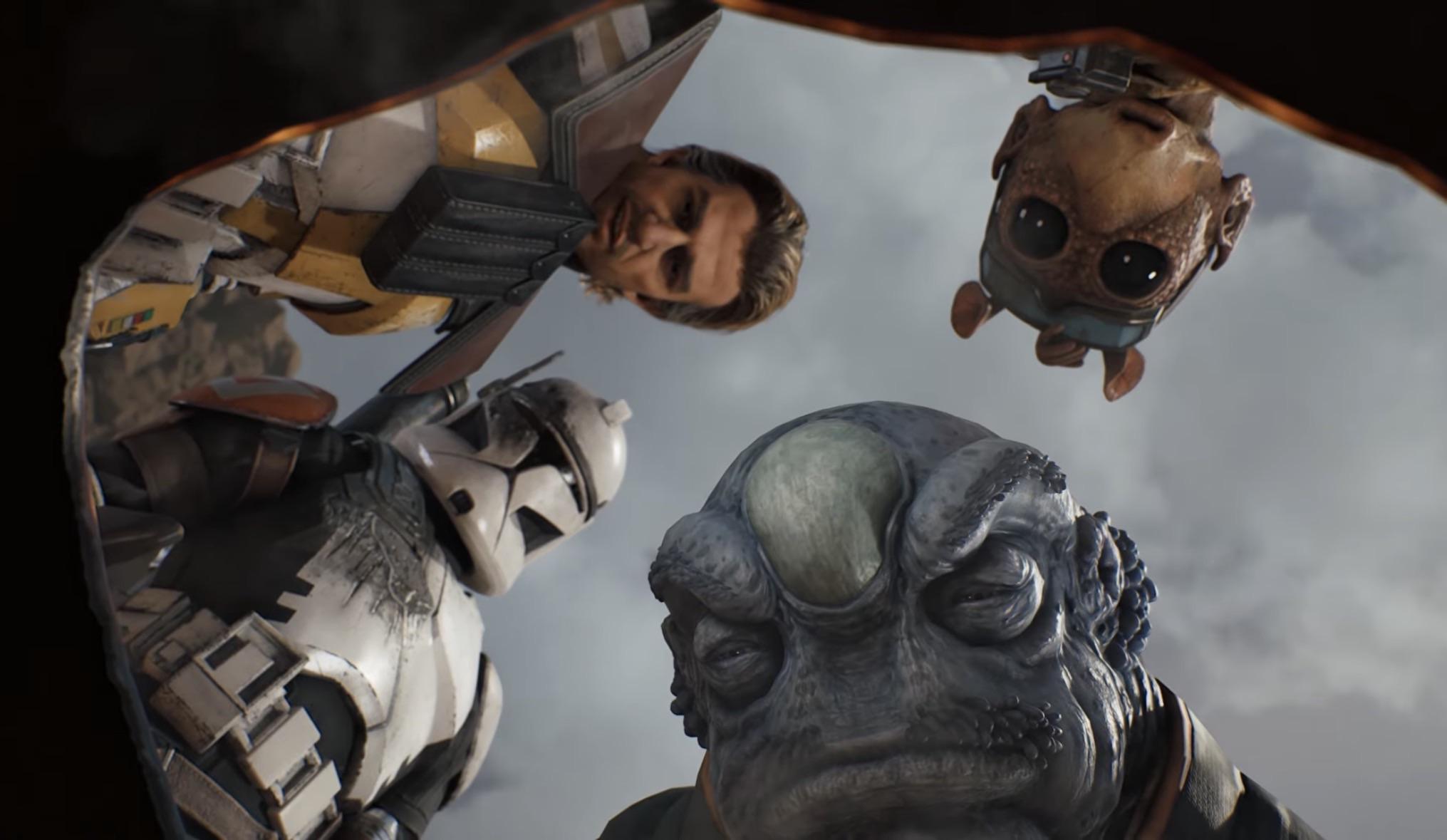
Star Wars Zero Company takes place during the twilight years of the Clone Wars. You play as Hawks, a former Republic officer who leads the Zero Company, a group of unconventional operatives recruited by Republic Intelligence.
The main threat is the Infinite Coil, a Separatist-aligned group led by Kundri Fathom. The Coil is spreading a deadly disease known as the Shadow Plague, and Zero Company is tasked with stopping them before things get even worse.
The game introduces new potential teammates throughout the campaign, each with their own personalities and motivations. I enjoyed getting to know most of them as I progressed, with the exception of Runa. She was as annoying as she was unlikable. Constantly lecturing the player, she felt like the typical girlboss character we are all too familiar with these days.
The story is linear, so don’t expect multiple endings or major branching paths. There are some plot twists along the way, which I don’t want to spoil. While they may not be new or even surprising, the high production value and good voice acting kept me engaged throughout my playthrough without making it feel unnecessarily long.
Graphics & Audio
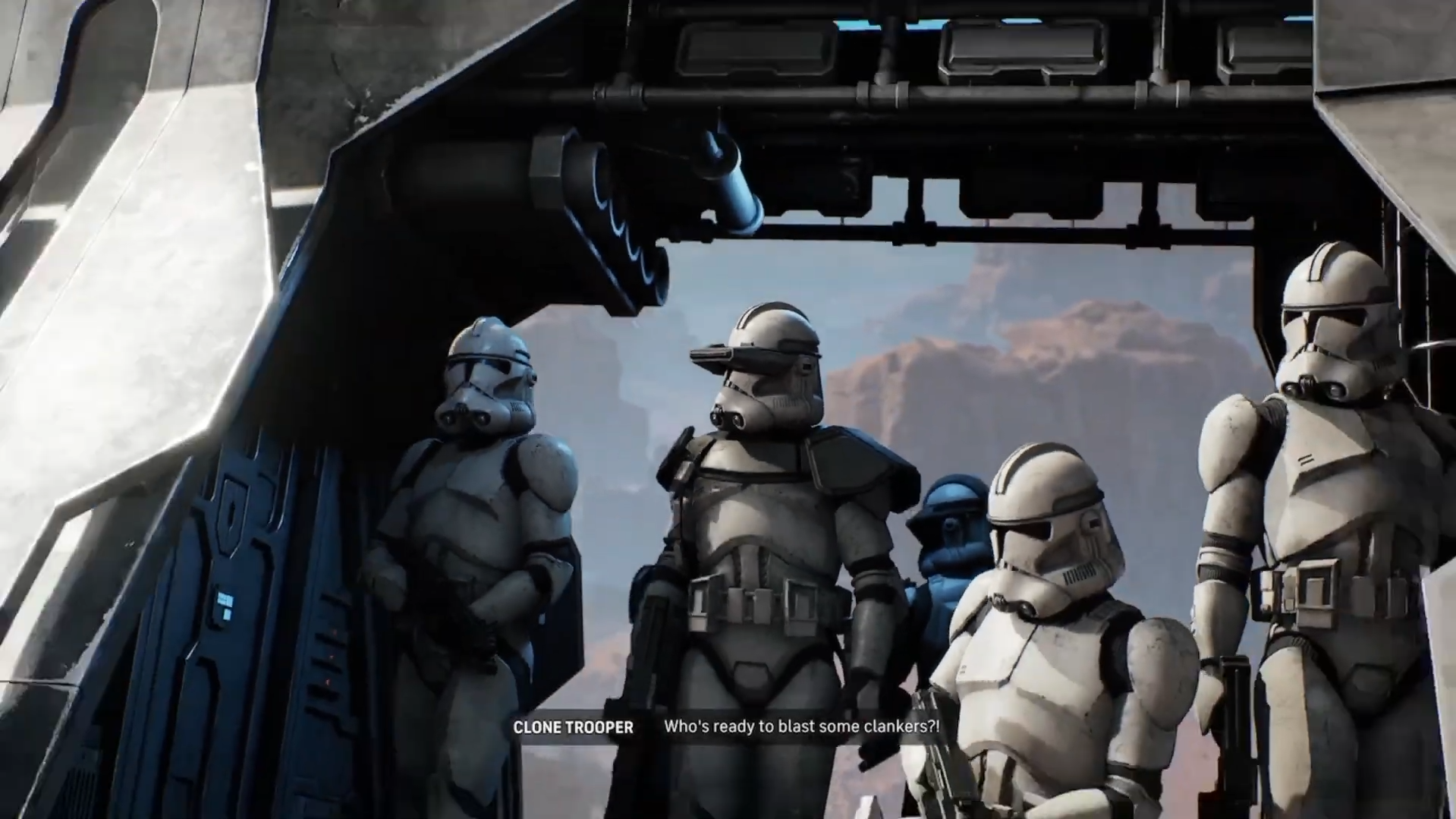
Visually, Star Wars Zero Company looks good. The character models and environments are detailed enough, and the game does a good job of recreating the Star Wars universe.
The different planets and locations have their own visual identity. Aside from the few non-story missions that reuse maps, there is enough variety to keep things from becoming boring. The lighting and effects are good, with destructible environments, blaster fire, and explosions keeping the game visually interesting.
The character animations are generally good as well, although I did encounter some issues during my playthrough (I’ll talk about that later). The ragdolls are great too. I never got tired of watching droids break into pieces, enemies drop dead, or grenades send them flying in all directions.
On the audio side, the game does a great job. The soundtrack and sound effects create that classic Star Wars feel, which really helps make the battles feel like they belong in the universe. The voice acting is solid, and I enjoyed listening to the conversations between the various members of Zero Company.
Gameplay
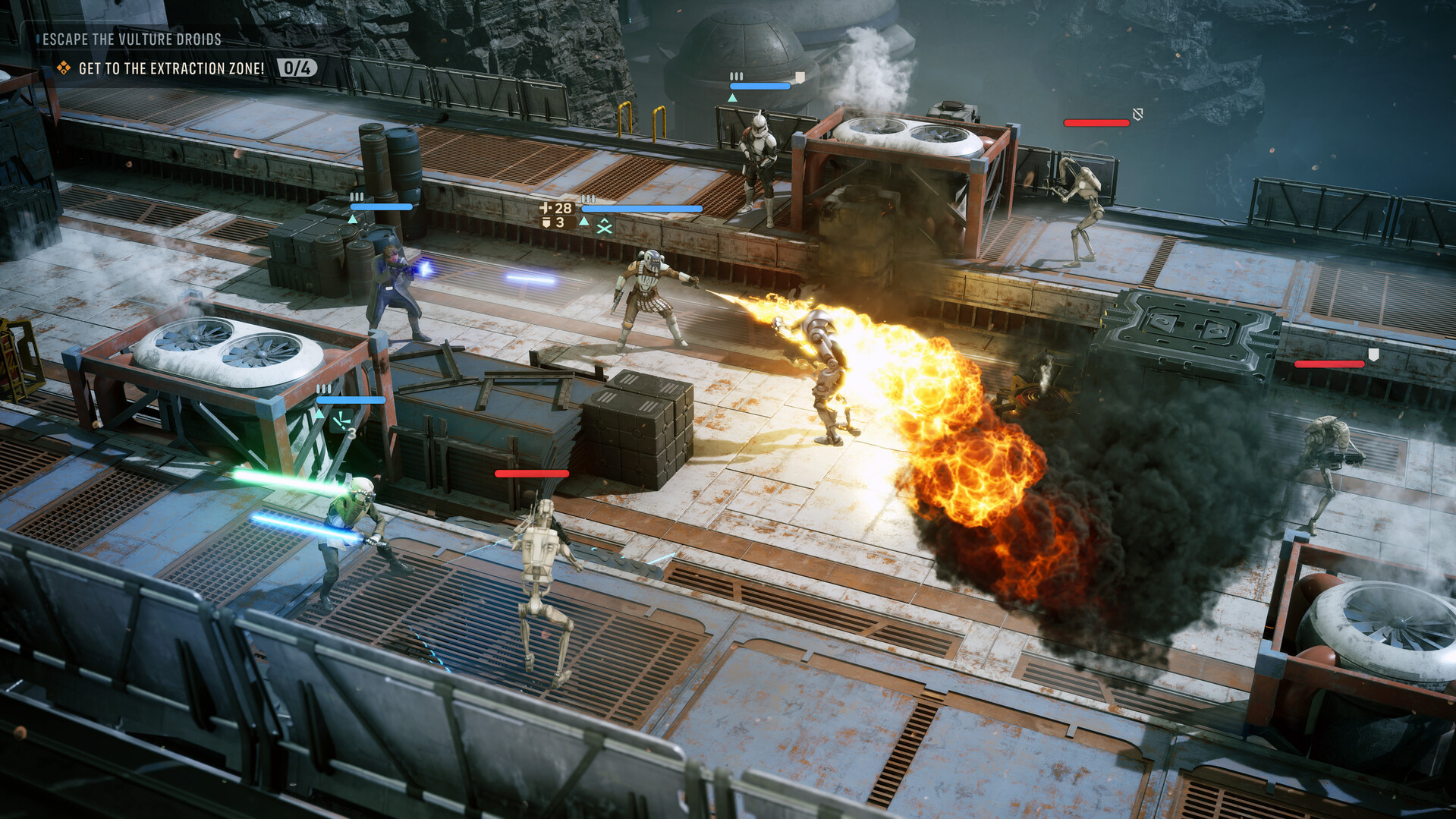
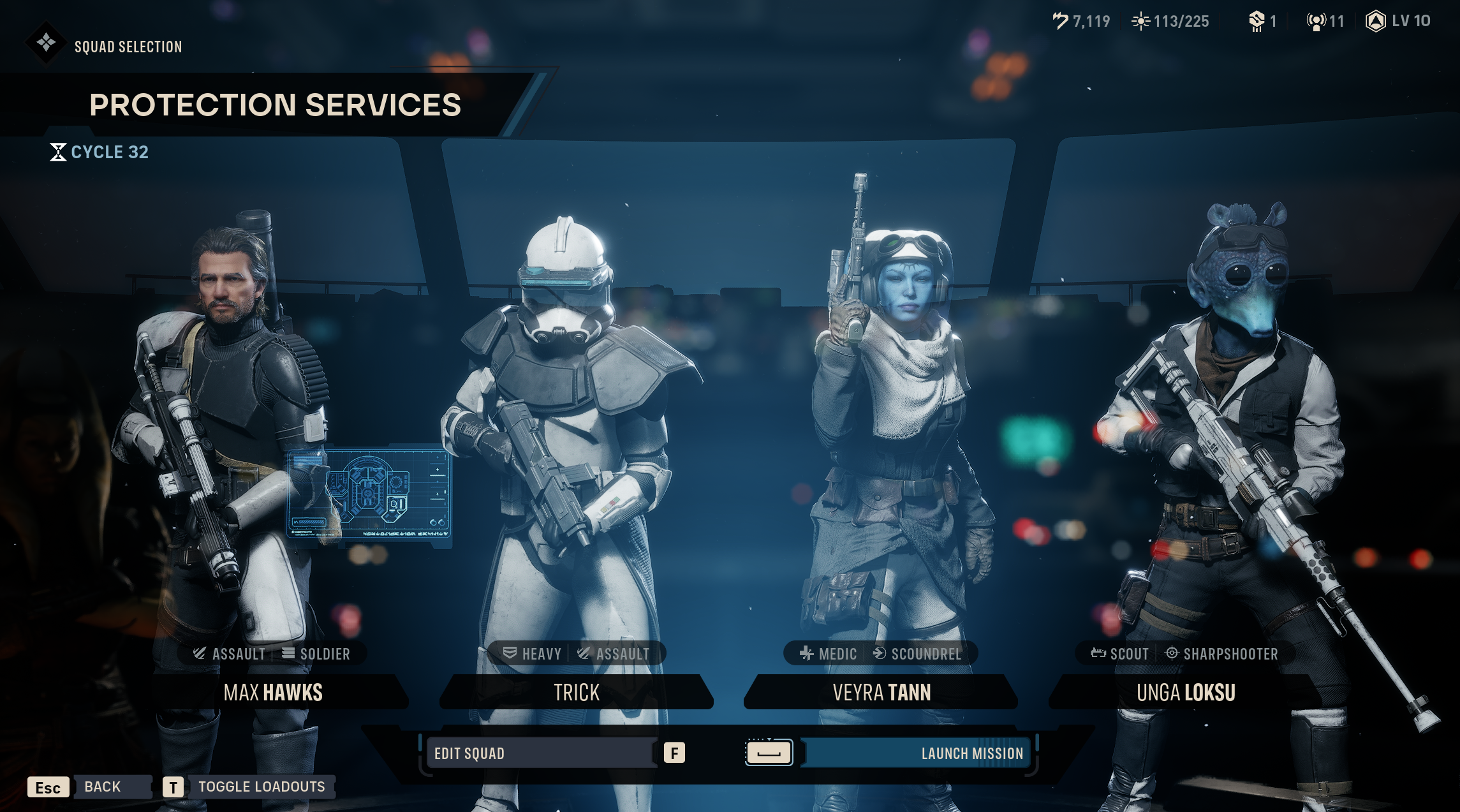
Star Wars Zero Company is a turn-based tactical game at its core. Each character has a number of Action Points that can be used for moving, attacking, using Overwatch, and activating various skills. You therefore have to think about how you want to spend your Action Points during each turn. Half cover, full cover, and flanking are also present, so if you’ve played XCOM or similar tactical games, you’ll be very familiar with these mechanics.
Your entire team gets to move before the enemy each round, and you can freely switch between your teammates. This allows you to set up different plays and coordinate your entire squad before ending your turn.
Another mechanic you have to keep an eye on is Advantage. You can gain Advantage by doing certain things during a mission, such as exploring the environment before a battle (only in story missions), damaging enemies on the battlefield, or using a Den upgrade. Advantage can then be used to activate a set of special abilities. The abilities available depend on the class, and they use Advantage instead of Action Points. However, Advantage is a team-wide resource, so if one character uses it all up, you’ll have to build it up again before you can use another ability.
Hawks and the astromech droid companions have abilities that allow them to grant Action Points to other characters. This can be extremely useful when you need to squeeze one more attack or ability out of a character during a turn.
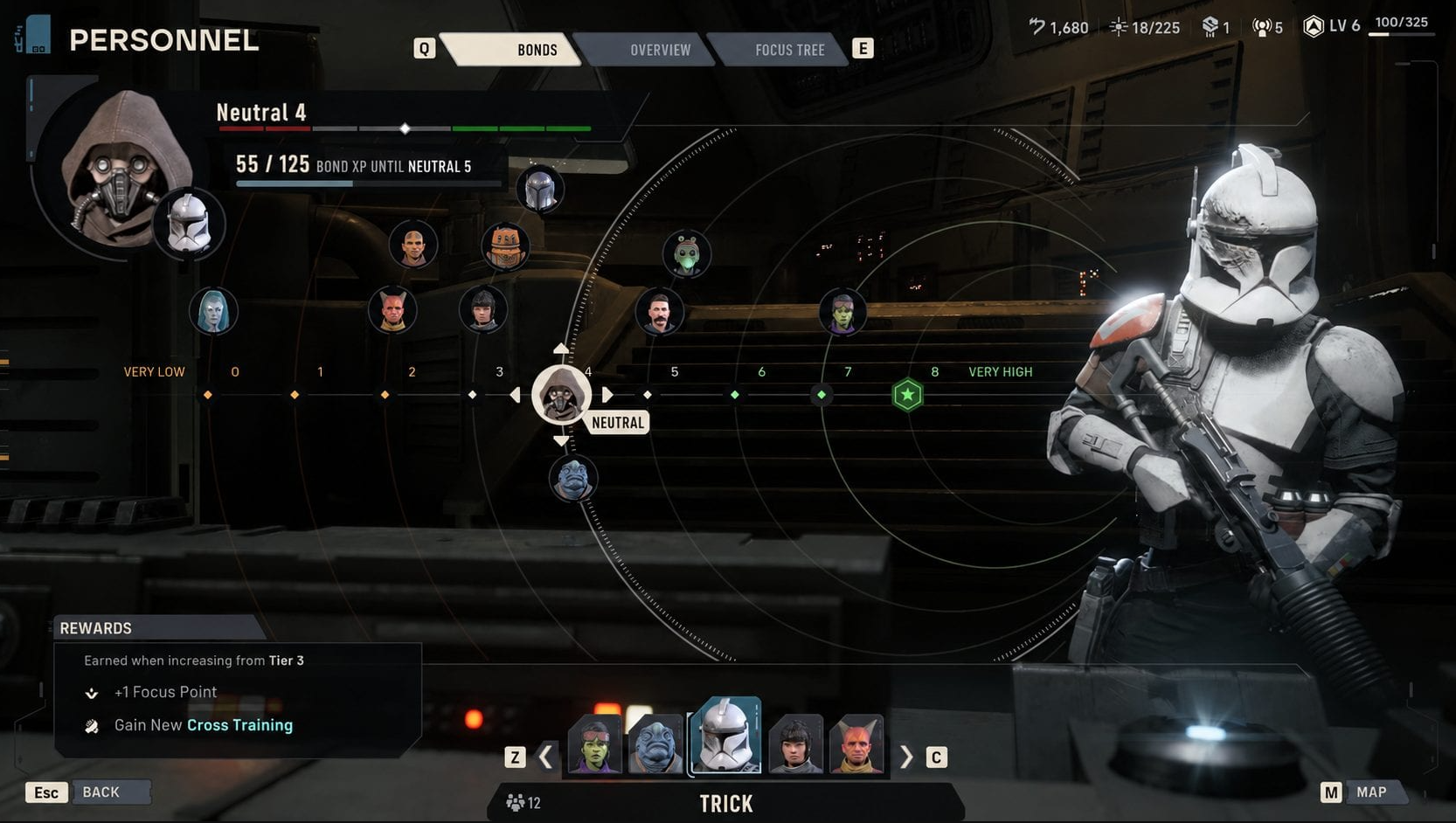
There is also a bond mechanic, where operators who assist, heal, buff, or give an additional Action Point gain Bond XP. As the Bond levels up, characters get stat increases, and at the max level, it grants a pretty good bonus to both characters.
A nice touch was also the fact that characters continued to fire at one another across the battlefield while I was deciding my next move. It created the sense of a living battlefield, as opposed to everything just stopping while I was making choices.
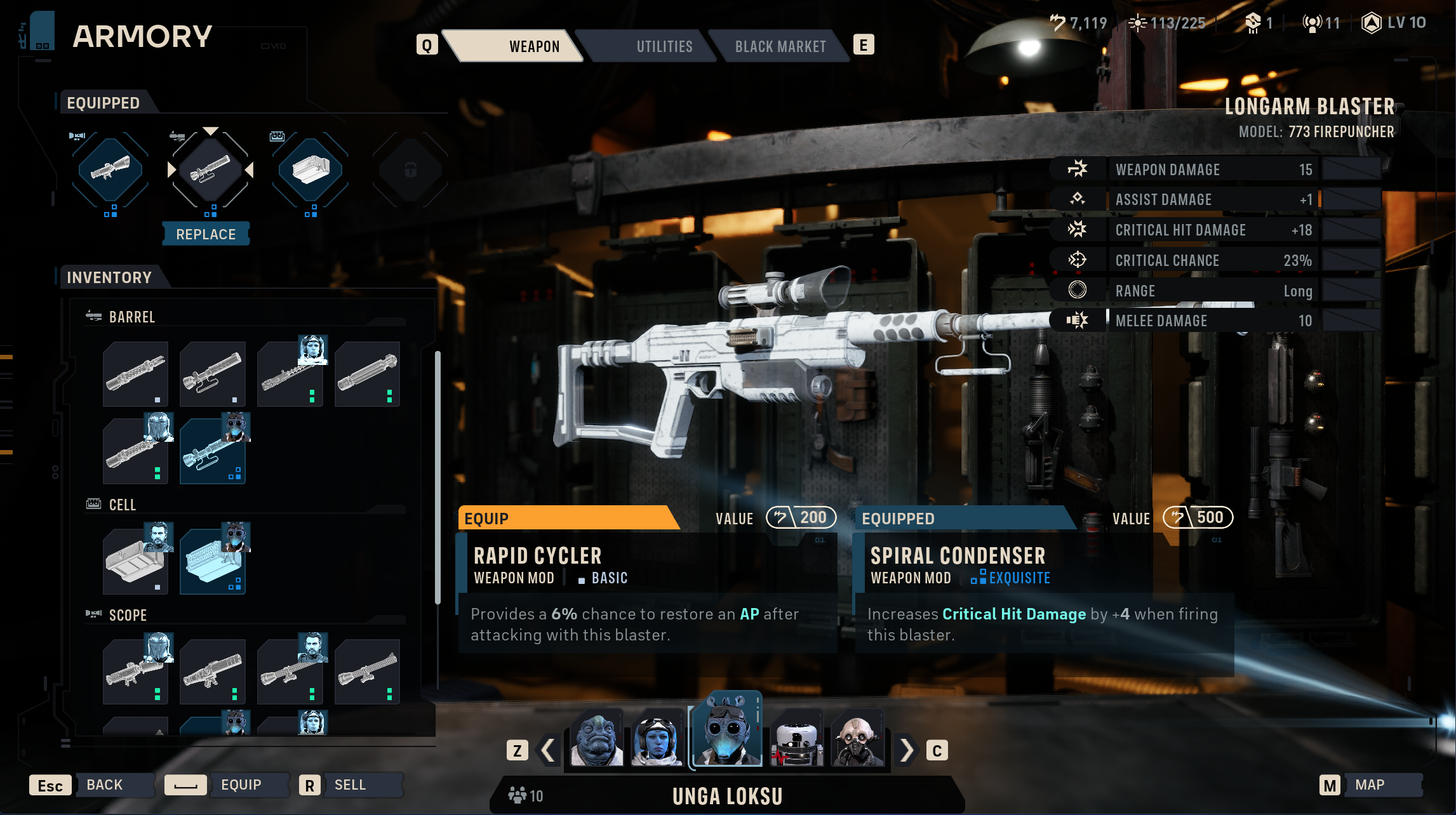
Each operator starts with one weapon mod slot and one utility slot. As you progress through the campaign, you can unlock additional mod and utility slots by upgrading the Den or increasing your reputation with certain faction zones.
There are quite a few weapon mods and utility items to find, with different levels of rarity. Some mods can increase your accuracy, for example, while utility items include concussion grenades, smoke grenades, and kits that allow you to move further or increase your defense. Some of these items are more useful than others, but there is a decent variety. They also allow you to customize your operators and their loadouts to a decent degree.
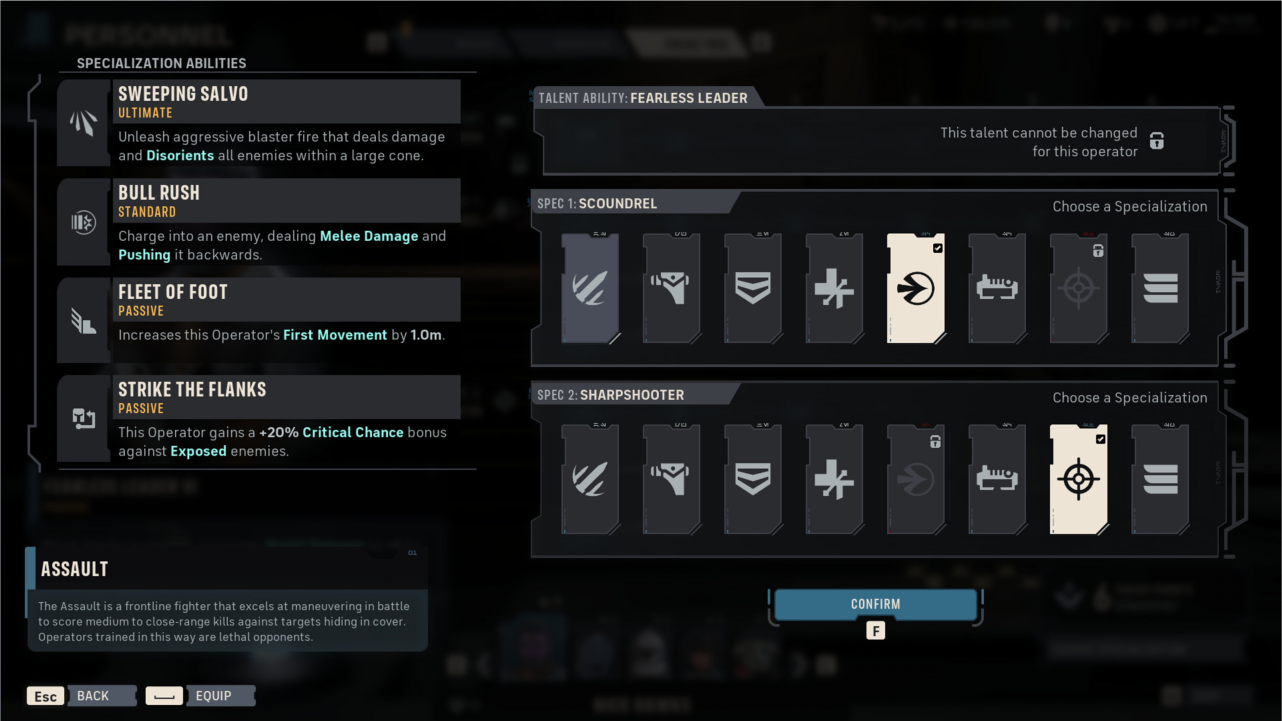
There are a total of eight different classes, each with their own unique skills. Later in the game, you can even dual-spec characters, giving you even more options when it comes to building your team. There are also a few exotic classes, but those are tied to certain named story companions and cannot be changed.
I really liked how all of these systems work together. You have to consider where your characters are positioned, how many Action Points they have left, whether you have enough Advantage, and which abilities you want to use. Once you start combining the abilities of different characters, the combat becomes quite enjoyable.
These classes can be changed at any time, and their skill points can be refunded. The only changes that cannot be reversed are the stat increases awarded for increasing bond levels between teammates.
There are several different types of missions throughout the campaign. Some are straightforward missions where you have to eliminate all enemies, while others require you to complete an objective before getting out. Side missions may require you to plant charges and escape, rescue NPCs within a time limit, or loot a container, for example.
The missions generally do a good job of changing things up, and you’re not simply doing the exact same objective over and over again. The different objectives also force you to think about how you approach each map. This is mostly true for the story missions. The side missions are a little more repetitive.
Before some story missions, you also have exploration sections. These allow you to move your squad around an area before entering the actual tactical encounter. You can occasionally talk to a person or two, or find Intel and Advantage Points.
The idea is good, although I wasn’t particularly impressed with how these sections were implemented. Most of them are basically short, linear paths with markers telling you where to go. There isn’t really much to discover, which somewhat defeats the purpose of having an open exploration section in the first place. It also means there is little need for markers showing you where to go.
The Den
In between the main missions, you can return to your Den to upgrade the base, buy new items from the black-market vendor, hire new operators, upgrade current operators, and edit your loadouts.
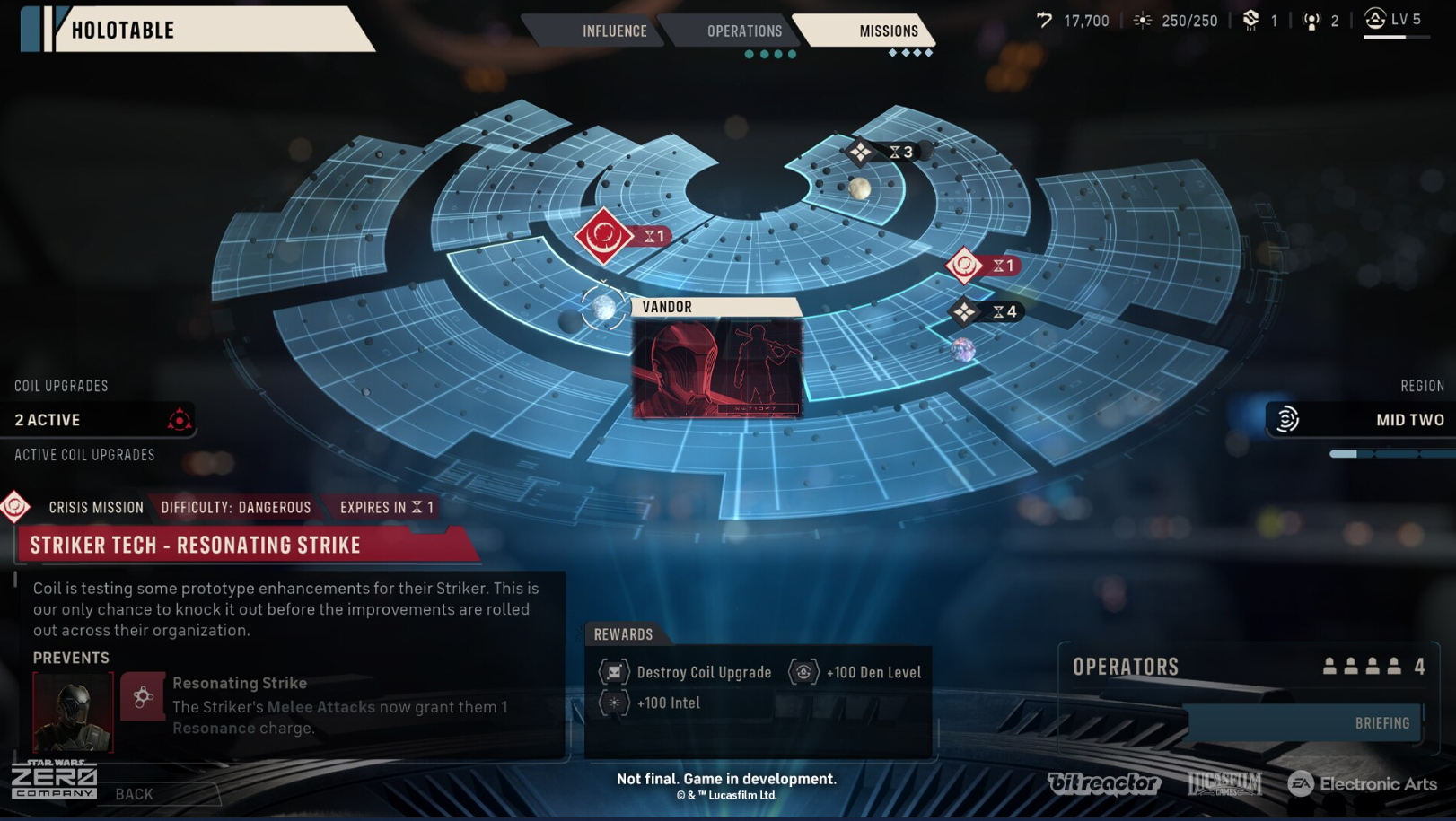
There is also a Holotable where you can undertake different Operations. These are non-combat assignments that can reward you with Intel, Credits, equipment, upgrades, and other useful items. Some Operations also give you choices. Depending on what you select, you can affect your relationships with your teammates, unlock additional missions, or increase a zone’s reputation.
As you progress through the campaign, you’ll come across some mandatory Operations where you can only pick one of two choices. Each choice grants an upgrade to Coil or droid troops going forward. The choice you complete will remove that upgrade from the enemy, while the other one will take effect. Which one you pick will depend on your team build and strategy.
You also have a limited number of Cycles in the game, meaning you can’t simply complete every Operation and mission that appears throughout the game. Completing these Operations costs Influence, Credits, and/or requires you to assign operators to them. In some cases, this also comes with a risk of injury. Assigning the correct operator will result in a better outcome.
The companion missions require that specific companion to be part of your squad. This means you sometimes have to change your usual team if you want to complete a character’s personal mission.
Character Creation
You can create a variety of races for Hawks, with male or female options.
- Human
- Togruta
- Twi’lek
- Zabrak
- Mirialan
- Devaronian*
- Weequay*
- Ovissian*
Only three of these use different faces (Devaronian, Weequay, and Ovissian). All the rest share the same 24 faces. Of those 24 faces, only a few, in my opinion, can really be made to look like decent male characters without looking like some weird hybrid. The female options are no better.
Not to worry, though. All the races can have vitiligo, even the alien races, because representation exists in a galaxy far, far away.
Otherwise, all the usual options are there: skin color, hairstyles, facial hair, scars, tattoos, and various options for horns and ears for the other races. The choices weren’t great, so I ended up simply using the default Hawks.
There are, however, a ton of outfit customization options available, so I have to give them points for that. These can also be changed at any point during the game in the Den, both for Hawks and his team.
Later in the game, you can also recruit operators at the Den. You can fully customize them as well, with the addition of Rodian and Neimoidian races and the option to choose their voices.
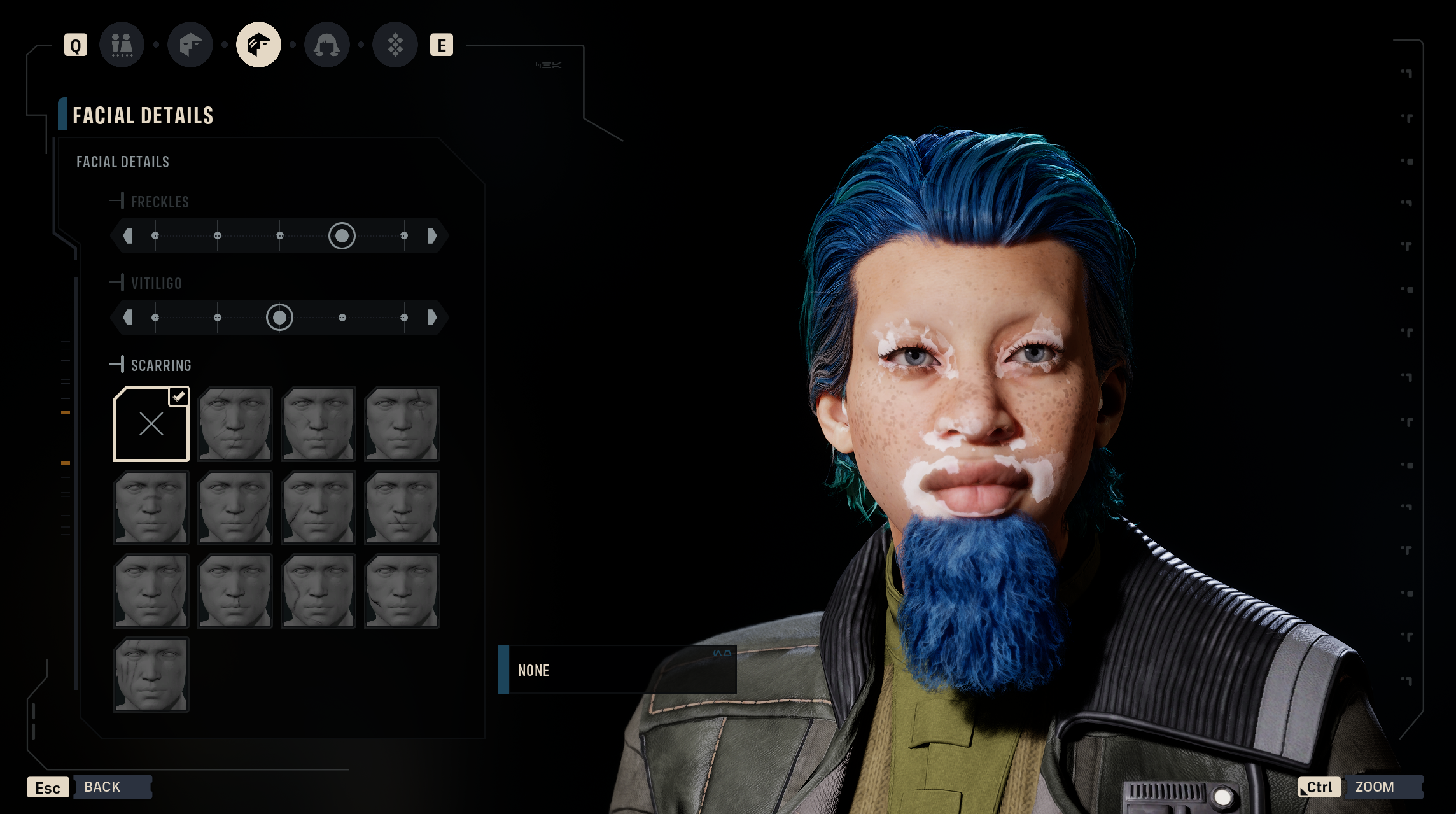 Unfortunately, this crap still exists in a galaxy far far away
Issues
Unfortunately, Star Wars Zero Company has some technical problems.
A lot of players have reported performance issues and bad stuttering. I have a beefy PC and also experienced quite a bit of stuttering, particularly during the exploration sections. In my case, a mod improved the stuttering significantly, but this really shouldn’t be necessary. A patch was released towards the end of my playthrough, which I believe improved the stuttering. However, there was still some stuttering present.
There were a few other bugs as well. On one occasion, an enemy became stuck inside the environment, and I could not shoot him, so I had to use a grenade to kill him.
I also encountered several instances where the enemy’s animation didn’t play correctly, and they simply slid across the terrain.
Towards the later part of the game, I noticed some enemy death animations stuttering as well. In addition, it was common to experience situations where it took a while for an action to register, which made combat feel unresponsive.
Enemy actions quite frequently took ages to even start, which left me just staring at a static screen as I waited. The first time it happened, I thought the game had frozen.
The camera was another issue throughout my playthrough. It would end up behind a wall or obstacle and completely block my view of what was happening. When reinforcements arrived on the battlefield, the camera would sometimes remain focused on some unimportant area instead of showing their arrival.
While these issues did not ruin the game for me, they break the flow of the game and need to be fixed.
Conclusion
I ended up enjoying Zero Company quite a bit, despite being skeptical of EA and modern AAA games in general. It has a good deal of replayability, a harder difficulty, and even a permadeath mode if that’s your thing.
The story certainly isn’t anything revolutionary, but the cinematics and voice work are very good. Along with the different members of Zero Company, they make for an enjoyable campaign.
While I feel it lacks the depth and focus of XCOM 2, it still has enough depth in its tactical gameplay to keep things fun throughout. I never felt like it dragged on or got boring.
I also liked the progression systems. Between upgrading individual operators, unlocking new abilities, improving Bonds, equipping gear, and upgrading the Den, there was always something to work towards.
The biggest problems I had were the technical issues, camera problems, and some of the bugs I encountered, along with the disappointing exploration sections, which I feel were a missed opportunity. Perhaps they simply ran out of budget. Despite these issues, none of them were so bad that they ruined the experience or hindered my enjoyment of the game.
I would say I look forward to seeing what they do next, but apparently the studio has furloughed 80% of its staff, so it seems the future is a little uncertain.
If you like Star Wars and enjoy tactical games like XCOM, there is a lot to like here. I would recommend giving it a try.

- Great presentation
- Deep gameplay and character progression
- Good voice acting
- Varied team compositions
- Free Respecs
- Replayability

- Performance issues and stuttering
- Occasional bugs
- Cameras can be problematic
- Exploration sections are too linear
- Runa is obnoxious
Computer Specs:
Windows 11 64-bit computer using an AMD Ryzen 9800X3D, 64GB RAM, and an NVIDIA GeForce RTX 5080 16GB graphics card

Stephen is our resident kung fu master and reviewer. When he’s not kung fu fighting, he’s playing games, and has been since the atari 2600. He also runs his own YouTube channel called Particular Pixels, where he creates a variety of content related to PC gaming. He goes by the nickname Shaoling (not to be confused with Shaolin), which comes from his favorite PC game of all time, System Shock 2.