
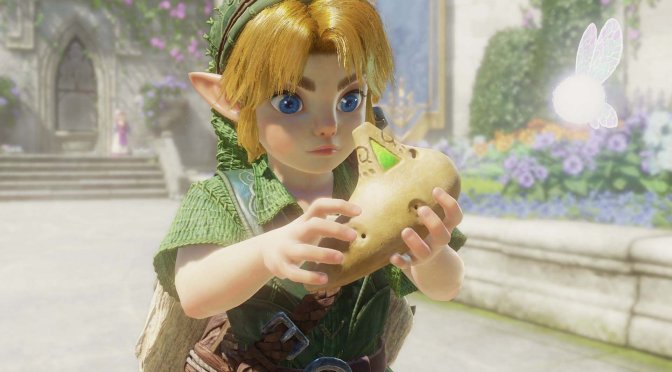
Yesterday, we reported that the Nintendo Switch 2 emulator Lichii could boot and run The Legend of Zelda: Ocarina of Time Remake. Just one day later, its developers have fixed most of the game’s visual issues and made it run much faster.
I’ve been covering emulators for many years, but I can’t recall seeing progress like this. We’ve seen huge gains in emulators such as shadPS4. However, this is the first time I’ve seen a game go from “Unplayable” to “Almost Fully Playable” in just two days.
What’s also crazy here is its performance. At first, the game could only run at 20-30 FPS. But now, the starting area runs at 60 FPS. The Great Deku Tree also runs at 60 FPS.
Now, I’m not saying that the entire game runs at 60 FPS. But we’re getting there. I honestly believe that by the end of next week, the game will be fully playable at 60 FPS on PC. This is crazy.
For those who did not know, Lichii is a fork of Eglantine. Right now, this appears to be the best fork of it, as it can run Star Fox Remake, Mario Kart World, and Donkey Kong Bananza at 60 FPS. So, if you want to play your Nintendo Switch 2 games on PC, I highly recommend using it.
One of the biggest additions is Dynamic FPS by Dark, an Eglantine developer. It is now built into this Lichii build, with his permission. You no longer need to install the mod by hand. It is on by default and shows up in the Add-Ons menu as “Dynamic FPS by Dark (built-in).”
As I said, the game also runs faster. While there are areas that can hit 60 FPS, there are others that run worse. For instance, in Kokiri Forest, the new build reaches a median of about 44 FPS. Before these changes, it ran at around 37 to 40 FPS. This gain comes from two key changes. The GPU back thread now does less work for each draw call, and the two GPU threads spend less time waiting for each other.
Shader stutter has also been cut down. The emulator now builds some cached pipelines in the background while you play. These are pipelines that the emulator skips during startup. This means more of them are ready when the game needs them. Mesh pipelines for things like terrain and plants are now saved in the shader cache, too. Before, they had to be built again each time you started the game.
There is also a change to how the shader cache is stored. This build now keeps its cache in its own vulkan-frizti.* files. It copies your old cache once, so you do not have to start from scratch. Other Lichii builds can no longer delete this new cache.
The update also brings in many changes from the main Lichii project. These include faster 3D method handling and quicker constant buffer uploads on the GPU back thread. It also cuts the cost of buffer tracking and keeps a list of used pipelines for 16 sessions. Texture unswizzling can now run across several threads at once.
More GPU changes improve how the emulator handles storage buffers and uniform data. It can now reuse cached storage buffer bindings and upload native uniform banks directly. The update also brings in safe fixes and some optional settings from other Lichii changes. Riskier options have been left out.
You can go ahead and download its latest version from here.
Have fun!
Breaking news 🚨
the legend of Zelda ocarina of time remake on pc in the latest build is running at 4k 60fps stable
– very clear visuals ✅
– no bloom issue ✅
– no artifacts ✅
– no slow motion ✅
– Minor stutters and freezing ❌#ZeldaOcarinaofTimeRemake https://t.co/hF1HyIFgbf
— J (@Jas769) November 6, 2026
🚨 ZELDA: OCARINA OF TIME REMAKE ALREADY HITTING 60 FPS ON PC! 🔥👀
the game JUST launched on Nintendo Switch 2!
• Experimental Lichii Switch 2 emulator
• 60 FPS demonstrated in opening sequences
• Tested on RTX 4080/5080- and in this a 5090 class hardwareAmazing progress 🔥 https://t.co/2C7PLkDkgo
— Chris Mizo (@MizoChris) November 6, 2026

John is the founder and Editor in Chief at DSOGaming. He is a PC gaming fan and highly supports the modding and indie communities. Before creating DSOGaming, John worked on numerous gaming websites. While he is a die-hard PC gamer, his gaming roots can be found on consoles. John loved – and still does – the 16-bit consoles, and considers SNES to be one of the best consoles. Still, the PC platform won him over consoles. That was mainly due to 3DFX and its iconic dedicated 3D accelerator graphics card, Voodoo 2. John has also written a higher degree thesis on the “The Evolution of PC graphics cards.”
Contact: Email