
Written by Søren Kamper
Star Wars games have always had a slightly strange relationship with PC gaming.
On paper, the franchise should have been easy to translate. Spaceships, blasters, lightsabers, bounty hunters, trench runs, evil empires. You can almost hear the pitch meeting writing itself.
But the best Star Wars PC games were rarely the ones that simply tried to imitate the films.
They were the ones that understood the platform.
They leaned into joysticks, mission briefings, CD-ROM drives, modding, mouse aim, RPG systems, hardware scaling, fan patches, weird engines, and the kind of long-term community support that console versions usually don’t get. Star Wars did not become interesting on PC because it looked like Star Wars. It became interesting because developers treated PC players like PC players.
That sounds obvious. It has not always been.
Star Wars Worked on PC When It Picked a Genre and Committed
The old LucasArts PC catalog was not afraid of genre.
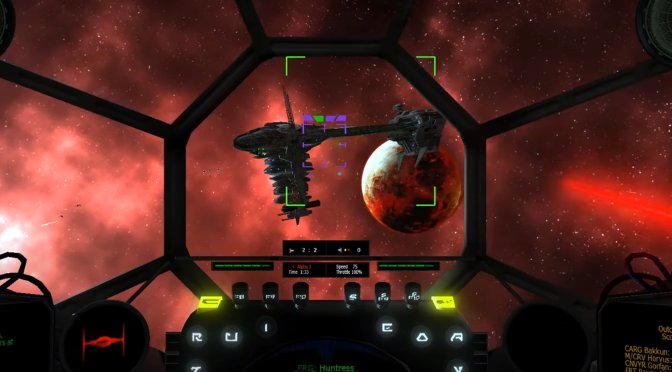
X-Wing and TIE Fighter were not arcade movie tie-ins with a cockpit slapped over them. They were PC space sims. They expected players to learn targeting systems, shield management, mission objectives, wingman commands, and the small religious ritual of owning a decent joystick. The fantasy was not just “you are in Star Wars.” The fantasy was “you are sitting at a desk, with hardware, pretending this cockpit is real.”
That mattered.
Those games worked because they respected the simulator language of the time. Missions had structure. Failure was possible. Control mattered. The Empire was not just a costume; in TIE Fighter, it became a whole campaign perspective.
That is the kind of thing PC gaming allowed Star Wars to do well. It could slow down. It could become technical. It could ask more of the player than “press button to feel like Luke Skywalker.”
Dark Forces did something similar for shooters. It did not just add stormtroopers to a Doom-like framework. It gave Star Wars an FPS identity, complete with vertical spaces, mission objectives, environmental puzzles, and a mercenary lead who did not need to swing a lightsaber every six seconds to justify his existence.
Later, Jedi Knight pushed that even further. It was messy, ambitious, strange, and very PC. First-person shooting. Third-person saber combat. Force powers. Multiplayer duels. User-made content. A control scheme that could feel like it was held together by cable ties and faith, but somehow worked because PC players were willing to meet it halfway.
That is the point. These games did not flatten themselves into generic Star Wars products. They became proper PC games first.
The CD-ROM Era Was Silly, But Star Wars Understood It
Then there was Rebel Assault.
It is very easy now to look back at the full-motion-video CD-ROM era and laugh. In fairness, a lot of it deserves laughing at. The 90s had a real talent for confusing “more video” with “the future of interactive entertainment.”
But Rebel Assault mattered because it understood the hardware dream of its moment.
For many PC players, the CD-ROM drive was not just a storage upgrade. It felt like a gateway to something bigger: full-screen video, voiced sequences, smoother presentation, and the vague promise that your beige tower had become a small home theater with loading times.
Rebel Assault was limited, stiff, and not exactly timeless as a game. But as a PC artifact, it is important. It sold the idea that Star Wars could be part of the multimedia PC push. Not always elegantly. Sometimes with all the subtlety of a badly compressed explosion. But it was there.
Star Wars has often been at its best on PC when it chases a platform-specific fantasy. In the early 90s, that fantasy was cockpit simulation and CD-ROM spectacle. Later, it became RPG structure, modding, resolution support, framerate targets, and now ray tracing, upscaling, shader fixes, and community preservation.
The platform changed. The lesson did not.
KOTOR Worked Because It Was a PC RPG, Not a Movie Simulator
Knights of the Old Republic is probably the cleanest example of Star Wars taking a genre seriously.
KOTOR did not work because it let players cosplay inside familiar film scenes. It worked because BioWare built a proper RPG around Star Wars: party composition, dialogue choices, morality systems, class progression, companion stories, inventory management, and turn-based combat hiding under a cinematic skin.
It trusted the genre.
That is why KOTOR still matters. It took the Old Republic setting far enough away from the films to breathe, then used PC RPG structure to make Star Wars feel personal. Not just “watch the hero.” Build the hero. Argue with companions. Choose badly. Save often. Regret later.
Even the modern life of KOTOR is very PC. Texture packs, fan fixes, compatibility work, restored content for KOTOR II, and constant remake speculation keep dragging it back into the conversation. DSOGaming has covered everything from KOTOR’s ESRGAN AI-enhanced HD Texture Pack to fan remake attempts and the official remake’s messy status.
That is what PC does. It does not let old games die quietly.
Sometimes that is noble. Sometimes it is obsessive. Usually it is both.
PC Players Also Remember the Bad Ports
Of course, taking PC seriously does not only mean building good old games.
It also means shipping modern games that run properly.
This is where Star Wars has had a rougher time. Star Wars Jedi: Survivor is the obvious recent example. DSOGaming’s PC Performance Analysis went deep on CPU behavior, GPU scaling, ray tracing, traversal stutters, graphics settings, and the kind of problems PC players immediately notice because they are literally staring at frametime graphs while trying to enjoy a lightsaber fight.
That is the modern version of taking PC seriously.
Not just “does it launch?” Not just “does it have Ultra settings?” Does it scale? Does it stutter? Does it support the right upscalers? Are its ray tracing effects worth the cost? Does the launcher add friction? Does the game demand hardware without giving enough back?
Those questions matter because PC players notice. They always have.
To Respawn’s credit, the game did improve over time. DSOGaming later looked at whether players could finally get a stutter-free experience in Jedi: Survivor, and the answer became more complicated than the disastrous launch narrative. Better, yes. Perfect, no.
That is PC gaming in one sentence, really.
Modern Star Wars Still Lives Through Benchmarks and Mods
The same is true for Star Wars Outlaws.
Whatever one thinks of the game creatively, its PC version became interesting partly because of the technology conversation around it. Snowdrop, mandatory ray tracing, RTXDI, GPU scaling, upscalers, and performance tuning all became part of the PC story. DSOGaming’s Star Wars: Outlaws benchmarks and PC performance analysis is exactly the kind of coverage that shows why PC-first analysis still matters.
And then there is the modding side.
Star Wars games keep getting second lives because PC players keep rebuilding them. Jedi Knight: Dark Forces II has benefited from projects like Star Wars Jedi Knight Remastered, while Republic Commando now has an RTX Remix path tracing demo. Even TIE Fighter has lived on through projects like the TIE Fighter Total Conversion Mod.
These are not just fan curiosities. They are the reason these games remain playable, discussable, and technically interesting decades later.
A console game can become nostalgic. A PC game can become a platform for archaeology.
The Best Star Wars Games Respect the Machine
The long history of Star Wars games is not one clean line. It is a mess of experiments, ports, brilliant ideas, terrible ideas, beloved classics, legal graveyards, and games that only make sense if you remember what PC hardware culture felt like at the time.
For anyone wanting the full chaos mapped out, Star Wars: Gaming maintains a complete reference archive of every Star Wars game ever made, which is useful if you want to see just how many genres this franchise has stumbled into over the years.
The pattern is pretty clear, though.
Star Wars games are usually better when they stop treating the license as the whole point.
A cockpit sim should be a proper cockpit sim. A shooter should be a proper shooter. An RPG should be a proper RPG. A modern PC release should run like someone actually tested it on real PC hardware. A remaster should respect resolution, framerate, input, and preservation. A modding community should not have to fix everything, but when it does, publishers should understand why that matters.
That is why Star Wars and PC gaming have worked so well when the relationship is at its best.
Not because the PC is magically superior at Star Wars.
Because PC gaming has always rewarded games that take systems, hardware, and player expectations seriously.
And when Star Wars does that, it stops being just another licensed game.
It becomes something far more interesting.
Author Bio
Søren runs Star Wars: Gaming, a long-running Star Wars gaming site covering classic LucasArts titles, SWTOR, KOTOR, modern Star Wars games, mods, retro releases, and the strange corners of Star Wars gaming history that never really disappear.

User’s articles is a column dedicated to the readers of DSOGaming. Readers can submit their stories and the Editorial team of DSOGaming can decide which story it will publish. All credits of these stories go to the writers that are mentioned at the beginning of each story. Contact: Email