
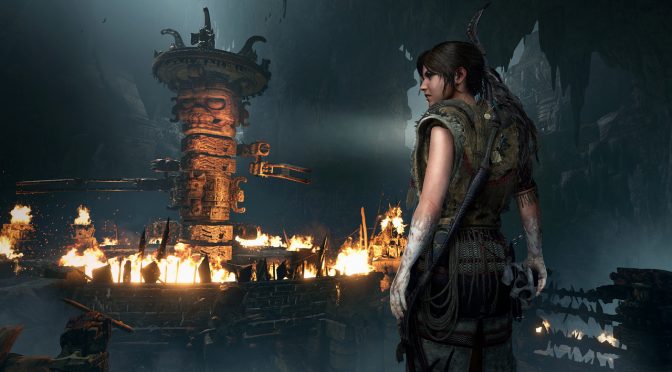
Shadow of the Tomb Raider feature 1

Shadow of the Tomb Raider is the first game that supports Intel’s XeSS

Nixxes Software has released a new patch for Shadow of the Tomb Raider that adds XeSS graphics support for DX12-compatible systems. As such, Shadow of the Tomb Raider is the first game that supports Intel’s upscaling tech.

What’s really interesting here is that Shadow of the Tomb Raider already supports NVIDIA’s DLSS tech. Thus, we’ll be able to compare these two upscaling techniques and see which one is better in this game.

Shadow of the Tomb Raider also supports Ray Tracing Shadows. So yeah, it will also be interesting to see the performance boost that Intel’s XeSS offers when a game uses Ray Tracing effects.

We’ll have comparison screenshots and benchmarks for NVIDIA DLSS and Intel XeSS later this week, so stay tuned for more.

Lastly, this latest update packs a fix to the deprecated online authentication method.

13 thoughts on “Shadow of the Tomb Raider is the first game that supports Intel’s XeSS”

    1. Intel likely would’ve paid the developer/publisher to patch it in. These Crystal Dynamics Tomb Raider games have been popular benchmarking games for almost a decade now, because they support bleeding edge tech on PC. It makes sense to add it to this game, especially since it already supports competing technology DLSS. Reviewers can do direct comparisons.

      1. Duh i know, they point was Just put that money in any other game widely used as a benchmark which is also actually still played today.
        That would make it more relevant than just a benchmark.

  1. But it is unique because it is a first for XESS support on DX12 in public release, que no? I am downloading the patch right now to test it against DLSS

  2. Out of curiosity I tried enabling XeSS on my RTX 2060 and the game slowed down to 4fps. I chuckled then re-activated DLSS. Oh well, so much for it working on any GPU.

  3. I did some testing with XeSS a few minutes ago, and here are my observations:

    1. You can’t turn on XeSS while CAS (Contrast Adaptive Sharpening) is enabled. The option for XeSS is grayed out until you turn CAS off.

    2. The visual quality of XeSS is not as bad as I expected. It mostly just looks like the visuals were softened, and when things are in motion (such as in the benchmark) you don’t really notice the loss of detail. Ghosting wasn’t really noticeable, however I did see some occasional artifacting.

    3. FPS with XeSS enabled was horrible. Even the “Performance” setting had trouble hitting the same FPS in some scenes of the benchmark that I would see in native resolution on my GTX 1080 Ti. This is a technology that you will probably only be able to benefit from if you have an Intel GPU, as none of the settings actually perform noticeably better than native resolution otherwise.

    1. Yep.

      On my 5700 XT, I was getting 20% less performance on 1080p XeSS Quality than 1080p native. Blurrier at the same time. And it didn’t seem to actually reconstruct anything.

      Would’ve been great if Shadow had an official FSR 2.1.1 implementation.

      1. Intel Xess uses XMX (Intel ARC GPUs) or DP4A
        DP4A is only supported by Nvidia GTX 10 series and Later. AMD RDNA2, Radeon VII and i think 5500XT too

Leave a Reply

Your email address will not be published. Required fields are marked *