
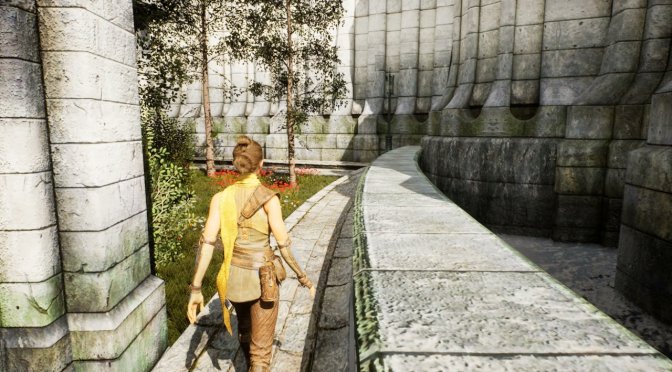
Greg Coulthard has shared an amazing video that will undoubtedly put a smile on all The Elder Scrolls fans. Coulthard has ported The Elder Scrolls IV: Oblivion‘s Imperial City in Unreal Engine 5 and used Lumen, Nanite and Echo.
Al the assets and textures that Coulthard are from the original Oblivion game. Moreover, the artist implemented Nanite in all assets (with the exception of the outer walls and the banners). The cobblestone & sidewalk texture normals were also cranked up with Crazy Bump. Additionally, Greg used Kuzja80’s 4x Texture Pack which overhauls the original textures, meaning that the game can now look sharper.
The end result is amazing and shows what an HD Remaster of The Elder Scrolls IV: Oblivion could look like. Since this project uses Lumen, it also packs some software Ray Tracing effects.
In order to capture this video, Greg used an NVIDIA GTX1660 6Gb, an Intel Core I7 4770K and 24GB of RAM.
Speaking of Unreal Engine 5, here are some other cool projects. We’ve shared two forest maps that use Nanite and Lumen and look pretty cool. You can find the one here, and the other here. Furthermore, there is an awesome Unreal Engine 5 Superman Fan Tech Demo.


John is the founder and Editor in Chief at DSOGaming. He is a PC gaming fan and highly supports the modding and indie communities. Before creating DSOGaming, John worked on numerous gaming websites. While he is a die-hard PC gamer, his gaming roots can be found on consoles. John loved – and still does – the 16-bit consoles, and considers SNES to be one of the best consoles. Still, the PC platform won him over consoles. That was mainly due to 3DFX and its iconic dedicated 3D accelerator graphics card, Voodoo 2. John has also written a higher degree thesis on the “The Evolution of PC graphics cards.”
Contact: Email