
In case you didn’t know Intel’s unreleased Core i9-10850K desktop processor was spotted few weeks ago, with geekbench entries of this CPU being listed as well, along with the specs.
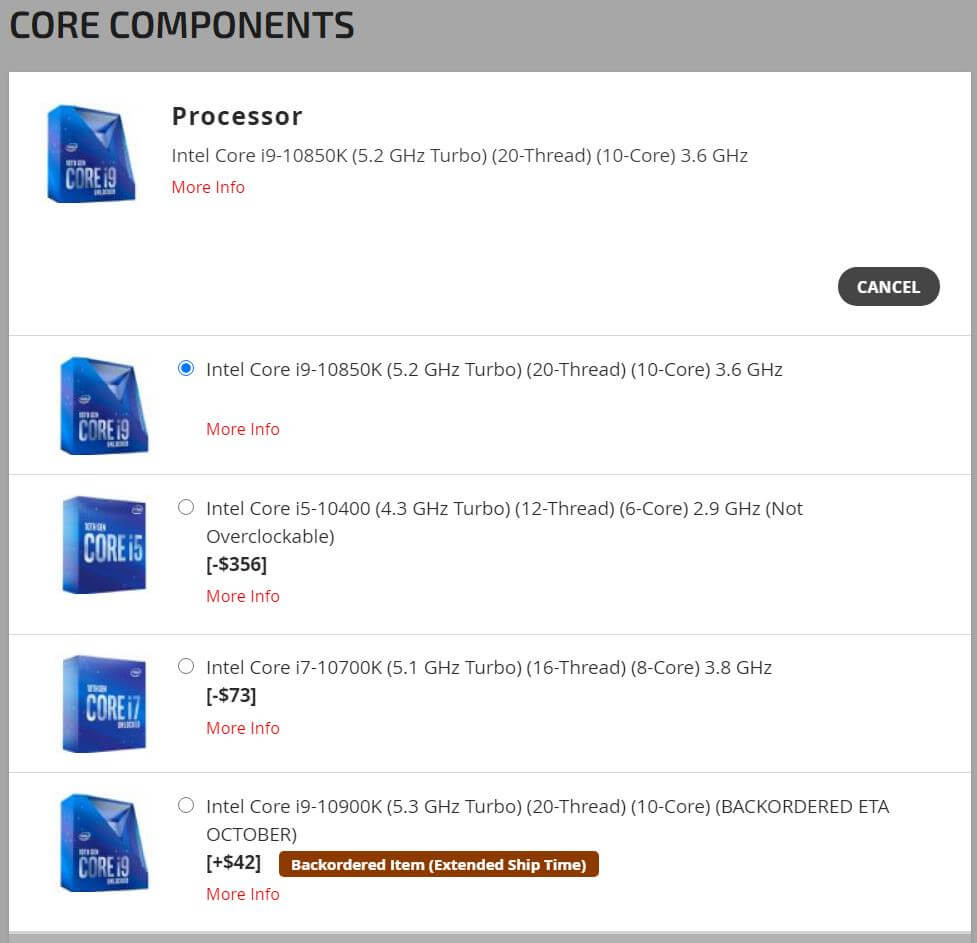
Now, the same CPU has been spotted on Digital Storm’s official webpage, confirming the chip’s existence. However, the question still remains whether this processor is an OEM-exclusive chip, or it might end up hitting the retail shelves as well. This leak originates from Digital Storm (via Momomo_US, and Wccftech) where the chip can now be found listed under the Digital Storm’s prebuilt system configuration webpage, along with the specs and expected pricing.
Like other Comet Lake-S processors, the Core i9-10850K is based on Intel’s 14nm process node. This processor first surfaced with a 3.6 GHz base clock and 5.2 GHz boost clock. And now, Digital Storm has the processor listed with the same clock speeds. The specifications seemingly confirm that the Core i9-10850K is nothing more than a Core i9-10900K with a 100 MHz slower base clock, and without the Thermal Velocity Boost (TVB) feature.
The specifications reported earlier were correct and the Core i9-10850K will indeed feature a 100 MHz lower clock speed for both the base and boost frequencies. Assuming that this chip isn’t an OEM-only part/SKU, Intel might be readying a Comet Lake refresh to ward off AMD’s recent Ryzen 3000XT lineup. We don’t know for sure whether this processor will come to the retail market though, but the part does look promising.
This new unannounced processor comes with an identical 10-core, 20-thread configuration as the Core i9-10900K. The Core i9-10850K packs 20MB of L3 cache, and 256KB of L2 cache per core. There’s no doubt that the Core i9-10850K is closely related to the Core i9-10900K. Being an unlocked K processor, it would be easy to overclock the Core i9-10850K to match or even surpass the performance of a stock Core i9-10900K processor.
The Core i9-10850K doesn’t feature Thermal Velocity Boost (TVB), and this would explain why this 10-core part maxes out at 5.2 GHz, instead of 5.3 GHz of the Core i9-10900K. There’s no TDP mentioned but we expect it be the same as the Core i9-10900K at 125 Watts.
To put this in a nutshell, the Core i9-10850K is technically speaking a Core i9-10900K with a 100 MHz lower base clock value, and without TVB. We can’t fully discard the fact that the Core i9-10850K is for Intel’s OEM clients, but this seems unlikely given that the processor is a K-series unlocked chip. Unless of course some brand is planning to offer an overclockable prebuilt system, I don’t see the Core i9-10850K being an OEM-only SKU. This processor should hit the retail shelves, hopefully.
The current speculation is to bring a processor that’s comparable to the Core i9-10900K’s performance, but with lower cooling and thermal/power requirements. According to Intel, the Core i9-10900K’s MSRP is between $488 and $499, depending on other factors. Therefore, the Core i9-10850K could sell for $446 or $457. Assuming that the Core i9-10850K isn’t just an OEM-exclusive chip, we can safely assume that the CPU can retail for around $450. So, does this mean Intel’s TVB feature costs $50 extra? Yes!

Hello, my name is NICK Richardson. I’m an avid PC and tech fan since the good old days of RIVA TNT2, and 3DFX interactive “Voodoo” gaming cards. I love playing mostly First-person shooters, and I’m a die-hard fan of this FPS genre, since the good ‘old Doom and Wolfenstein days.
MUSIC has always been my passion/roots, but I started gaming “casually” when I was young on Nvidia’s GeForce3 series of cards. I’m by no means an avid or a hardcore gamer though, but I just love stuff related to the PC, Games, and technology in general. I’ve been involved with many indie Metal bands worldwide, and have helped them promote their albums in record labels. I’m a very broad-minded down to earth guy. MUSIC is my inner expression, and soul.
Contact: Email
intel K series is waste of money, when locked i5-8400/9400 & i5-10400 run games like a charm even hitting well beyond 144fps if you have the GPU capable for it
depends on a game. If all you are playing are console ports – then yes. Both XBox One and PS4 feature extremely weak mobile AMD CPUs. Any game made for them is extremely CPU limited so naturally 2-3 times more powerful i5-8400 will blast them.
and you need more money for Z motherboard for K cpu. lmao
AMD X is waste of money too?
When will Intel leave the 14nm node ? It feels like they’ve been on this forever. Also, what would a lower nm node bring ? I know you can put more « transistors » onto the die/waffer (whatever it’s called) but this would in turn bring more heat ?
Metal Messiah can give you a more thorough answer but the way it works with GPUs is that a lower node brings greater efficiency so that you can pack more cores (more transistors on the chip) on a GPU for the same wattage used. The heat wouldn’t be increased if the wattage used was the same from the old node to the smaller new node.
It should work the same for the CPUs.
Thank you! I’m wondering though, in the case of Nvidia the 2080 has a lower TDP than the 3080. Following what you explained (which makes sense) it means that everytime gpu makers change nodes, the « wattage slack » created is then nullified by the makers to create more performance for the same wattage (compared to previous gen) and in some cases, like the one above, more wattage than previous gen. Is this way of doing things applicable on the cpu side ?
It just depends. The GPU/CPU engineers could decide to add even more cores than just the additional cores provided from the greater efficiency of the lower process node or boost the clocks even further. This would increase wattage use and therefore heat.
The real test will be performance per watt when the 3080 gets reviewed. I expect it will be a considerable amount for the 3080 7nm over the 2080 12nm.
@Metal Messiah, I thought you might get a laugh out of this. https://www.youtube.com/watch?v=72rT8i9hzHE
Yup, those Cyberpunk accessories are really becoming a fad these days, with peeps looking to buy any gear or stuff related to Cyberpunk, which is hilarious.
Buy a new motherboard so you can keep running the same Skylake architecture, except with 200 MHz more overclock and 30% more TDP!
More milking from INTEL. ! I bet Intel fanboys are going to purchase this regardless.
Does anyone even care about Intel’s rehashed CPUs anymore?