
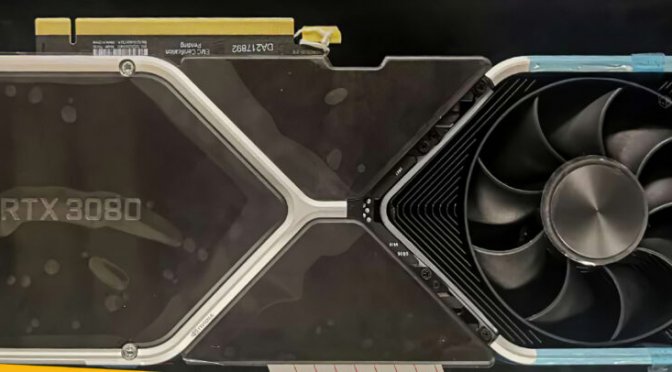
We all know about winning the Silicon lottery, and how lucky would it be for anyone to get a higher binned quality chip straight out of the box. Every hardware chip is different. Imperfections during fabrication cause each chip to have different limits in terms of clock speed, performance, and thermals.
When chip manufacturers like Intel, TSMC, UMC, GF, etc. make wafers, there are slight variations in material quality across the wafer surface, there are local variations in how the lithography, metal vapor deposition, photoresist chemical deposition, etc. are done, and this can yield a significant contrast between how good the best chip of a given batch will perform vs how bad the worst chip of the same batch will perform. When you get a better chip that will in essence overclock better, you have thus won the silicon lottery. This applies to both CPUs and GPUs.
Igor’s Lab, who is having inside sources within the graphics card industry, explains us the quality of silicon that we can expect from Nvidia’s GeForce RTX 30-series Ampere cards. We all know by now that Ampere GeForce gaming graphics cards employ Samsung’s 8nm process node, unlike the A100 chip which is built on TSMC’s 7nm FinFET process node. But Samsung’s custom 8nm manufacturing process is still better than TSMC’s 12nm process node used in the previous-gen Turing GPU architecture. Dubbed as ‘8N Nvidia’, this custom process produces chips that deliver up to 10% higher performance than other chips that are made by Samsung.
We already know both the GeForce RTX 3090 and GeForce RTX 3080 GPUs employ the GA102 silicon die. The GA102 die dimension is less than Turing’s TU102 die that checks in at 754mm square. The die shrink node has also helped push the GA102’s number of transistors up to 28 billion as well, a 50% increase over the previous TU102 silicon die. But as with any early stage of production the initial yields and silicon quality won’t be outstanding.
But the early yield figures for the Ampere GPU lineup aren’t that bad actually. According to Igor, vendors/AIBs actually divide and segmentate the quality of the silicon into three main categories or TIER: Bin 0 for the average quality chips, Bin 1 for good quality and Bin 2 for very good/best quality.
Naturally, one would expect to get the BIN 2 silicon on his/her system, because dies from this category operate at a significantly lower temperature under full load, along with a higher boost clock speed at the same voltage. These chips also provide more overclocking/OC headroom.
Igor Lab’s sources claim that 30%, 60% and 10% of the GeForce RTX 3080 dies fall within the Bin 0, Bin 1 and Bin 2 category, respectively. We do have some positive data on this, and it appears that the majority of consumers are going to get a good quality sample (Bin 1). Coming to the RTX 3090, we can expect the percentage of Bin 2 chips to be higher, due to the fact the RTX 3090 has to use a higher binned GA102 chip in the first place, since it has 82 SMs instead of only 68 SMs.
There is a catch though. Assuming that most of the Bin 2 chips end up going into the RTX 3090 GPU, the RTX 3080 should be manufactured on most of the remaining Bin 0 chips, so your chance of getting a very good quality RTX 3080 GPU chip actually drops. Custom AIBs will also further bin the best chips they receive, and reserve it for the faster factory overclocked SKUs, and sell them at a premium price. A heavily factory overclocked custom AIB card, will guarantee you a minimum level of performance, and roughly around 5-10% faster overclock speed.
To quote Igor’s Lab:
“Now it becomes interesting of course, because the longer a chip production runs, the better the chip qualities or the percentage ratio of very good, good and ok. With the new ampere cards I have various statistical evaluations, which can of course be averaged. As we are still at a very early stage, the shares are of course only worse than they could be in a few months. Internally, binning is usually divided into 3 stages. Then there is the sort ok as “Bin 0”, the sort good as “Bin 1” and the really good as “Bin 2”.
The sources speak almost unanimously of an average of up to 30% of chips with Bin 0, approx. 60% with Bin 1 and only 10% with Bin 2 for the RTX 3080, which is still quite good for such a short production period and actually speaks for Samsung. By the way, most of the custom models intended for press sampling are of course the top dogs of the respective manufacturers and thus Bin 2. You should have this in mind, because NVIDIA’s Founders Edition is no longer a “cheap” reference card, but rather a highly sophisticated product.
It is also reported that every GPU reacts differently and the dispersion between the deliveries is quite large. What makes Bin 2, however, is a significantly lower temperature under full load with a higher boost clock at a similar voltage. Overclocking is much better and the card is already a noticeable tick faster ex works and even without OC.
With the 3090 the case is even more complicated, because the board partners have received only a few chips from the pilot production so far, so the chips for Bin 2 are even less. But that should also change soon when you go into mass production. But here again, the same applies to the samples as described above”.
Stay tuned for more!

Hello, my name is NICK Richardson. I’m an avid PC and tech fan since the good old days of RIVA TNT2, and 3DFX interactive “Voodoo” gaming cards. I love playing mostly First-person shooters, and I’m a die-hard fan of this FPS genre, since the good ‘old Doom and Wolfenstein days.
MUSIC has always been my passion/roots, but I started gaming “casually” when I was young on Nvidia’s GeForce3 series of cards. I’m by no means an avid or a hardcore gamer though, but I just love stuff related to the PC, Games, and technology in general. I’ve been involved with many indie Metal bands worldwide, and have helped them promote their albums in record labels. I’m a very broad-minded down to earth guy. MUSIC is my inner expression, and soul.
Contact: Email