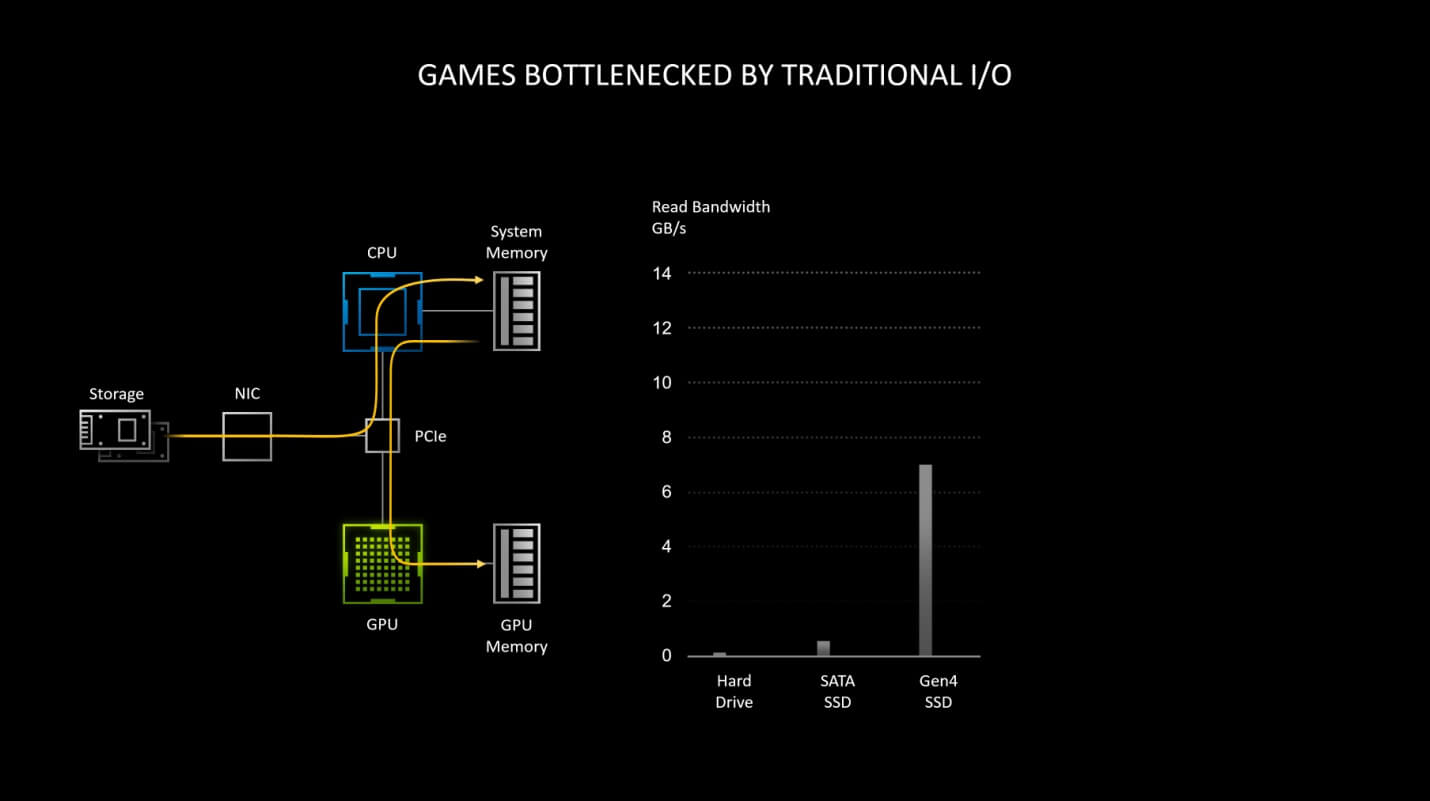
With the recent launch of the RTX 30 series Ampere cards, NVIDIA also announced a new suite of I/O features that they’re calling RTX IO, which is basically an I/O architecture. This is a new feature of Ampere GPUs that helps handle data from high-speed SSDs with the graphics card, thus taking the load off the CPU.
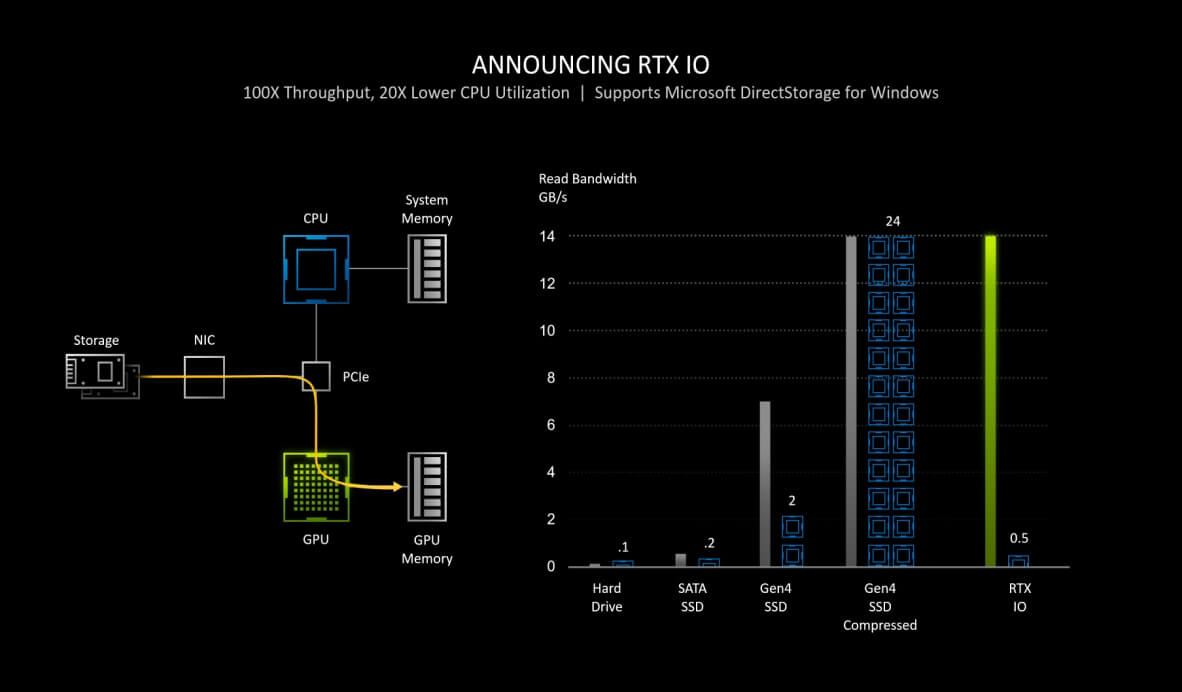
RTXIO leverages Microsoft’s DirectStorage API and promises to provide a significant leap in performance by decompressing and loading assets directly off of the GPU, thus eliminating CPU bottlenecks, and major decrease in processor utilization (up to 20x).
At a higher level this feature appears to be NVIDIA’s implementation of Microsoft’s forthcoming DirectStorage API, which like on the Xbox Series X console, will allow for direct, asynchronous asset streaming from storage directly to the GPU. The I/O latency and the throughput can be improved via DirectStorage/RTXIO, by bypassing the CPU for this work. This will directly fetch the resources the GPU needs. More importantly, Ampere GPUs are now capable of directly decompressing game assets.
Decompressing those game assets to something the GPU can use, and offloading it from the CPU not only frees it up for other tasks, but also helps improve the asset streaming performance and game load times. We already know this technology is coming to the Xbox Series X and PlayStation 5, so this is just Microsoft and NVIDIA trying to keep parity with the next-generation of consoles. This technology delivers GPU-based lossless decompression and low-level, super-efficient APIs architected specifically for game workloads.
Nvidia says RTXIO offers 100 times the throughput and 20x lower CPU utilization as compared to traditional CPU decompression techniques. RTX IO allows for performance which is 100 times faster than standard hard drives and older APIs.
“Object pop-in and stutter can be reduced, and high-quality textures can be streamed at incredible rates, so even if you’re speeding through a world, everything runs and looks great,” the company explained. “In addition, with lossless compression, game download and install sizes can be reduced, allowing gamers to store more games on their SSD while also improving their performance.”
When used with Microsoft’s new DirectStorage for Windows API, RTX IO offloads dozens of CPU cores’ worth of work to the GeForce RTX 30 GPU, thus improving frame rates/FPS, and enabling near-instantaneous fast game loading.
“Microsoft is delighted to partner with NVIDIA to bring the benefits of next generation I/O to Windows gamers,” wrote Bryan Langley, Group Program Manager for Windows Graphics and Gaming.
“DirectStorage for Windows will let games leverage NVIDIA’s cutting-edge RTX IO and provide game developers with a highly efficient and standard way to get the best possible performance from the GPU and I/O system. With DirectStorage, game sizes are minimized, load times reduced, and virtual worlds are free to become more expansive and detailed, with smooth & seamless streaming.”
To be precise, NVIDIA RTX IO brings GPU-based lossless decompression, allowing reads through DirectStorage to remain compressed while being delivered to the GPU for decompression. This removes the load off the CPU, moving the data from storage to the GPU in its more efficient, compressed form, and improving I/O performance by a factor of 2. By using DirectStorage, next gen games will be able to take full advantage of RTX IO-enabled hardware to accelerate load times and deliver larger open worlds, all while reducing the CPU load.
Right now it is not clear whether this new RTXIO feature is exclusive to the GeForce RTX 30 Series, or if it will be available for Turing-based GPUs as well.
All Turing GPUs will also support RTX IO.
Hello, my name is NICK Richardson. I’m an avid PC and tech fan since the good old days of RIVA TNT2, and 3DFX interactive “Voodoo” gaming cards. I love playing mostly First-person shooters, and I’m a die-hard fan of this FPS genre, since the good ‘old Doom and Wolfenstein days.
MUSIC has always been my passion/roots, but I started gaming “casually” when I was young on Nvidia’s GeForce3 series of cards. I’m by no means an avid or a hardcore gamer though, but I just love stuff related to the PC, Games, and technology in general. I’ve been involved with many indie Metal bands worldwide, and have helped them promote their albums in record labels. I’m a very broad-minded down to earth guy. MUSIC is my inner expression, and soul.
Contact: Email


@MetalMessiah0:disqus Dude they said on their new article that it does support the 2000s. This was posted “RTX IO is supported on all GeForce RTX Turing and NVIDIA Ampere-architecture GPUs.”
Pretty awesome stuff and I am glad they support the older cards. Just go to the Nvidia site and go to News and then look for the article “Introducing NVIDIA RTX IO: GPU-Accelerated Storage Technology For The Next Generation of Games”
Bye bye PS5 🙂 and no the PC is still not dead LOL. Mmmm that 3080 looks really nice m/ 🙂 m/
They mentioned if afterwards. It was not stated clearly in the Blog post before, as Nvidia’s Andrew Burns updated the article, by featuring his own comment.
This was done AFTER I wrote this whole article, or at least the featured comment was not there when I first checked that blog post. This was also not mentioned in the Huang’s Geforce live event Video as well.
https://uploads.disquscdn.com/images/222cf57a886193c43a176fb23f26e4eff6de256681d8069a26ce416ceff3fbd0.png
All good Man, I was just trying to help out. I know it must of been insane for you today with all the crazy news!
Yeah, I know were trying to help man ! I appreciate the feedback. I just didn’t sleep properly these past few days, so my head keeps on spinning hard. lol
Didn’t mean to sound harsh though. MY apologies if I did !
Soyny announces revolutionary new SSD technology with great fanfare and is duly hyped to the heavens by the access media. Five minutes later, PC says hold my beer!
Yup
One thing to note – Sony ALWAYS lies.
Their good at marketing and its clear many of their zealous fanbase just suckle that magic sauce bs w/o thinking for themselves.
https://uploads.disquscdn.com/images/9c30af6b6812a9ebacd9023a60d976cc3b81a8ce1de9acc0a2f5e7bf3bc402f0.jpg
https://uploads.disquscdn.com/images/086ff285ace91558badbdc49a25f9f760ea6c7e4727a6d9ea1469bc3dcf7542a.jpg
LOL..hell yeah is it GOOD to be a pc gamer or what. we can just laugh to hell and back and blow these console fanboys away 😀
Pc is and Allways progress and do it so much better then any console POS trash can do.
Well to put it simply – PcRules 😉
It sounds like this new batch of cards may as well do my laundry too.
Sound amazing!
I would like more details about this new tech if it gonna help with regular sata ssd or even hdd?
And also if you need pcie 4.0 or that it will also boost pcie 3.0 users?
think about how silly that last question is. for one thing Turing cards dont even have pcie 4.0. another thing 99.9% of users are on boards with pcie 3.0. so yes ofc it will be utilized on pcie 3.0
some quotes taken from the original geforce article:
“Instant game loading and stutter free navigation through endless open worlds has long been a goal of gamers and developers alike. Even with the incredible performance of Gen4 NVMe SSDs, this goal has remained out of reach. Modern game engines have exceeded the capability of traditional storage APIs; a new generation of I/O architecture is needed.”
“GeForce RTX GPUs are capable of decompression performance beyond the limits of even Gen4 SSDs, offloading dozens of CPU cores’ worth of work to deliver maximum overall system performance for next generation games.”
they did not mention gen3 nvme at all so my question is not that silly.
“think about how silly that last question”
its better to ask silly questions than not asking anything at all
but yea makes sense now that turing will also support this tech
as for sata storages i presume it wont affect them at all due to them not being on pcie hence no interaction with the gpu.
Think its for nvme only, that said i doubt direct storage api won’t have a fallback layer where the cpu can do the decompression (when hw support of decompression is missing) so the dev’s can still use compressed assets in all installs.
Second if the assets are compressed and decompressed at the endpoint (gpu in this case) it will be less strain on the buses so in a situation where an typical 20 rtx series pcie3 16x gpu bus would bottlenecked that compression will help
Sounds great but let’s see how and when it actually gets implemented.
Awesome stuff. We could possibly see Virtual Texturing make a big comeback with this kind of innovation. Perhaps the latest iDTech engine will take advantage of this.
Yeah and imagine what open world games can do with asset streaming after this, details details!
Well done.
“PS5 SSD performance” – why would you even want something so slow on your PC?
If your bored on pc… why not get 2x smaller and raid0 for stellar sequentials
Not sure now is the time to even comopare it since neither Sony or MS have released actual benchmarks for the SSD inside them.
BUT…BUT… THE POWER SSD!!!
https://uploads.disquscdn.com/images/2526aa40e348c8a5226db190e9defb7d7beeed999cd89044275c14d73a041783.jpg
https://youtu.be/cWD01yUQdVA
PS5 doesn’t even have a price yet and it’s already obsolete
Yeah, looks like rusty preowned cars now pretty much
The guy from hardware unboxed thinks they doubled the number of CUDA cores per SM, i believe this is a good guess.
Leakers did their calculation on the usual number cores on a SM.
There’s also something new about their Async, meaning in something old (DX11) they can throw everything to FP performance, which i believe leads to the ridiculous Tflops numbers.
It’s not full ‘twice the performance’ because bandwidth, rops… isn’t doubled, but it seems enough to bring a huge jump in performance.
In something more modern/sophisticated they can better split between INT/FP, at least i think that’s the idea.
Sounds like a rip off of AMD’s HBCC. Though AMD’s HBCC is not restricted to NVME.
Kinda laugh that the consoles said look what we got that you dont (for once)… then even before the console hardware have it – The pc will have it. Vs the new 3000 series gpu’s the “new” consoles almost look like rusty preowned cars in comparison
20gb is not enough for you even when its enough to drive 8k in most games?
What I don’t understand-why did it take them a console reveal to bring this to PC? We could’ve have it for few years already but no… Suddenly PS5 is announced and everyone acts like it’s a future of gaming and that PC can’t stand in it’s way. Human stupidity never ceases to amaze me.
This is something that I’m actually quite hyped about. We’ll finally get to benefit from the speed of NVME’s in gaming instead of being bottlenecked by the CPU.