
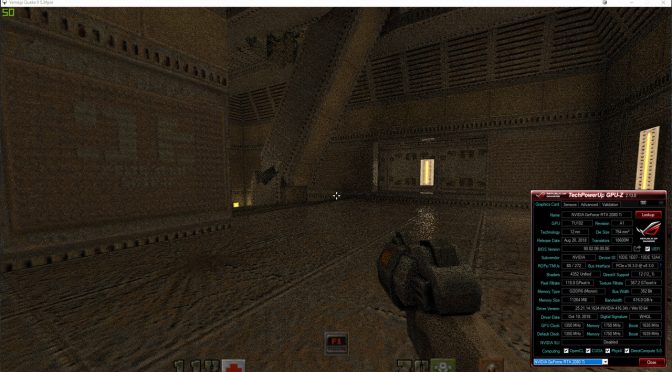
Here is Quake 2 Path Tracing running on the NVIDIA GeForce RTX 2080Ti at 1920×1080

YouTube’s ‘Thavex’ has shared a video, showing Quake 2 Path Tracing running on the latest high-end GPU, the NVIDIA GeForce RTX 2080Ti. In case you weren’t aware of, this real-time path tracing is possible thanks to Amietia; a from-scratch GPU-based pathtracer created specifically for Quake 2.

Amietia – which you can download from here – has several optimisations which are only viable due to the typical characteristics of Quake 2 such as support for parallogram-shaped lightsources, BSP ray traversal, and special handling of sky ‘surfaces’ (portals).

Now us you will notice, there is a lot of noise (which is a side-effect to the low samples that are used for the real-time path tracing). From what I know its developer has not used any de-noiser which is a shame. Not only that, but this GPU-based pathtracer does not take advantage of the RTX2080Ti tensor cores.

What ultimately this means is that this special version of Quake 2 could run significantly faster on the RTX2080Ti. Thavex has used an an i7-6700k (overclocked to 4.7Ghz) alongside the NVIDIA GeForce RTX2080Ti and ran the game at 1920×1080. It’s not entirely smooth but keep in mind that we’re talking about full path tracing in real-time.

Here is hoping that someone will resume development for this GPU pathtracer so that it can take advantage of the Tensor Cores (a de-noiser filter would also be a welcome addition)!


Quake 2 Real time Ray Tracing on nVidia RTX 2080 Ti FE

20 thoughts on “Here is Quake 2 Path Tracing running on the NVIDIA GeForce RTX 2080Ti at 1920×1080”

  1. Pathtracing and raytracing are different things. Raytracing is more demanding and more realistic than pathtracing (and that’s why there is noise, it’s way more demanding and we still to not have powerfull enough graphic cards to show noiseless images, even with an old videogame like Quake 2)

    1. Where did you find that info?
      Both pathtracing AND raytracing will be noisy when only using a couple of samples.
      Pathtracing is much heavier than raytracing but is a much more realistic method to calculate light as it treats everything as a reflective surface that bounces light randomly. Just like the realworld pretty much.

      It doesn’t matter if you do Raytracing or Pathtracing. If you want it realtime you have to denoise. With current RTX cards they do raytracing with roughly 1-4 samples per pixel if I’m not mistaken.
      If you want a clean frame you probably need at least 1024spp.
      So yes you are correct about GPU’s being far from powerful enough to do the job.

    2. Where did you find that info?
      Both pathtracing AND raytracing will be noisy when only using a couple of samples.
      Pathtracing is much heavier than raytracing but is a much more realistic method to calculate light as it treats everything as a reflective surface that bounces light randomly. Just like the realworld pretty much.

      It doesn’t matter if you do Raytracing or Pathtracing. If you want it realtime you have to denoise. With current RTX cards they do raytracing with roughly 1-4 samples per pixel if I’m not mistaken.
      If you want a clean frame you probably need at least 1024spp.
      So yes you are correct about GPU’s being far from powerful enough to do the job.

    3. That can be solved with AI denoising though – this is most likely the way forward. All the recent RTX demonstrations seen so far rely on denoising and actually work at a very low sample count per pixel.

    4. This particular mod doesnt use RTX cores at all, and not even tensor cores for denoising. If they will update this mod to quake 2 will run 6x faster and without artifacts/noise on RTX gpu’s.

  2. “1920×1080. It’s not entirely smooth”

    Seemingly a recurring theme. Might be best delaying purchase of a new card until RTX2180 when the technology and its implementation has somewhat matured.

    1. At least here it’s full screen tracing and not just small elements. Honestly, this is technically more impressive than anything else I’ve seen demoed.

        1. Oh, absolutely. This card gen is a mess and, honestly, a rip.
          The biggest selling feature at this point is DLSS, which is just more upscaling. It seemingly doesn’t even work in actual games at this point, considering it “just works” and no one has implemented it.

          1. Yep. DLSS is hugely promising but that’s pretty much all it is at this point in time. A proprietary technology that has to be implemented by game devs on a per game basis. If, and it seemingly is very much an if, it becomes widely adopted then that’ll obviously be a great thing… for Nvidia users at least. Again, though, I’m perfectly content to give it some time so by the time RTX2180 arrives it might be commonplace.

            I’m not intending to rag on Nvidia. They’re bringing some impressive features with these new cards and we’ll need plenty of early adopters to be buying them if things are to improve to a point whereby I (and I suspect many others like me) will be prepared to jump on board.

          2. I too am glad Nvidia is bringing something new to the market. But, my big concern is what if this doesn’t take off in the next gen or two? What if the performance hit is always too great (it will have to scale with resolution increases to look good). Will Nvidia stick with it or drop it?
            I’m also curious to see if devs find other ways to get raytracing like effects at lower performance hits (as they always seem to do).
            I, personally, would rather see an open source solution take over instead of proprietary hardware that takes up die space (which equates to more money with no performance gain, even if it adds features).

          3. Indeed. It’d sure sting to have paid such a price premium for the featured new tech’ to then not see it being widely adopted. Such is the risk inherent when purchasing new tech, I suppose. Arguably more so when it’s proprietary to one manufacturer. I’m glad Nvidia are pushing new tech but I’m not personally going to risk that level of required financial investment at this point. I say that as somebody who owns the likes of Atari Lynx and Sega Dreamcast, i.e. one-time hugely capable new gaming hardware that ultimately saw little mass market adoption. So I don’t wish to get burned again!

            Agreed. Also, if an equivalent tech (given that they’ll likely be sticking with AMD) were to be featured in the next gen of leading consoles then widespread mass market adoption of (some) ray tracing techniques would be assured but that remains to be seen.

  3. That’s pretty awesome. This card is really strong but way too expensive, I see more use of it in VFX than games

  4. Have seen this a long time ago. 1080 sli was pulling the same I think. Nothing new. Just a little faster. It’s all doable. But for now render elements is the way to go. Full scale raytrace isn’t there with current hardware. Some crazy quad sli 2180 might get close. And for the de-noisers. Such api isn’t made by one man. The depicted is just raw power. Not features.

  5. I’m glad I got a GTX 1080 Ti FTW3 that can hold a core speed of 2037mhz at 59c

    Can skip this gen and wait for the next, I’m having no issues powering my 35 inch 3440×1440 100 MHz monitor

    Im a die hard EVGA fanboy, so no AMD 7nm for unless EVGA starts making

Leave a Reply

Your email address will not be published. Required fields are marked *