

VRMark Cyan Room DirectX 12 benchmark now available, appears to run amazing on AMD’s GPUs

Futuremark has announced the release of VRMark Cyan Room. VRMark Cyan Room is a VR benchmark that uses a pure DirectX 12 engine built in-house and optimized for VR. This benchmark tool features a large, complex environment and many eye-catching effects.

Players can run the test on their monitor or on a connected HMD. The benchmark runs on a fixed path, which makes it easy to repeat the test on other systems to compare performance.

At the end of the test, players will see if their PC was able to meet the target frame rate. Moreover, a comparison with other systems, and detailed hardware monitoring charts will be present.

VRMark Cyan Room also offers an Experience mode with a VR headset to judge the performance of a system. This mode lets you freely explore the Cyan Room in your own time. You can change the rendering resolution and other settings to make the scene more or less demanding. Experience mode is a great way to see how performance affects your VR experience.

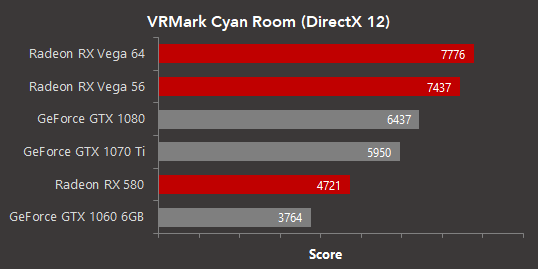
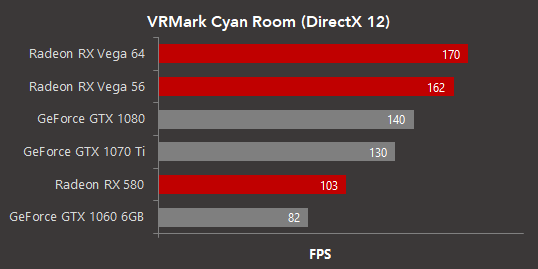
Furthermore, it appears that this DX12 benchmark runs incredibly well on AMD’s hardware. The red team revealed some benchies in which the VRMark Cyan Room runs great on its hardware. Both the AMD Radeon RX Vega 64 and 56 ran the benchmark better than NVIDIA’s GTX1080. The performance difference between the RX Vega 64 and the 1080 is 30fps. AMD did not include the GTX1080Ti, so our guess is that NVIDIA’s top GPU may be slightly faster than the RX Vega 64.
Cyan Room is available now as a free update for the full version of VRMark.

Enjoy!

25 thoughts on “VRMark Cyan Room DirectX 12 benchmark now available, appears to run amazing on AMD’s GPUs”

        1. By the time DX12 becomes standard in games, all their GPUs will be out of date anyway, it’s DX11 still for years to come.

          1. I don’t know if DX12 will ever be the standard like how it was with DX11. CPU wise DX12 is very good improvement over DX11 (but still there are developer that want to hammer everything to single core despite DX12 should make using multi core cpu much easier on developer part) but graphic side it was mixed in the bag. Even AMD GPU did not always benefit from DX12 (SWBF2). If MS improve the situation on CPU usage on high level API (DX13 maybe?) developer probably will have no reason to go with DX12.

          2. DX12 is mainly about CPU bottlenecks, so if there is no CPU bottleneck in DX11 then DX12 won’t probably gain much (it can actually loose a bit), but with slower IPC CPU there will be very likely significant difference.

          3. is that so? more like it is AMD that want it more than game developer because they want to shift game optimization more towards game developer (it is one of Mantle main bullet point). for game developer rather than low level i think what they really want is for PC to have one architecture only to ease their development. low level API can come after that. Dice the one that “ask for it” to the point they co-develop Mantle together with AMD so far show poor result with their DX12 implementation even on AMD hardware. don’t forget it is game developer that want much easier development on PC in the first place that create DirectX and OpenGL on PC.

          4. That’s the thing that AMD fans overlook. Yes, AMD GPUs run DX12 better but DX12 hasn’t been fully utilized in almost all games and some Developers are whining about it being to hard to fully implement. I’m guessing 7nm Navi will be the time to look seriously at buying an AMD GPU but that’s probably 2 years away unless AMD has been pumping serious money into RTG R&D. For now Pascal and Volta next year are the way to go.

          5. New Volta Titan V is in many games significantly slower than Titan Xp based on pascal ( Volta’s monster is 32% slower than much smaller pascal in Hitman).
            That pretty much explains why nvidia never released Volta for gamers and why they never will, because it sux. Not to mention terrible stuttering which is present in many games that have been tested.

            Nvidia actually do not have to release anything until AMD fix Vega drivers and fact is AMD might never do it with its first Vega iteration. They probably fixing it for refresh version since all those advaced tech in Vega are so hard to optimize for in driver stack. (but if they used they can be actually boost performance a lot – (primitive shader can have 6 times higher throughput than traditional model of rasterization). As I said we might never see this happen with first Vega 10 as it seems to be incredibly hard to use in driver stack on general level.

            But nvidia wont be that stupid as intel is, so they will release new GPU they just overprice it even more 🙂

            So great year 2018 to everyone 😛

          6. They are going to be higher regardless. Have you seen the rumors that Volta GPUs for professional cards are running up to $1,000 to manufacture on the 12nm process. The gaming GPUs will be cheaper for a couple of reasons. There will be salvage parts that are partially defective and the yields on Volta wafers will probably be better next year.

            But the main reason is that AMD doesn’t have anything in the pipeline to compete with Volta next year. We will probably see a Volta Titan that is much more expensive than the Titan XP and even midrange Voltas being higher that Pascals. And with the AIB manufacturers raising their MSRP for non-reference coolers on Pascals so much and getting away with it then add that on to the costs for Voltas.

            But the good news is that Pascal will be fine for a few years and we can just wait it out for 7nm Navi to come in a couple of years.

          7. Polaris will be just fine for few years to come. Depends what we consider to be “just fine”. AMD no longer trying to compete in gaming market, because history teach them a lesson when even with better architecture all around they have been loosing money. That is why Vega is what it is and that is why customers will never benefits as they never do from monopoly.
            AMD actually compete with vega much better in professional market and also rumours are there will be no Volta for gamers.
            And yes Navi could be same what RYZEN is for CPU market as they use IF and possibly multi-die solution for graphic market. I do not think it will lead to better prices for customers due nvidia’s mind-share though.

          8. Polaris will be fine for miners I guess but for gamers they will mostly choose Pascal.

            There is a reason why AMD didn’t compete with Pascal and it has to do with the R&D budget that AMD has to work with. When you look at the financials of AMD compared to Intel and Nvidia it’s clear that they can’t compete with Intel and Nvidia at the same time. It’s really remarkable that AMD even brought the Ryzen CPUs to begin with. It was a wake-up call for the CPU giant Intel and that’s good for all of us.

            Now that Ryzen is mostly a done deal I’m thinking AMD will be devoting a good bit of their R&D budget towards their RTG division.

            Multi-GPUs will most likely come but not the way we are accustomed to. SLI and Crossfire are dying out with both companies and Developers too. So few are even running rigs like that. Multi-GPUs will most likely be packed closely together with an interface that makes them run like a single GPU and sharing a data bus with VRAM.

          9. I was going to have a good rant about AMD but stopped myself. All I’ll say is ‘RIP Mantle’, you were a good scapgoat that never had a real chance.

        2. Actually DX12 is about 50/50 on who wins, with DX11 more in favor of NV all the way around. Not really future proof when DX12 is not being utilized effectively in the games currently using it. By the time it takes over DX11 NV will be 1 or 2 more gens ahead. If the devs do their job then yes AMD SHOULD be the clear winner in DX12 titles.

        3. That’s simply not true. Where is your evidence? You have none because the facts don’t bare out your ridiculous claims.

        4. Fury X is future proof because it has HBM. xD

          In 2017…
          techpowerup . com/forums/threads/finewine-finevinegar-furyx-aging-horrible-in-2017.238741/

      1. Hello, I represent team green in this site. Your loyal comment has moved my heart and filled my company with great joy. As such we’re extending a discount voucher for you, 20% off your next GPU purchase.

        Expect details in your inbox soon.

        Also, I’m contacting a friend who is also a representative of Red Team, to do the same for the user whom you’ve just replied.

  1. That is until Nvidia optimize their drivers. I would bet money that the Nvidia will catch up with their next driver. It’s a story we’ve seen over and over again, this same thing just happened with the release of Forza 7. AMD was out performing Nvidia and then BAM! New driver changes the game… Just wait for it…

    1. Hardocp actually tested this and came up with different result that you suggest. There were significantly bigger performance gain on Radeons compare to GeForce.

  2. Looks like AMD bride developers because if you check Hardocp VR games benchmarks AMD is failure for VR.

    Also these results are from HIV headquarters aka Radeon . com

    1. Mainly because those early VR games uses DX11. But low level APIs make sense espcially in VR and it is obvious AMD will have a lead there. So I wouldn’t be surprised by that, same as noone is suprised by nvidia’s great DX11 performance.

    2. It doesn’t mean they are not legit. They definitely are, but they are also the best case scenarios. They used RYZEN, means VEGA with intel probably had lower results, same as nvidia had probably better performance with intel.

      In any case those numbers show potentitial which Vega certainly has but havent really showed it yet, apart some DX12/Vulkan games

Leave a Reply

Your email address will not be published. Required fields are marked *