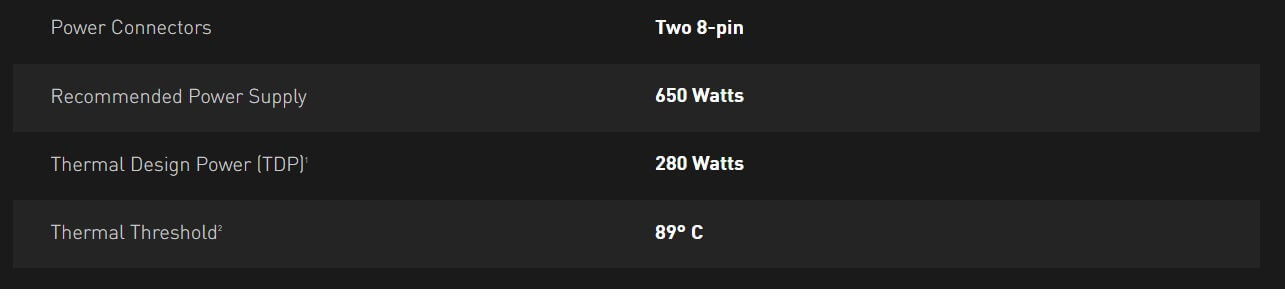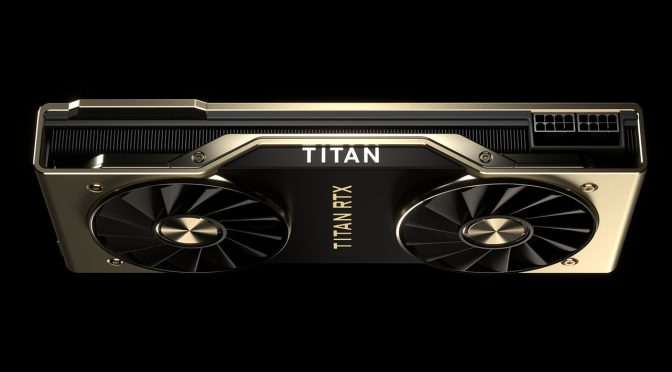
NVIDIA Titan RTX has been officially announced, priced at $2500, full specifications revealed

Just as we predicted, NVIDIA has officially announced the NVIDIA Titan RTX graphics card. According to the green team, the NVIDIA Titan RTX is powered by the Turing architecture, bringing 130 Tensor TFLOPs of performance, 576 tensor cores, and 24 GB of ultra-fast GDDR6 memory to your PC, and will be priced at $2500. 

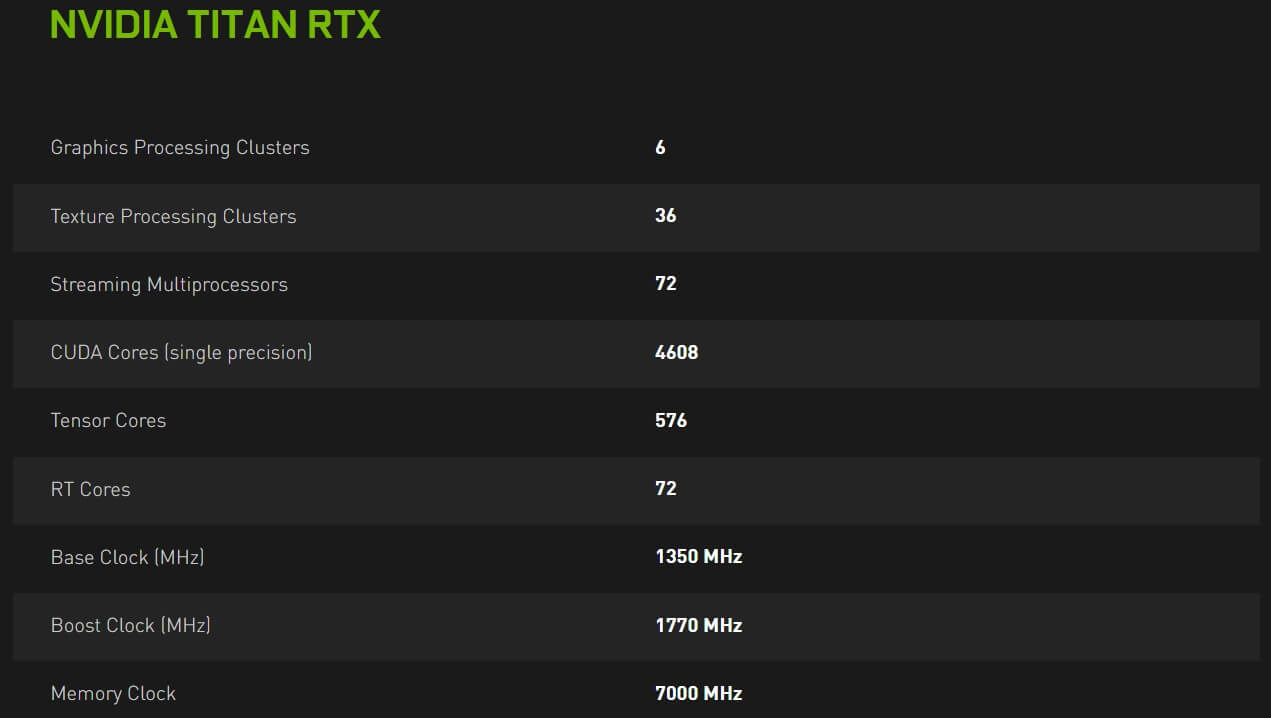
The NVIDIA Titan RTX will feature 6 Graphics Processing Clusters, 36 Texture Processing Clusters, will be clocked at 1350 MHz and can be turbo boosted at 1770 MHz.

This new graphics card will be made available later this month and below you can find its full specifications.
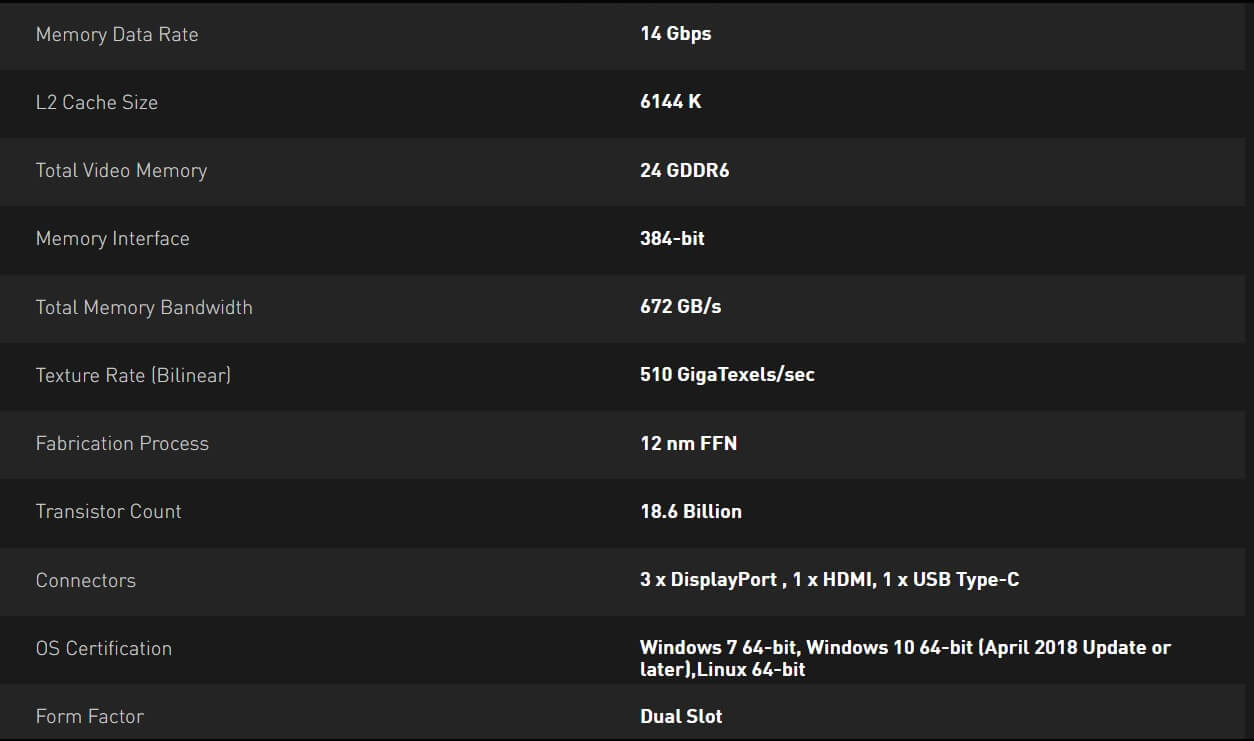
Needless to say that we don’t expect a lot of gamers acquiring this new graphics card, even though it will be slightly faster than the RTX2080Ti. Our guess, from the specs, is that the Titan RTX will be around 8% faster than the GeForce RTX2080Ti.

Still, we believe that this new GPU does not justify its ridiculously high price for gamers. But then again, the RTX2080Ti was also overpriced and apparently it’s been constantly out of stock.

41 thoughts on “NVIDIA Titan RTX has been officially announced, priced at $2500, full specifications revealed”

  1. 8% faster for twice the price? I mean the Titans have always been overpriced but this is just ridiculous.

    1. 2080 Ti is twice the price of 1080 Ti and Titan RTX is 2-2.5x the price of past Titan cards (excluding Titan V & Titan Z, the latter of which was multi GPU). Ain’t a lack of competition great?

      1. It’s really disappointing. I was looking forward to upgrading from my 1080 to a 2080ti but the prices are just absurd. Now I’m just waiting for a deal or good price on a used 1080ti.

      1. No way, this one is twice the price of a last gen Titan for 10% performance increase, I refuse to pay anything less than $5000 otherwise NVidia will be devaluing their product

  2. “bringing 130 Tensor TFLOPs”

    Slight correction. That’s 130 teraflops of deep learning performance (not tensor), and 11 GigaRays of ray-tracing performance.

    “Needless to say that we don’t expect a lot of gamers acquiring this new graphics card, even though it will be slightly faster than the RTX2080Ti. Our guess, from the specs, is that the Titan RTX will be around 8% faster than the GeForce RTX2080Ti”.

    This card wasn’t actually meant to actually target gamers, but more like the prosumer market, mostly content creators, developers, and scientists who can utilize the 130 Tera-flops for AI, data science, and other scientific/compute applications

    Also, I think there must be around 10% of graphics horsepower gain when compared to the RTX 2080 Ti, give or take, and slightly more added to 5% as well, with the extra memory bandwidth increase, which is 672GB/s (16.2 TFLOPs of FP32 compute).

    Still, the card is indeed very pricey !

        1. Lol! Damn we all said the same thing when the original Titan’s were at $1000 USD. I hope these prices will not be the norm.

    1. “This card wasn’t actually meant to target gamers, but more like the
      prosumer market, mostly content creators, developers, and scientists who
      can utilize the 130 Tera-flops for AI, data science, and other
      scientific/compute applications (16.2 TFLOPs of FP32 compute).”

      That’s what I hear as well. It’s not intended for gaming.

        1. Nah. I didn’t actually threaten, and that too several times. Yes, on one occasion, I indeed posted a rant, but that was because of some serious misunderstanding on my part…..And, I admitted my fault as well.

          Nothing personal.

    1. Sounds too cool for such a meh product, I guess they planned their name well. Reminds me of the opposite case with the XBox One, I remember some interview where they said the idea behind that name was that they thought it would be dubbed “The One”, then it got dubbed “XBone” about 10 seconds into the reveal. MS must have been pretty disappointed.

  3. It’s just number priming. They don’t expect to sell much of these but hope to make the higher price of other cards seem smaller by comparison. Like when stores put a ridiculous expensive item out where you walk in so the rest of the stuff in the store seems a better deal.

        1. Yes, I agree these RTX cards are indeed expensive, if we compare them with previous GEN releases from Nvidia/AMD.

          Not really worth the purpose, at this time of year. The GTX 10 series still remain a very strong/worthy contender. Basically, we are paying a premium, or an “early adopter” price for this new Turing tech/hardware.

          But Gamers didn’t ask for this, because it was Nvidia’s decision to implement these features in the GPU architecture, as evident from the change in the DIE SIZE, and the Streaming Multiprocessor/SM design, RT and Tensor Cores, among other things.

          Nvidia totally changed the GPU arch as well, with the addition of new RT and Tensor Cores, and other design/pipeline improvements (memory/cache) etc. But to take proper advantage of this hardware/HW, few games and software are currently out in the market. So basically the hardware won’t get fully utilized (if we think from this perspective).

          Also, how well some of the upcoming Games will actually perform on a TURING GPU, with Real time ray tracing and DLSS, still remains to be seen. I think it will take at least another 2-3 years for this whole RTX technology to become mainstream.

          As of now, few PC titles are going to take full advantage of this new RTX feature, provided Game developers also adopt and implement ray tracing, and DLSS deep learning AA in games as well.

          Still, it’s GOOD to see new Tech being released. With time things might settle down a bit, and the performance gain might be there when DLSS and Ray Tracing features are enabled.

          I still hope AMD brings something new to the table with NAVI, assuming it is made on a 7nm process node, and competes well with Nvidia’s mid/high-end.

          Right now, the GPU market is a total mess. We seriously need more competitors, and here’s hoping that INTEL might enter this market come 2020. But that’s still a far cry. I’m more concerned about next year.

Leave a Reply

Your email address will not be published. Required fields are marked *