New gaming benchmarks revealed for Intel’s Core i7 8700K & 8600K (six games tested)

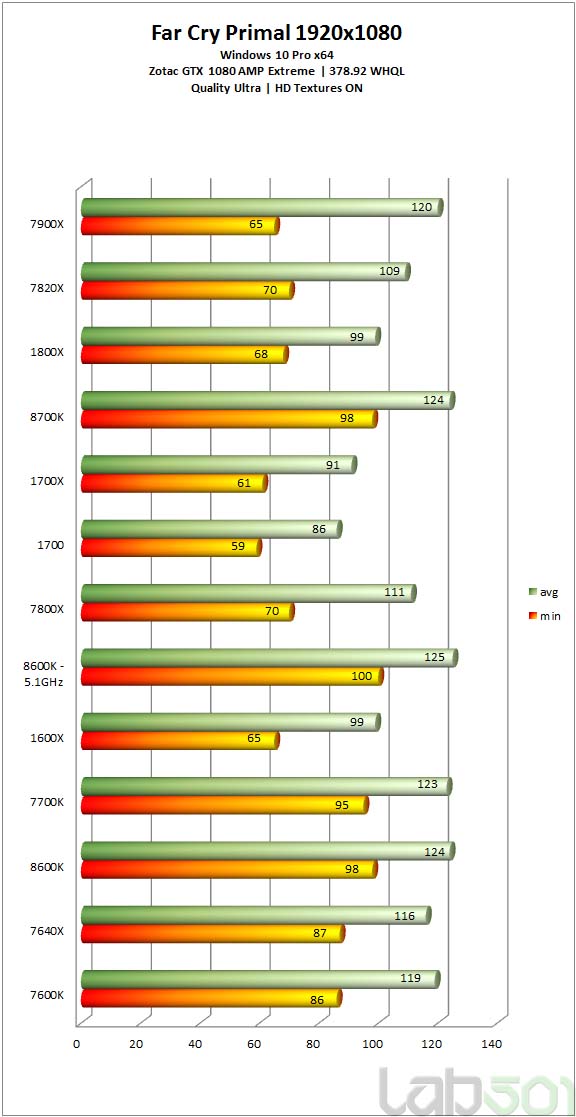
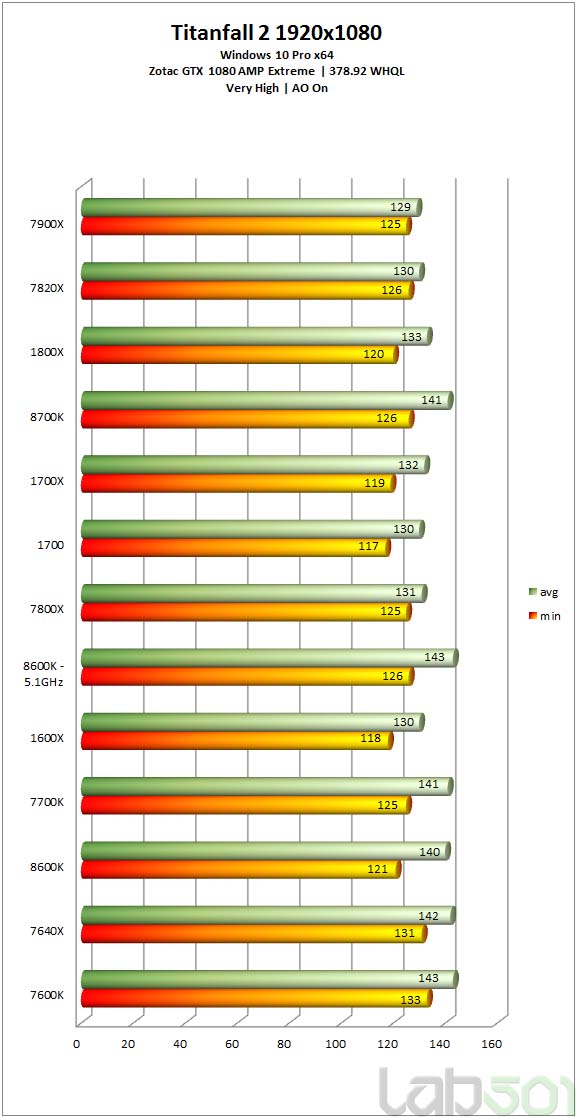
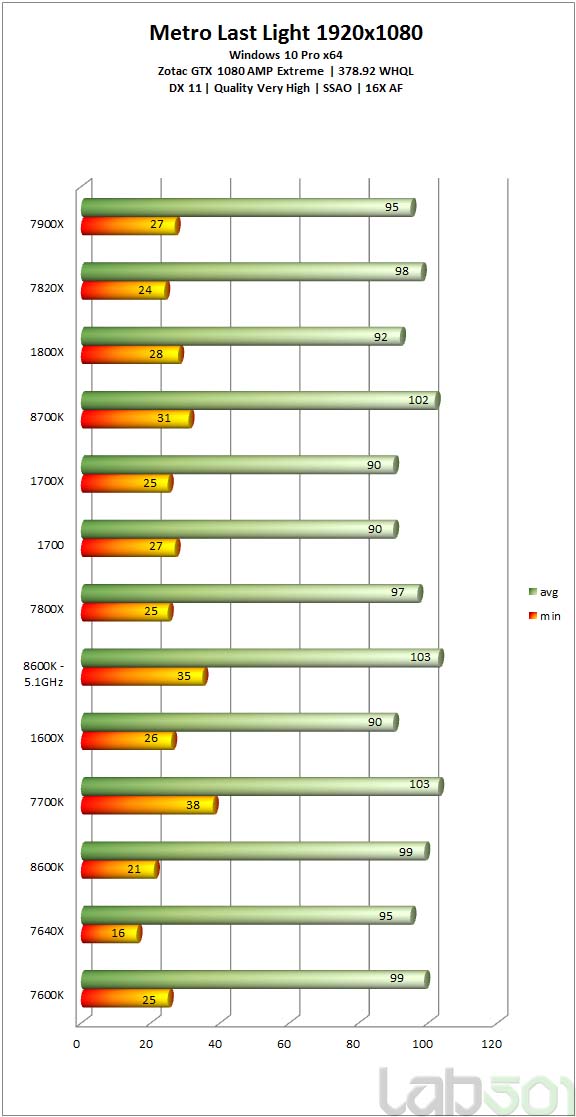
Lab501 has broken the embargo and leaked some new gaming benchmarks for Intel’s upcoming CPUs, the Intel Core i7 8700K and the Intel Core i7 8600K. Lab501 has tested six games and according to their findings, there is not that big of a performance difference between the 7700K and the 8700K (despite the fact that the 8700K is slightly faster in most cases).

In Titanfall 2, the Intel Core i7 8700K was faster than all CPUs except of the Intel Core i7 7700K. The same can be said about Metro: Last Light, DOOM and Far Cry: Primal. While the i7 8700K was faster that AMD’s offerings, it was able to match the performance of the i7 7700K.
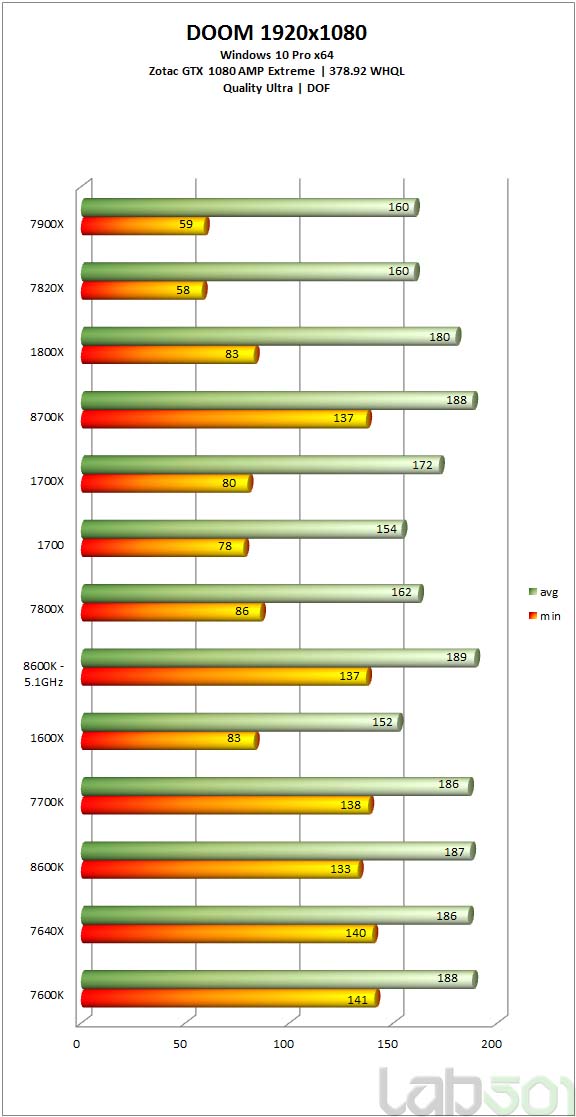
In GTA V and Sleeping Dogs, however, the i7 8700K was able to surpass Intel’s previous-gen CPU by 11fps and 23fps, respectively.
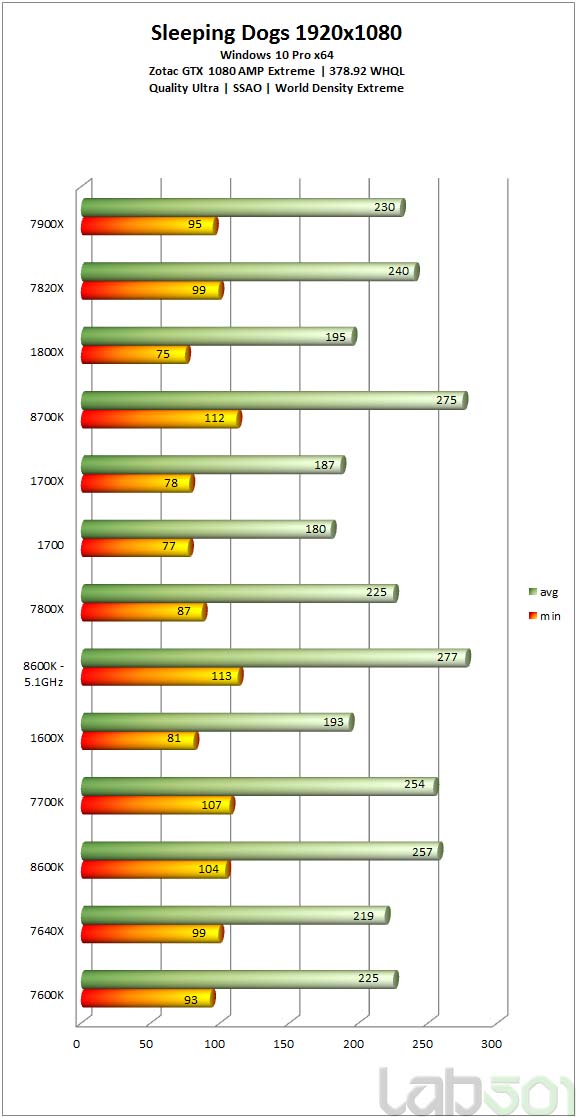
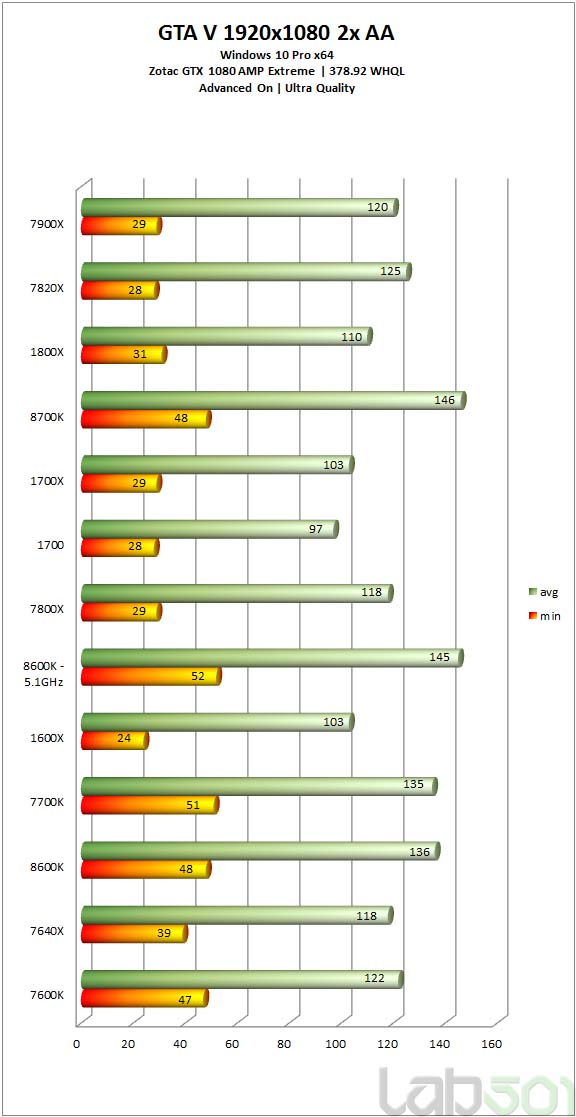
What’s also interesting here is the performance of the i7 8600K. The Intel Core i7 8600K is a six-core CPU that does not support Hyper Threading, and performs as good as the i7 8700K in modern-day games. Naturally, this does not surprise us and falls in line with what we’ve been experiencing. After all, and as we’ve already covered in our PC Performance Analysis articles, most games are still unable to take advantage of more than four CPU cores. Whether this will change in the future remains to be seen.

Lab501 used an NVIDIA GeForce GTX1080Ti and ran the games at 1080p. As we’ve already said, we’d like to see reviewers dropping the resolution to 720p (even when using such powerful GPUs) so they can eliminate any possible GPU bottleneck, especially for modern-day games!

43 thoughts on “New gaming benchmarks revealed for Intel’s Core i7 8700K & 8600K (six games tested)”

  1. “What’s also interesting here is the performance of the i7 8600K. The Intel Core i7 8600K is a six-core CPU that does not support Hyper Threading”

    That’s the i5 8600k you’re talking about.

  2. As expected, there’s no major gaming improvement in the here and now for the i7 line (the i5 should see some decent gains in areas where it was previously thread limited). The big benefits I see are:

    1) Productivity will be much better on Intel’s mainstream platform, although there’s a good chance Ryzen will still be king in some applications with 8C/16T offerings (again, speaking for mainstream platforms only, not HEDT).

    2) We’re much likely to see developers prioritize optimizing for more than 4 cores over the next several years now that there are viable 6+ core offerings in the mainstream. The R5 1600 has already shown to be exceptionally popular and I imagine the 8600k will do pretty well for itself too.

  3. I think 90% games are dependant on GPU while 10% on cpu for 1080p.
    All u need is a decent CPU like i5 4,5,6th gen and u will be good.

    1. Well for GTX1080 ti overclocked at 2050mhz I see 90% of games bottlenecked by 6600k CPU which is at 4,7Ghz when using 1080p resolution. I always use DSR or resolution upscale to get full GPU usage and make image a little cripier.

      These benchmarked games are not very CPU bound games. If this 8600k @ 5,1Ghz is real deal I’m very impressed. Gonna get 8700k on release and test how well it OC with big water cooler. Hoping to finally break the 5Ghz barrier.

      1. Well 1080ti is not made for 1080p.Its a 1440p and 4k crusher.No one will use it below 1440p for atleast next 6 months.

      1. Yes, exactly. Some do, some don’t. The single-thread performance is still very important even to the well-threaded games. And single-thread performance changes very little, mostly through increasing the clock’s rate.

        Taht’s also why we need variable arbitrary frequency per core

    1. All that shows is both cpu’s maxed out his gpu. There’s nothing strange or bizarre about those number.

      1. backwards. the gpu is probably only a 1/3 utilized. The cpu’s are showing their performance. I think it’s hilarious you think an nvidia1080 is being maxed at 1080p when it can easily do 3-5 times much work.

    2. you’re missing the big picture. the important thing here is that games do not take a massive performance hit with added cores with an 8700K like they do with literally any ryzen CPU. i have a 1700x and my frame rates are actually MUCH lower than what they were with a 6600k i use to have, and that’s with the same 1080 ti. and yes, i do game at 1080p when playing competitive. in games where the outcome can entirely change with 1 kill, those extra 30-40 FPS i USE to get made a hell of a difference. when gaming for fun i play on a 3840×1600 monitor. on that monitor the difference is only 1-2 FPS.

      i’ll be replacing my 1700x at 10am on the day the 8700K is released, because my local microceter opens at 9am.

  4. Really need to test games that bottleneck at 1080p, Ghost Recon Wildlands, AC unity, Syndicate all bottleneck at 1080p on my GTX 1070. Basially any games that use 100% on all cores on a quad core is where you should then test a CPU with more threads or cores, then you get to see the difference as it’s no good testing games that don’t bottleneck or are very GPU bound in regard to CPU testing in my view. Digital Foundry still use AC unity and Crysis 3 because they’re a good CPU workout, GR Wildlands is as well.

  5. Test the witcher 3, since it’s a well optimized game which can benefit from
    additional CPU gains (on higher resolutions of course)

    1. “can benefit from additional CPU gains (on higher resolutions of course)”

      What? That’s totally backwards, are less in need of faster CPU’s at higher resolutions because you’re more likely to be GPU limited.

  6. should i wait for canon lake or upgrade now to coffee lake then upgrade to canon lake(z370 will also support canon lake) upgrading from an i7 3770k

    1. This question really deserves a thorough going over to consider all aspects but the short answer is that a 6 core 12 thread i7 8700k will probably be more than enough for the next 4 or 5 years so an upgrade to Cannonlake from that wouldn’t be worth the money. Once we see a review with the 8700k at 720p then we will know the maximum number of frames that this CPU is capable of sending draw calls to the GPU.

      The complications come in with what Hz your monitor is and whether your target is 60 FPS or 120/144 FPS. Also if you are trying to achieve very high FPS in modern AAA games then most likely the GPU will be your bottleneck anyway at higher resolutions. For example at 4K it’s a challenge to reach a stable average of 60 FPS in some games even with a 1080 Ti. 120/144 FPS at 4K in some graphically intense games is years away in GPU technology and games are only going to demand more from the GPU in the future.

  7. I’m glad I didn’t wait and opted for a 6700K and Z270 mobo for far cheaper locally (thanks, Kijiji). I hope developers make better use of the extra cores and threads.

  8. Again using 2400Mhz RAM ….use 3200+ and u should see some different results including 7700k winning in single thread and min FPS

  9. All these test show is the 1080 is bottleneck on new processors. No amount of developer optimization, increased core count or higher clock speeds can overcome a maxed out gpu. Redoing these benchmarks with a 1080ti will truly show how much of a upgrade the 8700k is or isn’t to the 7700k.

    1. Really what is needed in comparing performance of CPUs is to test with a 1080 Ti @ 720p. That mostly eliminates the GPU potential bottlenecking and we get to see just how many FPS each CPU is capable of sending draw calls to the GPU. Once we know what the possible FPS is then it’s just a matter of buying enough GPU at your resolution to get the target FPS that you want. That’s what GPU reviews/ benches tell us.

      1. wrong again. The GPU isn’t affecting these results at all. You guys got some learning to do but I’ve got too much life to be doing than teach you.

        1. I’m assuming you have an understanding of the relationship between the CPU and GPU in gaming. If so then you will understand what my comment said that benching a 1080 Ti at 720p will show what the maximum possible FPS is for each CPU. That’s all I’m saying. CPU benches should eliminate the GPU as a factor and GPU benches should eliminate the CPU as a factor and that is why you see GPU benches using an overclocked high end CPU usually.

    2. Hahahahah way to misinterpret the results friendo. All this shows is that the GPU *isn’t* bottlenecked. Not sure how you got it backwards.

  10. What i think is the most impressive thing here, is that GTA 5 can now be run at over 100fps like it was a Counter-Strike Game by todays high end hardware.

    1. Waiting game has no limits, there ALWAYS something better on the horizon.
      No such thing as future proof with PC parts, most gaming computers get new upgrades every 2-3 years.

      7600K with its overclock potential is just like 7700K is still faster than ANY Ryzen CPU in gaming.

      But now the crown goes to 8700K, a 6 core CPU that rivals 8 core 1800x in almost everything

    2. By the time more cores pay off all Ryzens will be outdated. Look at these benchmarks. I don’t care about a few experimental outliers like that Ashes strategy game AMD keeps pushing. Mid-range Intel CPUs like the 7600K obliterate all of Ryzen in most games and it’s going to stay that way until Ryzen is a distant memory, like the FX 6300 is now. Remember that? Had 6 cores and there were always gamers who would tell you it’s good “value” and that the additional cores are going to start paying off any day, month or year now. Nope. Now it’s outdated and the revolution never came. Gamers bought power hungry work station CPUs that never did well in games and some of them still won’t admit to it today. Is buyer’s remorse really that powerful? It’s kind of amazing that after a decade of irrelevance due to betting on the wrong horse (moar cores!1!) AMD keeps doing the same thing and is able to trick a sizable portion of the gaming community into falling for the “future-proof” argument. It’s a lie. There is no future in gaming for these low IPC CPUs. Single core performance will remain the predictor for a CPU’s gaming performance for the foreseeable future.

      I hate Intel and AMD is the only competitor. I want them to succeed, but by building a gaming CPU, not by lying about work station CPUs.

  11. These new cpus are silicon turds next to my 7700k at 5ghz. Wake me up in 6 years when I have to upgrade. I am incredible!

  12. Good that AMD came around and kicked Intel’s arrogant behind! Most games don’t take advantage of more than 2-4 cores is due to the fact that the mainstream was never going to get more if it were up to Intel, they have been feeding us small breadcrumbs ever since Sandy Bridge, had they actually offered more cores to the mainstream consumer at fair prices many more games would be able perform better due to better CPU scaling and what not.

  13. Another rehash from the Activision of CPUs. The only thing I learned from these graphs is just how far behind Ryzen’s first generation is for gaming. I knew it was bad but not this bad. Damn. Now I doubt they can match Intel even next time.

Leave a Reply

Your email address will not be published. Required fields are marked *