
AMD vs NVIDIA by MAHSPOONIS2BIG

AMD plans to bring its “Smart Access Memory (SAM)” tech to Nvidia GPUs, ensuring compatibility on both Intel/Nvidia platforms

In case you didn’t know, AMD recently detailed three new RDNA 2 features: RAGE Mode, Smart Access Memory and Infinity Cache. The SAM or Smart Access Memory is a new feature that allows AMD CPUs to access all the VRAM in a Radeon RX 6000-series GPU.

AMD’s solution was only supposed to work with its latest Ryzen 5000-series CPU and RX 6000-series GPU lineup, with compatible B550/X570 motherboards. So many were concerned that this feature would only work within AMD’s ecosystem, but now it appears AMD is opening the compatibility on both Intel and Nvidia-based platforms.

In an interview with PCWorld AMD has stated that its Radeon group is working with INTEL to get this feature to work with RX 6000-series GPUs, and also on Intel’s latest compatible CPUs and motherboards.

It was also mentioned that AMD’s Ryzen group is working with Nvidia to get the new Smart Access Memory/SAM feature to work with NVIDIA GeForce GPUs. Thus, we can expect SAM to work on Nvidia GPUs as well.

AMD also stated in the interview that this feature isn’t just a simple “toggle option” which you can just easily switch on/off. Instead, it will require development and proper optimization to get max performance gains from the feature.

Recently, Nvidia also confirmed that the company is working with Intel to get a similar feature, to work on their own GeForce GPUs. NVIDIA stated that they are also working on their own SAM or Smart Access Memory feature similar to what AMD has enabled on their RDNA 2 GPU lineup.

Nvidia said this SAM feature will be enabled on all the GeForce RTX 30-series Ampere GPUs via future software and driver updates, and it will be compatible with both AMD and Intel processors. Thus, Nvidia GPUs are also going to leverage a similar feature which might give them an upper hand in Games as well.

Nvidia said this feature is easy to implement since the “resizable BAR” is actually a part of the PCI-Express specifications, and NVIDIA’s existing hardware fully supports this functionality.

As per this PDF document dating back to 2008, “This optional ECN adds a capability for Functions with BARs to report various options for sizes of their memory mapped resources that will operate properly. Also added is an ability for software to program the size to configure the BAR to.”

So every PCIe compatible device can enable it with a driver update via the software.

This new technology feature will not require a PCIe Gen 4-compatible platform as it will be supported by PCIe Gen 3 systems as well. BAR basically defines how much discrete GPU memory space can be mapped. Modern PCs are typically limited to 256 MB of mapped memory.

It is typical today for a discrete graphics processing unit (GPU) to have only a small portion of its frame buffer exposed over the PCI bus. For compatibility with 32bit OSes, discrete GPUs typically claim a 256MB I/O region for their frame buffers and this is how typical firmware configures them.

A GPU, supporting resizable BAR, must ensure that it can keep the display up and showing a static image during the reprogramming of the BAR.

This feature is rather important for graphics hardware, because the PCI BARs are usually limited to 256MB while on modern cards you can easily find 4GB or more VRAM. The end result is that only a fraction of that VRAM is CPU accessible, causing a whole bunch of workarounds in the driver stack for that hardware.

AMD says that with SAM they can access all of the GPU memory, thus removing any bottlenecks. This will also allow for faster performance. In conventional Windows-based PC systems, processors can only access a fraction of graphics memory (VRAM) at once, limiting system performance.

With AMD Smart Access Memory, the data channel gets expanded to harness the full potential of GPU memory, utilizing the bandwidth of PCI Express to remove the bottlenecks and increase performance.

To explain this feature in more details, AMD’s new Smart Access Memory feature will boost the overall gaming performance by optimizing the data transfer between the CPU and the GPU.
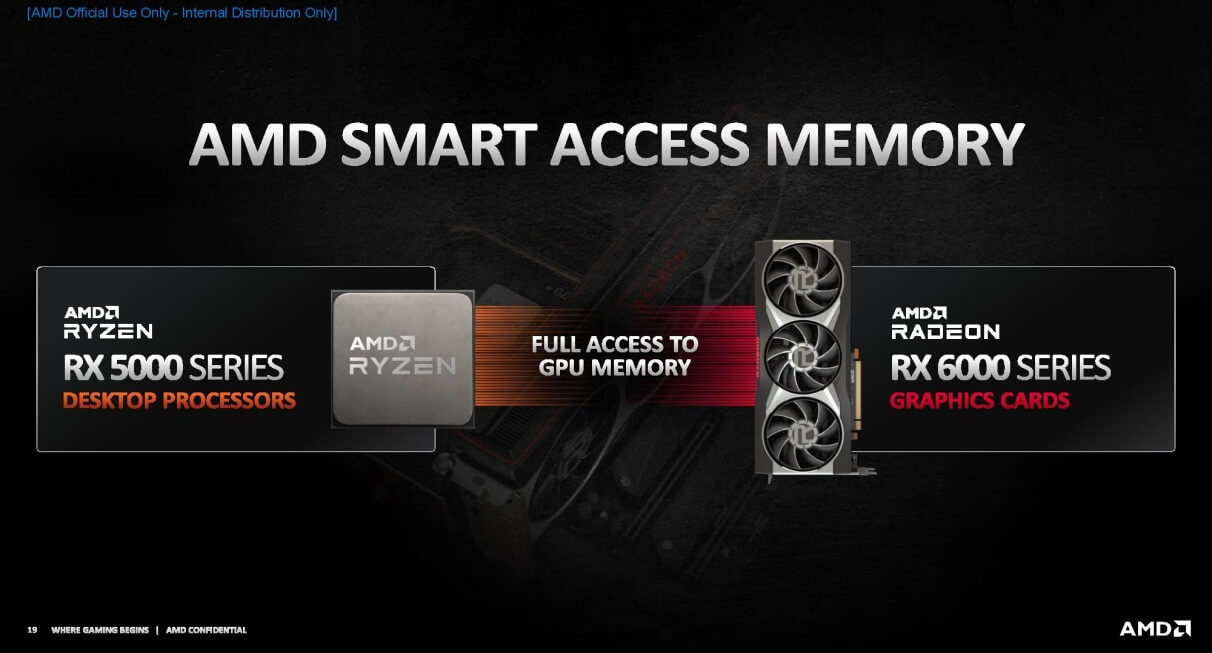
AMD Smart Access Memory

What this basically means is that the Radeon RX 6000 GPUs can now work and operate in tandem with AMD’s Ryzen 5000-series processors, provided you use a 500-series compatible motherboard, through this new Smart Access Memory feature.

Smart Access Memory aims at optimizing both the GPU and CPU to offer the best possible performance when they operate in tandem.

According to the concept, once you enable the Smart Memory Access feature in the RX 6000 card’s VBIOS and the motherboard BIOS, both the CPU and GPU will gain full access to each other’s memory. Doing this will maximize data transfer and performance between the CPU and the GPU’s VRAM.

Smart Access Memory helps boost performance by enabling faster data transfer speeds between the CPU and GPU. And by pairing this efficient data transfer smart access feature with the new AMD 128MB Infinity Cache feature might help boost the throughput between the CPU and the GPU as well.
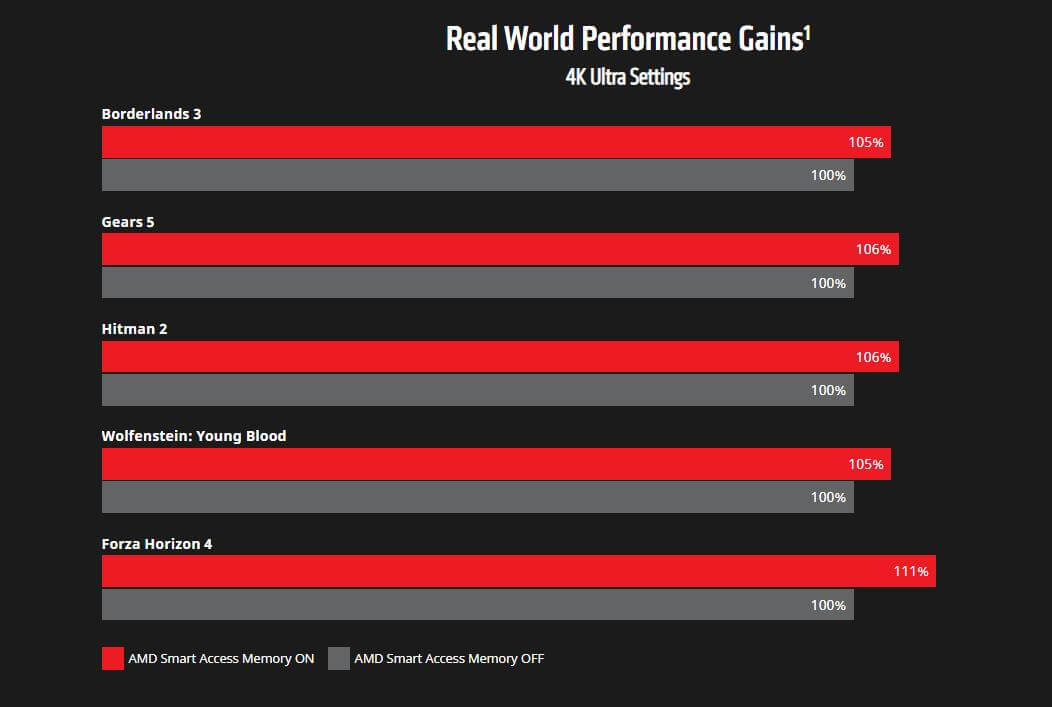
AMD SAM gaming improvements-2

The new Infinity Cache takes advantage of the GPU’s data paths to maximize performance while minimizing the data movement and power within the GPU itself.

According to AMD, Infinity Cache delivers a 10% increase in power efficiency and it also doubles the bandwidth (almost 117% increase), all at a lower power than traditional memory.

Infinity Cache is based on the Zen CPU’s L3 cache design. Infinity Cache boosts performance-per-clock scaling as frequency increases largely because the GPU is now less constrained by external memory bandwidth limits. The Infinity Cache also boosts ray tracing performance, as more of the data set is kept closer to the compute units to feed.

Most importantly, AMD says that individual game developers will have to optimize games for this new Smart Memory Access feature. As such, it could take six to twelve months before we can see this new tech in games.

Lastly, AMD’s Radeon RX 6000 GPUs will also support the DirectStorage API, which might help reduce the game load times. It remains to be seen how much of a performance boost this SAM feature gives on both AMD and Nvidia’s ecosystem.

AMD Interview, RX 6800/6800XT reviews, Q&A | The Full Nerd ep. 158

Stay tuned for more!

26 thoughts on “AMD plans to bring its “Smart Access Memory (SAM)” tech to Nvidia GPUs, ensuring compatibility on both Intel/Nvidia platforms”

  1. So first they announced how this will only work with their latest cpu. gpu and mobo combo. After nvidia said this is agnostic tech from pcie and they’ll make it work with everyhting, now AMD all of a sudden is too ? 😀

    1. AMD has always pushed open tech. Nvidia has always pushed closed tech. It is why all Nvidia bloat garbage always fails (DLSS is next). Devs want open. Consumers want open. Only Nvidia wants closed.

        1. It’s literally the biggest innovation ever for gaming. Better graphics with higher resolution. There has never been a win win like this before.

      1. I can’t see Microsoft’s solution coming close to the quality of DLSS. Then there is the performance loss that AMD will take as they have no dedicated hardware.

        1. Or you could just turn off stupid Ray Tracing. We’ve done fine without it all these years. And everyone has forgotten that Nvidia’s ray tracing ain’t even bloody real, you need 50k worth of hardware to get PROPER raytracing. Nvidia has provided an entry level solution and it BLOWS. Trying to bring you 50k hardware solutions on 600-1200 hardware, yeah good luck with that. Everyone seems to forget that lil fact it seems. Ray Tracing my A$$, more like Fake Tracing.

        2. Microsoft is a software company, they can do it if they want…… but it will hard for them because nVIdia already has DLSS 2.0 and probably DLSS 3.0 or whatever is in the works.

      2. “AMD has always pushed open tech”

        not always the case really. been watching all this stuff for a decade some of the company out there even if they said they want to support and push for open tech they still do it with their own agenda behind it. even AMD are like this.

        “Devs want open.”

        yes developer want something that truly open. that’s why Mantle is dead despite being touted as “open”.

      3. Everything that failed was a mostly a gimmick, but DLSS actually works and helps a lot, even devs are more and more interested in it because it helps with performance

        1. Dlss is a game-changer really especially since all aaa games are so hellbent on utilizing cheap aa in the form of TAA – That’s is good as AA but sucks as smearing out the finer details at the same time…

          Something dlss (quality mode ofc) in big parts restore resulting in even the upscaled surpasses 1:1 native thats been destroyed by taa smear.

          It still have some minor artifacts but compared to the washed out image taa produces i think dlss wins way more times than it looses. And its a big difference in later v2 of the tech so once its perfected… it will only be a boon.

      4. Everyone knows this but they will deny it straight out, especially those Nvidia apologists. There was one of them complaining about this said thing yesterday in another post about how AMD at first sight turned into Nvidia because they won’t share, AMD have no problem sharing and the record is there. I remember when TressFx debut i had a GTX 690 and none of nvidia cards could run it at launch. AMD made it open source the next week and BAM nvidia cards were all good. As for GameDONTWork and Hairworks and LOADED tessellation in every Nvidia title. I hate fanboyism because it hides the truth and picks at the trivial.

        Oh yeah, don’t shine light on their DLSS, they will crucify you. Because after spending 1500 dollars you still need an AI to run your Sh*t, that’s what we all dreamt of apparently… NOT!!! pffft, DLSS … The sad part about all of this is, instead of appreciating the tech that each company brings, all i ever hear is when is AMD gonna have what Nvidia have. “If everyone plays the same note, then it ain’t music now is it?” that was a quote form my 10th grade Band director. ALl these people care about is AMD helping them get nvidia for 50 bucks cheaper. They wouldn’t even by AMD if it’s 200 dollars cheaper and run faster. Most of them wouldn’t even understand how to use an AMD card, with their overclocking every damn thing A$$.

        1. “AMD have no problem sharing and the record is there”

          what happen to mantle before said other wise.

          “I remember when TressFx debut i had a GTX 690 and none of nvidia cards could run it at launch. AMD made it open source the next week and BAM nvidia cards were all good”

          TressFX only end up being open source by AMD after GPU Open initiatives. and GPU Open initiatives only happen a few years after TR 2013 release. the issue with tressfx back then is not about open source. but the final version of tressfx that being use in the game. when nvidia are optimizing their performance they were given the game build with older version of tressfx. performance are fine on those older build. since nvidia never got access to the final build of the game it took them roughly a week to release new driver with new optimization for the new tressfx version in the game. nvidia don’t need tressfx to be open source to optimize their performance for it.

          1. “what happen to mantle before said other wise.” it got opensourced to Microsoft and Khronos Group and served as foundation for DX12 and Vulkan

            “TressFX only end up being open source by AMD after GPU Open initiatives.
            and GPU Open initiatives only happen a few years after TR 2013 release.
            the issue with tressfx back then is not about open source. but the
            final version of tressfx that being use in the game. when nvidia are
            optimizing their performance they were given the game build with older
            version of tressfx. performance are fine on those older build. since
            nvidia never got access to the final build of the game it took them
            roughly a week to release new driver with new optimization for the new
            tressfx version in the game. nvidia don’t need tressfx to be open source
            to optimize their performance for it.”
            oh yeah! and later novidio added its “tweaks and magic” to ruin later performance in TR2016 for amd cards

          2. i’m not talking about how AMD shared the spec to MS and Khronos. the issue is sharing mantle spec itself among IHV (which is a promise that AMD never fulfill). as richard huddy said in one of his interview mantle are build and optimized for GCN hardware first. when they release the spec to MS and Khronos they want the low level API version of DX and OpenGL will be build with AMD hardware in mind first. now does it make sense why DX12 end up yielding more performance on AMD especially async compute? if you really follow what happen back then you will see that AMD is very reluctant to let other IHV to see mantle spec. also AMD have some plan with Mantle back then and some of them Richard Huddy already told it to the public during his tour of interview with various tech outlet like how Mantle will continue to exist side by side with DX and OpenGL and Mantle 2.0 will eventually comes out before MS release DX12 to the public. october 2014 AMD brag almost 100 game developer have sign in for the program. roughly three months later (january 2015) AMD pretty much terminate the program moving it to internal development only. and from the attitude AMD are showing back then there might be unpleasant things happening between AMD and game developer.

      5. Then why did Amd basically try to close an open tech this time? Im all for open as it gives a new tech way higher chance of adaptation rather than each push their own.

          1. So you haven’t paid attention then? SAM aka Resizable BAR was only to be available to certain Amd cpu/gpu/chipset configs… Yet when the competition set out to enable it on pretty much all config… all of as sudden AMD could do it too!

            Resizable BAR is part of the pcie specs… and they were about to only enable it on certain configs…

          2. Nice try, but long before Nvidia mentioned doing it AMD said in an interview with PC world that they were working on bringing it to as many configurations as possible after the 5000 series launched. They also said this applies to all of their technologies. Back porting is a fucus for them and this has always been this way.

          3. Interesting as their review just a few days ago said it was only for the locked down config and no mention about it being made available elsewhere. Where is that other interview?

          4. It was on the Full Nerd podcast a while back, but they actually mentioned it again, I thin, on last weeks (they have AMD engineers on from time to time and it is fascinating).

    2. Truth be told….. nVIdia was the one who had many proprietary stuff in the last two decades which worked only on nVidia GPUs for new things they introduce, AMD was always more for open source and open standards.

      Basically, this is the first time actually that nVIdia is doing something “right” (support on all platforms first).

  2. Good move, though they would first artificially cripple the capability for a resizable pcie bar consider their initial wording.

    And if i’m not mistaken – The resizable bar won’t actually speed up the pcie transfers themselves at all but rather save the overhead in additional handling of the small limited bar vs direct addressing the data.

    Super simplified – Kinda see it as copying files back and forth with a smaller drive between two big drives… adds steps rather than being able to do a direct copy.

  3. I wonder why these “free” performance enhancements haven’t been used before since they are part of the pcie standard.

Leave a Reply

Your email address will not be published. Required fields are marked *