

Intel’s senior Vice President, Raja Koduri, recently posted a teaser of the company’s first gaming discrete graphics cards on Twitter, the Xe HPG. Intel’s Xe HPG DG2 (High-Performance Gaming) gaming graphics card appears to have been tested in the new 3DMark Mesh Shader feature test by Intel.
The Intel DG2 graphics appears to be the first GPU based on the HPG architecture. This graphics processor is rumored to offer up to 512 Execution Units, which gives the GPU 4096 cores (Shading Units). The card is based on the Gen12 graphics architecture.
This is the first public tease of Intel’s Xe HPG graphics card, and the card will sport features like compute efficiency, scalability and graphics efficiency. Intel has also confirmed that the new HPG architecture will use the GDDR6 memory type.
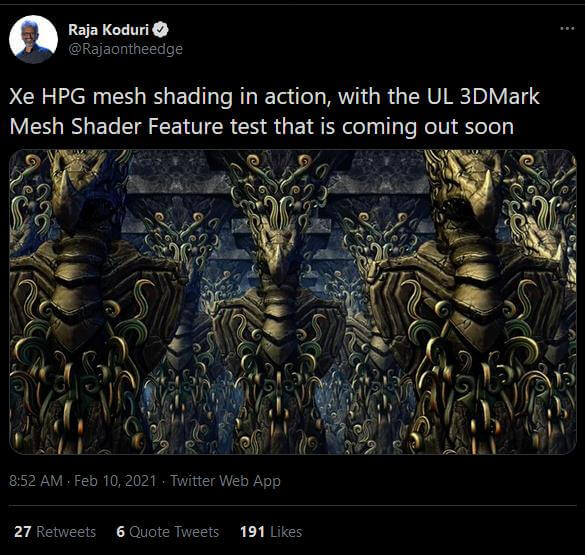
Mesh Shader is one of the major features introduced within DirectX 12 Ultimate API back in 2020. The feature is supported by NVIDIA’s Turing, Ampere, and AMD’s RDNA 2 lineup of gaming cards.
Intel will also be adding Mesh Shaders support on its Xe-HPG discrete GPUs. Mesh Shaders give developers more programmability than ever before. By bringing the full power of generalized GPU compute to the geometry pipeline, mesh shaders allow developers to build more detailed and dynamic worlds than ever before.
Prior to mesh shader, the GPU geometry pipeline hid the parallel nature of GPU hardware execution behind a simplified programming abstraction which only gave developers access to seemingly linear shader functions.
For more technical details on Mesh Shaders, kindly refer to NVIDIA’s and Microsoft’s developer blogs. NVIDIA has already demoed Mesh Shading back in 2018.

Back in October 2020, Intel taped out its first discrete gaming GPU, the Xe-HPG ‘DG2’ graphics processor. The company reaffirmed that it is working on a full stack of discrete Xe-HPG-based GPUs that will target the mid-range/mainstream, and also the enthusiast gaming market segment sometime later this year.
The new Intel DG1 on the other hand, is Intel’s first discrete GPU in over 20 years. Intel’s DG1 GPU is already shipping in volume. DG1 is codenamed as Intel Iris Xe MAX GPU, which is used in ultraportable and thin laptop designs. It is based on the Xe-LP architecture for iGPUs and low-power models, and entry-level gaming PCs.
The new Intel DG2 discrete gaming graphics processor on the other hand was in “alpha silicon” form back then, but Intel said they’ve already powered-on this new DG2-based GPU in their labs. DG2 isn’t just a successor to DG1, but instead is a higher performing bracket GPU based on the company’s latest Xe-HPG architecture.
Xe-HPG is the enthusiast, and gaming-focused GPU architecture, incorporating hardware-enabled features found in similar discrete GPUs from AMD and NVIDIA like e.g. ray tracing/RTX etc.
Intel’s family of Xe-HPG graphics processors will consist of multiple SKUs targeting different market segments spanning all the way from mid-range to the high-end enthusiast level.
This GPU was already rumored to be manufactured outside of Intel’s fabs, in an external foundry. Back then while Intel didn’t mention which fab and process node was going to be used, but as per one report from REUTERS, they might tap TSMC’s enhanced 7nm process node.
Intel has actually used a lot of other third-party IP, such as the memory controller and interface, and display interface to optimize the overall design costs.
Though, Intel hasn’t clarified whether DG2 is a flagship-grade bigger chip, or a more modest, and smaller high-volume part. For now, the company is simply saying that DG2 will, “take our discrete graphics capability up the stack into the enthusiast segment.”

Intel is expected to unveil its DG2-based graphics cards later this year. Though at the recent January 11 CES 2021 event, there was no mention of this discrete gaming GPU.
Stay tuned for more tech news!

Hello, my name is NICK Richardson. I’m an avid PC and tech fan since the good old days of RIVA TNT2, and 3DFX interactive “Voodoo” gaming cards. I love playing mostly First-person shooters, and I’m a die-hard fan of this FPS genre, since the good ‘old Doom and Wolfenstein days.
MUSIC has always been my passion/roots, but I started gaming “casually” when I was young on Nvidia’s GeForce3 series of cards. I’m by no means an avid or a hardcore gamer though, but I just love stuff related to the PC, Games, and technology in general. I’ve been involved with many indie Metal bands worldwide, and have helped them promote their albums in record labels. I’m a very broad-minded down to earth guy. MUSIC is my inner expression, and soul.
Contact: Email