
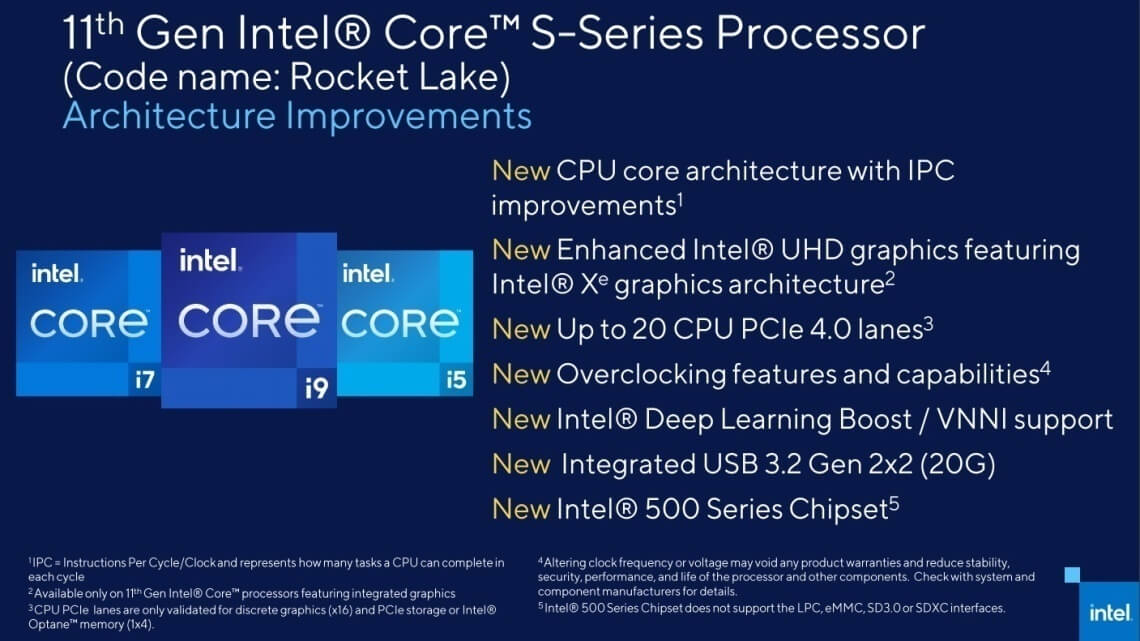
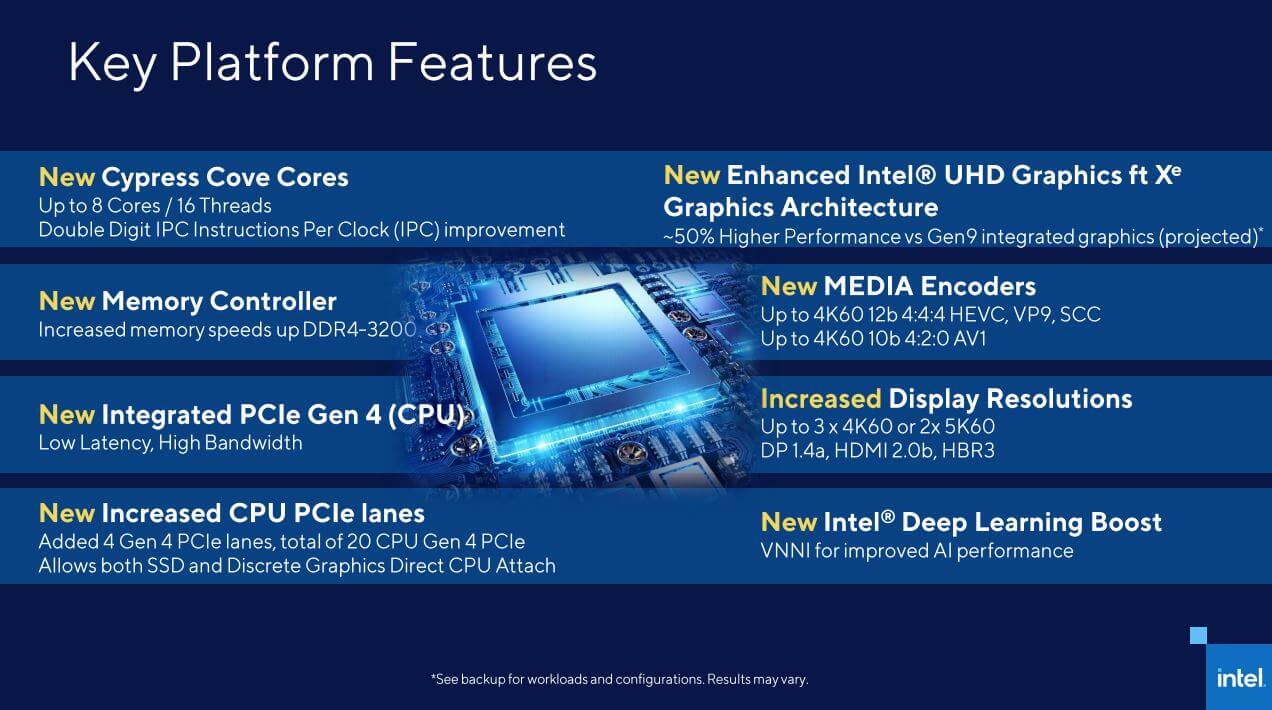
At the recent CES 2021 event, Intel officially announced its 11th Gen Core Rocket Lake-S CPU series during the press briefing. Official announcement slides were leaked as well, which showed almost 14% IPC boost with this new CPU lineup.
Intel’s 11th gen desktop processor lineup will feature both Rocket Lake-S and Comet Lake-S “refresh” CPUs. The Intel 11th generation lineup includes 13 Rocket Lake/RKL and a total of 13 Comet Lake refresh desktop CPUs. Rocket Lake lineup features the core i9, i7 & i5 variants, while the Comet Lake refresh desktop CPUs will come in Core i3, Pentium & Celeron variants.
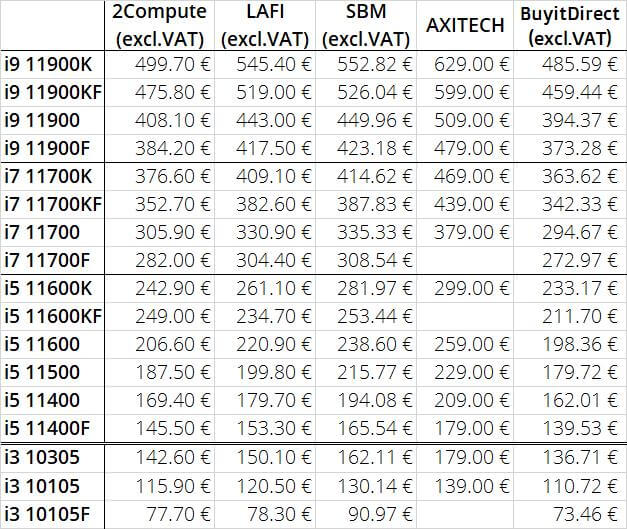
Now, we have some preliminary info on the expected pricing of these new 11th gen core processors, courtesy of 2Compute, a Belgium retailer, coming via Tom’s Hardware, and @momomo_us.
But before continuing, you should bear in mind that these prices shouldn’t be taken as a base guideline to make any purchasing decision, since the price in most of the European countries tends to be on a higher side, as compared to US and other countries.
More importantly this is also unreleased hardware we are talking about, since these CPUs haven’t hit the retail shelves yet. So please exercise some caution here. With that being said, assuming this Belgium retailer 2Compute’s pricing closely reflects Intel’s official MSRP, then we could be looking at a price difference of up to $30.
Tom’s hardware did an apples-to-apples comparison using 2Compute’s previous Comet Lake-S pricing as a base reference. Only the top K-series models were compared to get an idea on the expected pricing of these new 11th gen SKUs.
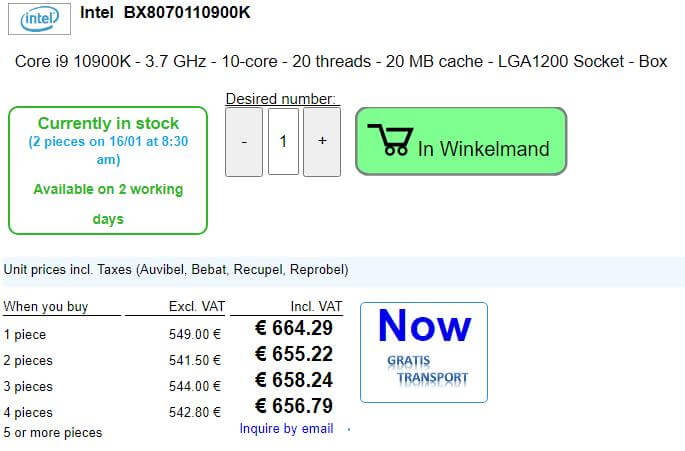
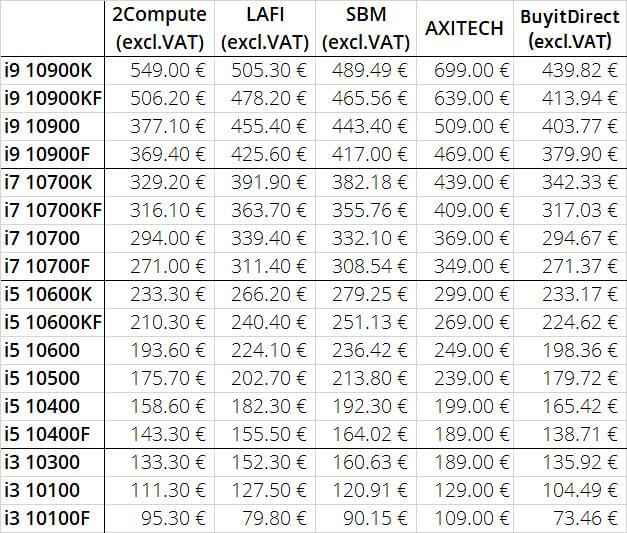
According to the retailer’s listing, the previous gen Core i9-10900K, Core i7-10700K and Core i5-10600K are selling for $555, $398 and $282, respectively.
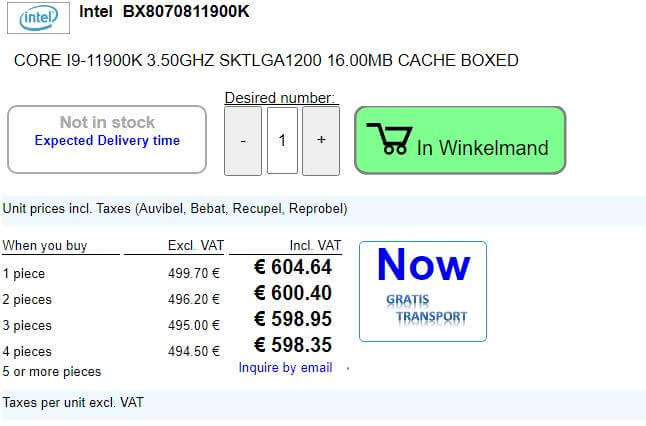
Therefore, currently the flagship Rocket Lake processors the Core i9-11900K and Core i7-11700K are costing up to 8.8% and 14.3% more, whereas the Core i5-11600K has a 3.9% higher price tag.
So basically the Core i9-11900K carries a 499.70 EUR price tag without VAT and around 605 EUR with 21% VAT included. This means that the 10900K Comet Lake-S processor is 8-9% more expensive.
The Comet Lake refresh chips also see a similar price trend, but you should only go for these lower-end chips if you don’t want to use any i5 or above processor SKU. For comparison, the Belgium retailer is selling the Comet Lake Core i3-10300 and Core i3-10100 for $161 and $134, respectively.
So right now according to the listing, the new Comet lake “refresh” equivalent chips are apparently 6.8% and 4.5% more expensive, the Core i3-10305 and the Core i3-10105, respectively.
Overall, it appears that Rocket Lake-S may cost up to 15% more than the previous gen Comet Lake-S lineup. But again, there is no hard and fast rule to this, because the price listing keeps on changing, and they differ from other retailers as well.
But you should also note that even though Intel touts IPC gains of up to 19%, and full support for the PCIe 4.0 gen interface, the Rocket Lake-S platform is the last to use the aging LGA 1200 socket, so obviously your upgrade options are going to be limited, should you plan to buy a new INTEL CPU in near future.
So the LGA 1200 socket will be considered as obsolete and short-lived by many gamers once the next-gen LGA 1700 socket platform arrives with the new Alder Lake-S CPU lineup.
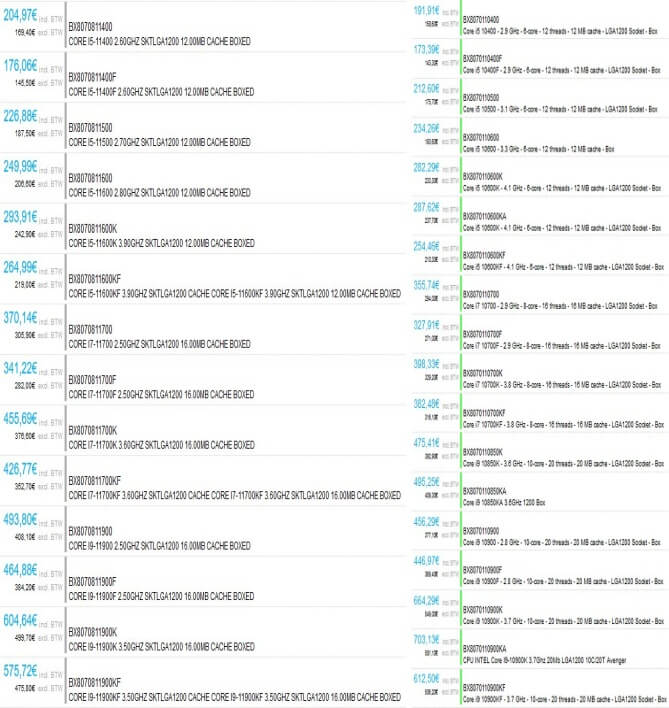
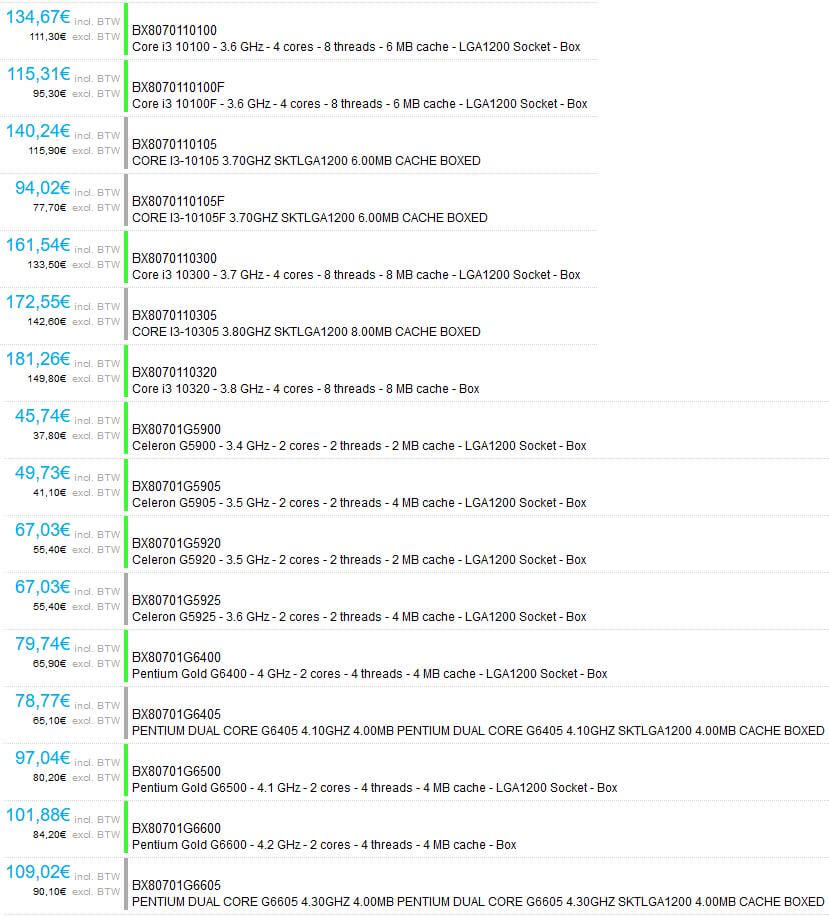
Twitter user @harukaze5719 also shared some pricing info of these CPUs by few other retailers, and judging from the listing, the prices seem to be random. Some retailers are listing these new CPUs at a lower price than the current Comet Lake-S SKUs, whereas other retailers have listed them at a higher price tag.
Rocket Lake-S desktop platform should also hopefully be the last CPU architecture to be based on an advanced 14nm process node. Comet Lake-S was also fabbed on this aging process node, which has held Intel back in terms of IPC uplift and efficiency gains over AMD’s Ryzen lineup.
RKL processor family will release in first quarter of 2021, and is expected to share the same socket and motherboard compatibility as the current 10th Gen Comet Lake processors, thus providing an upgrade path even for those rocking the flagship Core i9-10900K Comet lake CPU.
Rocket Lake-S will be housed on the 500-series motherboards. Although the Rocket Lake-S lineup will be the last to feature the LGA1200 socket/Z490 chipset, Intel is planning a full range of chipsets, including workstation W580, high-end gaming Z590, H570, and budget-oriented B560 and H510 series. The current 400-series motherboard chipsets will also support these upcoming SKUs after a BIOS update.
Intel has also broadened the DMI interface, which connects the processor to the platform controller hub (PCH), from x4 to x8.
John Bonini (VP and GM of Client Computing Group Desktop, Workstation, and Gaming at Intel) has also confirmed that the 11th Gen Core series processors codenamed Rocket Lake will be Intel’s first lineup to support the PCI-Express gen 4.0 interface, a feature which has been seemingly missing in Intel’s client Desktop CPU platform for quite some time.
Rocket Lake will deliver desktop users up to eight cores and sixteen threads on the high-end, which means two cores and four threads less than the current Comet Lake processor lineup. But the reduction in core count could also mean that Intel plans to rely on increased single-threaded performance, thus boosting overall system performance through single-threaded gains.
Single-threaded performance will help Intel to compete more in the CPU market segment, even if AMD can deliver higher core count SKUs. Not all applications or tasks are highly multi-threaded in nature, which makes the single-threaded performance all the more important.
Stay tuned for more tech news!

Hello, my name is NICK Richardson. I’m an avid PC and tech fan since the good old days of RIVA TNT2, and 3DFX interactive “Voodoo” gaming cards. I love playing mostly First-person shooters, and I’m a die-hard fan of this FPS genre, since the good ‘old Doom and Wolfenstein days.
MUSIC has always been my passion/roots, but I started gaming “casually” when I was young on Nvidia’s GeForce3 series of cards. I’m by no means an avid or a hardcore gamer though, but I just love stuff related to the PC, Games, and technology in general. I’ve been involved with many indie Metal bands worldwide, and have helped them promote their albums in record labels. I’m a very broad-minded down to earth guy. MUSIC is my inner expression, and soul.
Contact: Email