
NVIDIA Ampere GPU general header 2

NVIDIA Ampere RTX GPUs to get their own “Smart Access Memory (SAM)” tech

In a recent statement to GamersNexus NVIDIA has just confirmed that they are also working on their own SAM or Smart Access Memory feature similar to what AMD has enabled on their RDNA 2 GPU lineup.

Nvidia has confirmed that this SAM feature will be enabled on all the GeForce RTX 30-series Ampere GPUs via future software updates. Thus, Nvidia GPUs are also going to leverage a similar feature which might give them an upper hand in Games as well. Though, this remains to be seen.


Just in case you didn’t know, AMD recently detailed three new RDNA 2 features: RAGE Mode, Smart Access Memory and Infinity Cache. This move from NVIDIA seems like an official response to AMD’s Smart Access Memory technology.

More importantly, the green team has also confirmed that resizable BAR is actually a part of the PCI-Express specifications, and NVIDIA’s existing hardware fully supports this functionality. NVIDIA has stated this SAM feature is going to be enabled through future GPU driver/software updates, and it will be compatible with both AMD and Intel processors.

Both Intel and AMD CPU-based systems will be fully supported; whereas AMD’s solution will only work with its latest Ryzen 5000-series CPU lineup and compatible X570 motherboards. AMD Motherboards will also require the latest AGESA 1.1.0.0 firmware update.

“We have it working internally and are seeing similar performance results.”- NVIDIA.

This new technology feature will not require a PCIe Gen 4-compatible platform as it will be supported by PCIe Gen 3 systems as well. BAR basically defines how much discrete GPU memory space can be mapped. Modern PCs are typically limited to 256 MB of mapped memory.

It is typical today for a discrete graphics processing unit (GPU) to have only a small portion of its frame buffer exposed over the PCI bus. For compatibility with 32bit OSes, discrete GPUs typically claim a 256MB I/O region for their frame buffers and this is how typical firmware configures them.

A GPU, supporting resizable BAR, must ensure that it can keep the display up and showing a static image during the reprogramming of the BAR.

This feature is rather important for graphics hardware, because the PCI BARs are usually limited to 256MB while on modern cards you can easily find 4GB or more VRAM. The end result is that only a fraction of that VRAM is CPU accessible, causing a whole bunch of workarounds in the driver stack for that hardware.

AMD says that with SAM they can access all of the GPU memory, thus removing any bottlenecks. This will also allow for faster performance. In conventional Windows-based PC systems, processors can only access a fraction of graphics memory (VRAM) at once, limiting system performance.

With AMD Smart Access Memory, the data channel gets expanded to harness the full potential of GPU memory, utilizing the bandwidth of PCI Express to remove the bottlenecks and increase performance.

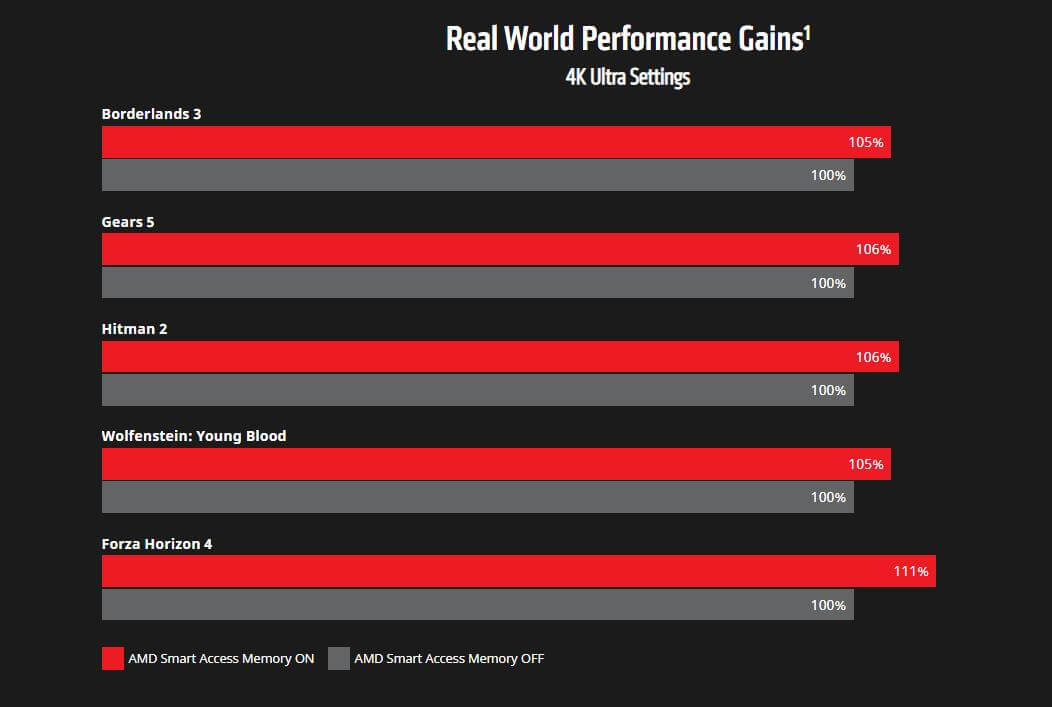
As you can see below AMD recently shared one chart showing the performance gains coming from this SAM feature in 4K AAA gaming. With SAM enabled we can see a 11% boost in Forza Horizon 4, and 5-6 % gains in games like Borderlands 3, Gears 5, Hitman 2 and Wolfenstein Young Blood.

AMD SAM gaming improvements-1AMD SAM gaming improvements-2

To explain this feature in more details, and to reiterate, AMD’s new Smart Access Memory feature will boost the overall gaming performance by optimizing the data transfer between the CPU and the GPU.

What this basically means is that the Radeon RX 6000 GPUs can now work and operate in tandem with AMD’s Ryzen 5000-series processors, provided you use a 500-series compatible motherboard, through this new Smart Access Memory feature.

AMD Smart Access Memory –“An exclusive feature of systems with AMD Ryzen™ 5000 Series processors, AMD B550 and X570 motherboards and Radeon™ RX 6000 Series graphics cards.

It gives AMD Ryzen™ processors greater access to the high-speed GDDR6 graphics memory, accelerating CPU processing and providing up to a 13-percent performance increase on a AMD Radeon™ RX 6800 XT graphics card in Forza Horizon™ 4 at 4K when combined with the new Rage Mode one-click overclocking setting”.

Smart Access Memory aims at optimizing both the GPU and CPU to offer the best possible performance when they operate in tandem.

According to the concept, once you enable the Smart Memory Access feature in the RX 6000 card’s VBIOS and the motherboard BIOS, both the CPU and GPU will gain full access to each other’s memory. Doing this will maximize data transfer and performance between the CPU and the GPU’s VRAM.

Smart Access Memory helps boost performance by enabling faster data transfer speeds between the CPU and GPU. And by pairing this efficient data transfer smart access feature with the new 128MB Infinity Cache might help boost the throughput between the CPU and the GPU as well.

The new Infinity Cache takes advantage of the GPU’s data paths to maximize performance while minimizing the data movement and power within the GPU itself. According to AMD, Infinity Cache delivers a 10% increase in power efficiency and it also doubles the bandwidth (almost 117% increase), all at a lower power than traditional memory.

Infinity Cache is based on the Zen CPU’s L3 cache design. Infinity Cache boosts performance-per-clock scaling as frequency increases largely because the GPU is now less constrained by external memory bandwidth limits. The Infinity Cache also boosts ray tracing performance, as more of the data set is kept closer to the compute units to feed.

It remains to be seen how much of a performance boost this SAM feature gives on both AMD and Nvidia’s hardware.

Stay tuned for more!

53 thoughts on “NVIDIA Ampere RTX GPUs to get their own “Smart Access Memory (SAM)” tech”

    1. Of course Nvidia can only offer a similar feature after a push from AMD. Classic.

      Cough cough RTX, cough, DLSS, cough.

          1. AMD developed their own version of Hairworks called TressFX, most notable implementation i believe was in the Tomb Raider series.
            Physx is a different story, nowadays it’s often enabled by default in games and you don’t even notice it, no big fuss.
            And of course it’s no longer locked.

      1. RTX is fully compliant with DXR. There is never issue with RTX being proprietary since IHV implementation of open standard spec have always been proprietary. Just look at tessellation. It is part of direct x spec since DX11. the implmentation are unique to each IHV. AMD have truform while nvidia have their polymorph engine.

        DLSS is fully proprietary. Nvidia idea of DLSS is to take advantage of tensor core inside their gpu. Since they are the only gpu maker with tensor core it is make sense for them to make it fully proprietary. MS have different idea with their directML where they want it to run fully on gpu shader core only because they believe it will be faster that way. But this is something that we need to see it’s impact on real world application. So far nvidia already prove that using tensor core is doable with their DLSS.

        1. So what? How is this relevant? Nvidia was still the first to bring real time RT to consumers and games.

          And as far as ray tracing software goes Nvidia is also doing a lot of research for improved game implementations, such as RTDI which supports millions of ray traced shadow casting lights in real time.

        2. While that’s good info his point is that recently NVIDIA has been pushing tech before AMD. Proprietary or not.

          It’s great really, good competition will yield rnd in tech and we’ll, as consumers, benefit. We already did in the case where AMD began competitioning with INTEL and the latter slashed prices by whay 40-50% to stay borderline relevant.

          Not even entering 6800/6900 territory because there’s too much speculation but right now AMD is firing in all directions and it’s hitting targets alright.

          It’s fkin great to see the BLUE and GREEN giants having to worry about competition.

    2. Scientifically speaking, how would they have come up with such an advancement in so very little time?. It doesn’t at all seem possible to whip something like that up so fast, and pin it as the push from AMD.

      It reminds me of how Valve spent years working behind the scenes on their UI/Storefront update. When it finally arrived, people put a baseless claim that Epic “forced” Valve’s hand in releasing the update, completely ignoring the fact that it was actually ready for launch. I feel like we’re seeing a complete duplicate of the same scenario here.

      Nvidia or any tech company for that matter, doesn’t simply whip up tech in a matter of weeks, let alone a single month, it takes up to half a year if not a year or more, and this kind is something that’s likely been in the works for at least 2 years. We the public just haven’t been privy to their backstage workings (hence why we get tid bit rumours and “leaks” (I say “leaks”, because it’s more common these days for a company to purposefully leak their own info to create chatter amongst the industry)

      1. Yeah I agree, generally, but there is the fact that this is a software based improvement, and it could easily be inspired by AMD, and also not take more than a couple of months to test all their Ampere cards to make sure it’s effective and not bricking them.

        But again, people are ALWAYS saying this about games that seem similar that come out soon after another one. I’m like.. this thing didn’t just get made a week ago.

        1. I just don’t think it’s because of AMD’s reveal though. I mean both companies definitely do take inspiration from each other over time, but this sort of thing feels like it’s been in the works for at least 2 years tops.

      2. I think its actually for once an somewhat easy feature to enable, it’s in the pcie specs and suspect its not hard to enable if the cards have full pcie capability’s already.

        That makes me wonder thoo… why wasn’t the feature enabled earlier.

        Either way… free performance boost is always the best performance boost!

        1. I don’t think it’s all that simple, and I refuse to believe it’s because Nvidia showed off their cards that they did this.

          1. The nvidia implementation is based on the bar in the pcie protocol and unless i got this on the backfoot this new way to utilized it for gpu’s will allow the cpu to directly work with the entire gpu’s addressable vram instead of an limited space that have to be further processed thus removing that overhead and bottleneck.

            Could be more than that but if it’s that – Then it should actually be easier to handle as it’s all available to adress to the cpu rather than a small chunk acting as a “data distribution point” of sorts.

            Example – Ok we need this part of the gpu memory to be read/written by the cpu, is it in the bar space? No – Then have to copy it to the cpu addressable space on the gpu, let the cpu does its part then work back from there rather than just let the cpu work with that first area directly.

  1. So what about the Games ? Do developers also need to code the engine to support SAM, or maybe provide support through patches as well ?

    I would like to see how this feature works. And how many games really benefit from it.

    1. I mean the game performance also varies from 5% to 11%, so different game engines might scale differently ??

  2. One big doubt:

    AMD now needs to be clear about why Smart Access Memory is exclusive to Ryzen 5000 series and Radeon 6000 series products. If Nvidia can support a similar feature on all CPU platforms, why can’t AMD?

    1. software implementation…reminds me of the software implementation of
      asynchronous compute on nvidia maxwell cards, lets just say it was not
      great.

  3. software implementation…reminds me of the software implementation of asynchronous compute on nvidia maxwell cards, lets just say it was not great.

    1. Of course we need more details but even before this news comes out there are discussion on the forum about how SAM might be AMD exclusive advantage. Then i saw some people with more techical knowledge saying that this stuff already exist and supported by windows. they said it seems AMD just rework it abit and then give their own naming for it. And for casual customer that only have basic knowledge about computer related stuff start thinking that this is something new that AMD coming up with. And since it touted only work with AMD CPU combined with AMD GPU people start thinking this might end up giving an edge for system that is going full AMD.

    2. I don’t think it is a complete flop but it is one way to make compute oriented architecture to perform better in games. Async compute probably one of the reason why nvidia is going back to compute architecture even for their gaming card starting with turing.

  4. “This new technology feature will not require a PCIe Gen 4-compatible platform as it will be supported by PCIe Gen 3 systems as well.”

    Sweet.

  5. Classic! The only reason we got sharpening slider in nvidia control panel and Game Filters is thanks to AMD. Without AMD’s offerings, non of that would have been developed and implemented. It’s like when AMD released their own “close to metal” API called Mantle… shortly after that Microsoft announced that dx12 was on the way… LOL.

      1. Nah, the ray tracing isn’t from AMD, it’s from Microsoft (DXR), AMD just added support for it. AMD has no ray tracing software of their own. Yes, the VSR from AMD was a direct response. But that’s like the only thing they copied from nVidia.

    1. They both copy/paste features… only a fanboi cry about it – I’m happy tech moves along and if both camps have it there is way higher chance the new tech’s that req dev’s to actively use gets adopted rather than if they push their own solutions

        1. Freesync (Based on g-sync idea) & Their version of dlss… just to name a couple. Don’t have all day to list copy/paste of ideas both did. Perhaps you have more spare time to google – Hint… its not that hard even for an tech amateur.

    2. Nvidia have their shaperning tools and filters around one year and a half before AMD. just that nobody really talked about it. What amd did it integrate it directly to their control panel. And nvidia also did that with their control panel (but only for sharpening) after that.

  6. If Nvidia gets this tech working on both Intel and AMD cpus it looks like AMD is artificially locking support to their new Zen 3 cpus.

    1. If that’s the case then yeah – Could also be that they require additional capability’s. We can only speculate at this point – That said if they don’t req additional capability’s then they have locked that feature down without the need beside competitive reasons (ie basically screw a portion of their customers over)

  7. “The capability for resizable BAR is part of the PCI Express spec” nvidia. ok.. lets do this, but only for ampere. ok, thank u guys!

  8. Technical question.

    Amd’s implementation seems hardware. Nvidia’s seems software. Would that introduce overhead or latency etc ?

  9. I wonder how useful it will be on Nvidia’s Vram starved cards…
    I mean if there’s a game demanding 9,5GB in standard mode the RTX 3080 won’t be able to do much… Unlike the Radeons.

    1. It’s about how much the processor can use, and they have to do this on top of the usual mem allocation for textures, shaders…

  10. Not sure any of this stuff matters from either company if the shelves are empty.
    They can go further and get the gpu’s to make me breakfast, Wash the dishes and even print money, But it’s useless if I can’t buy one.
    By the time any of this is useful, We will be already hearing of 4000 series and RX7000 and may actually be able to buy one if the world gets back to normal next year.

Leave a Reply

Your email address will not be published. Required fields are marked *