
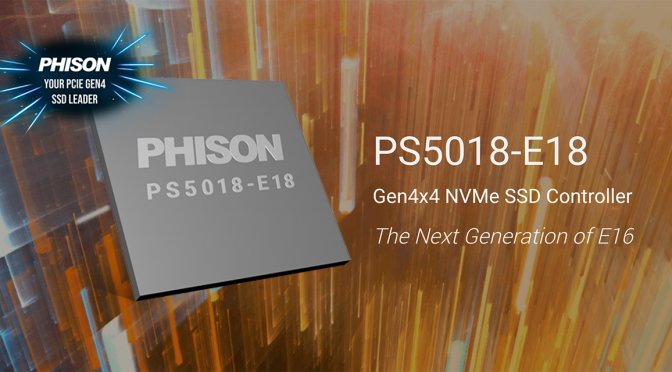
Phison PS5018-E18 SSD feature

Phison’s PS5018-E18 SSD controller can hit 7.4 GB/s sequential read speed, 1.2 million IOPS

Last year Phison was the first company to introduce an SSD controller with a PCIe 4.0 interface, which allowed the company to capture most of high-end client and commercial SSD market.

But since the competition has been heating up in the storage industry and NAND market, Phison’s previous SSD controller the PS5016-E16 has recently been dethroned and outclassed by its rivals and industry peers (such as the Samsung 980 Pro M.2 NVMe SSD).

Additionally, Silicon Motion one of its rival has just announced new PCIe 4.0 controllers, the SM2264 and SM2267, respectively, and Adata’s XPG Gammix S50 Lite products are already hitting retail shelves.

So Phison wants to stay ahead in the SSD market and the company recently teased its next-gen high performing E18 SSD controller, the PS5018-E18.

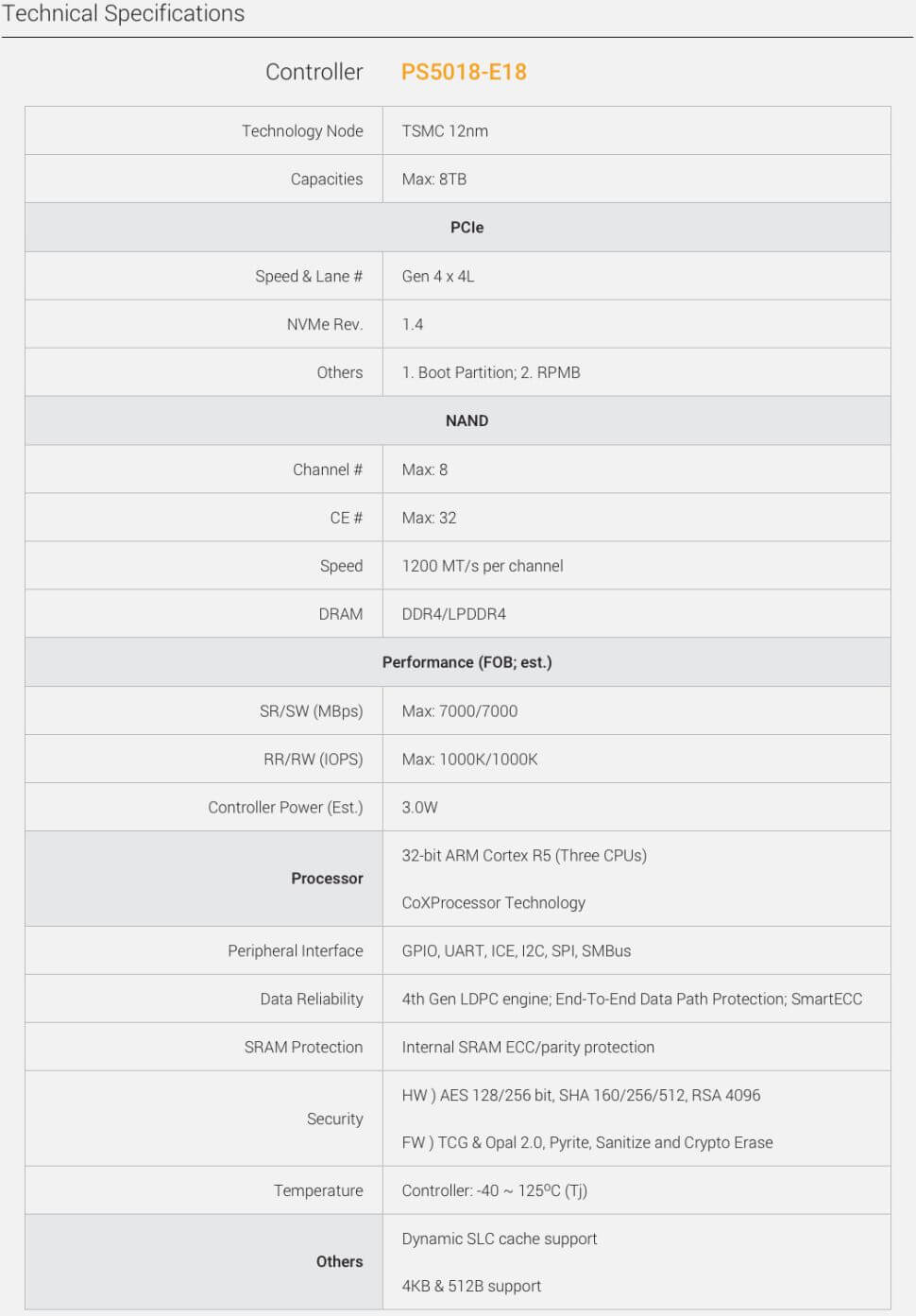
The PS5018-E18 is the company’s 2nd-gen controller for high-end client SSDs having a PCIe 4.0 x4 interface. It is based on three 32-bit Arm Cortex-R5 cores, having a CoXProcessor Technology, and made using TSMC’s 12 nm process node.

The controller can support eight NAND channels at a 1200 MT/s speed with 32 CE targets. The controller features Phison’s 4th-gen LPDC ECC engine and supports the NVMe 1.4 protocol. Phison claims that its PS5018-E18 controller can enable up to 7,000 MB/s sequential read and write speeds as well as 1,000K/1,000K read/write IOPS, but in fact the controller can actually hit even higher speeds, as evident from one benchmark test.

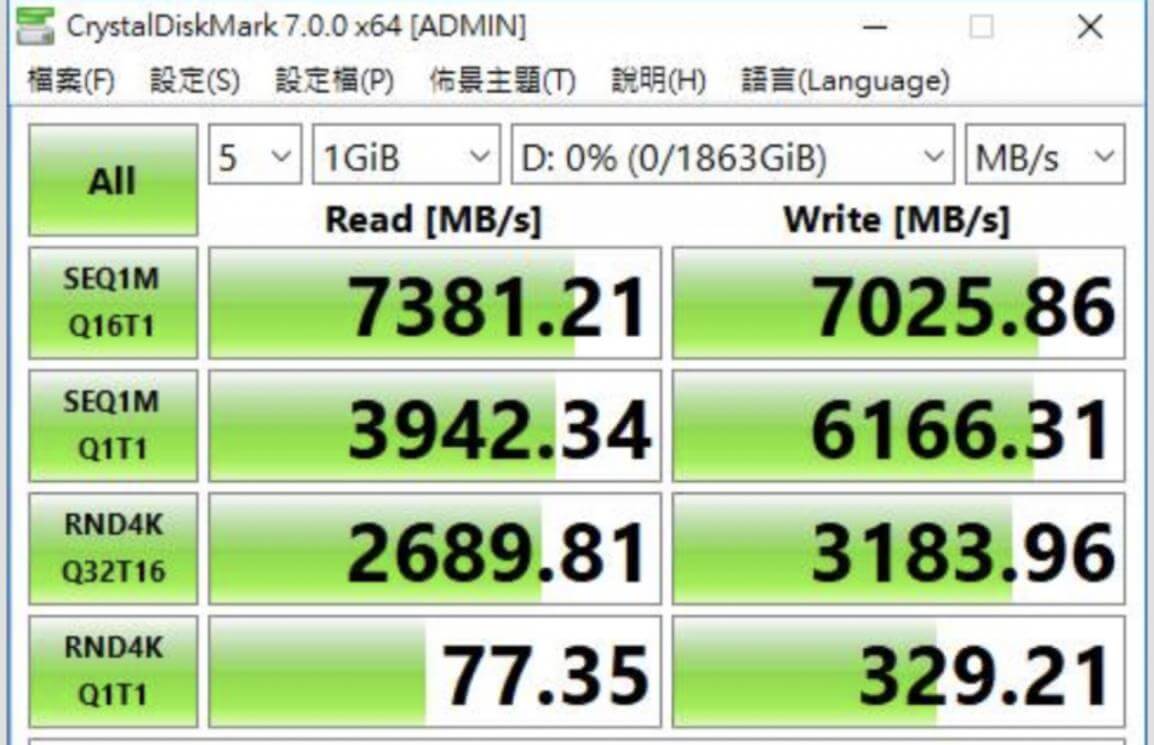
Tweaktown recently published a preliminary benchmark result showing that the controller can actually hit a sequential read speed of 7,381 MB/s and a sequential write speed of 7,025 MB/s in CrystalDiskMark 7.0.0.

For context, Samsung rates its 980 Pro SSD with 7,000 MB/s sequential read speed as well as 5,000 MB/s sequential write speed.
Phison PS5018-E18 SSD controller-1

But do note that early benchmark results should always be exercised with caution. Furthermore, the CrystalDiskMark 7.0.0 bench tool only demonstrates the peak performance value. So it is not an indicative of performance in real-world applications.

Also, Phison offers its partners SSDs with different firmware and allows them to choose the version which might work best for them. So certain firmware versions may show extreme sequential write speeds for the SSD, and it does not mean the consumer and client SSDs are also going to offer a similar level of performance.

Nonetheless, the performance numbers for Phison’s PS5018-E18-based SSDs look promising. We’ve already seen Sabrent’s next-gen Rocket 4 Plus SSD screaming along at 7GB/sec, but the real-world results from the Phison E18 SSD controller shows past 7GB/sec, up to 7.38GB/sec.

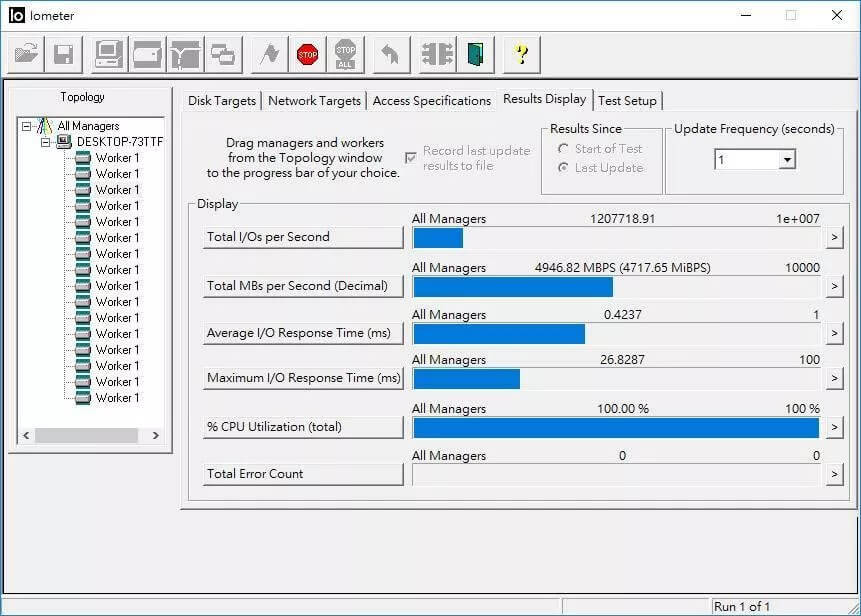
Since the PS5018-E18 PCIe 4.0 x4 NVMe 1.4 SSD controller has neared the final stages of development, the company gave us an exclusive glimpse of its current capability. Phison’s test lab recently shared some impressive results, and we can see the E18 controller speeds in excess of 1.2 million IOPS, as shown in the screenshot below.

According to the company’s official document these results are based on a 2TB engineering sample sporting Micron’s 512Gb B27B 96-Layer TLC flash.
Phison PS5018-E18 SSD controller-2

For context, Samsung and its powerhouse 980 PRO SSD with speeds of 7/5 GBps, has the ability to sustain 1 million IOPS, so Phison’s new controller seems to take the lead at least for now.

It remains to be seen whether the company will maintain its lead in the high-performance SSD market segment in the coming months. Phison is currently sampling its SSDs powered by the PS5018-E18 controller to its customers.

PS5018-E18’s specs courtesy of Phison.
Phison PS5018-E18 SSD controller-3

Stay tuned for more!

21 thoughts on “Phison’s PS5018-E18 SSD controller can hit 7.4 GB/s sequential read speed, 1.2 million IOPS”

  1. Lot of competition in the SSD market these days. Its nice to see speedy drives coming out, mostly M.2 but i hope the previous news of the price CUT is actually true ?

    I need a fast 1TB NVMe SSD. Not interested in SATA drive though. It looks like we have a race for “need for speedy SSDs” these days.

    If you buy A SATA SSD, you compromise slow speed for more storage space, Well, at least to some extent, depending on the drive’s model..

    1. yup basically i consider sata as a technology obsolete now that we have M.2 and NVMe for a while now, but hey cheaper sata SSD’s are a welcome thing 😉

      1. Yeah but where are 10 – 30 TB SSDs? HDDs are getting 20 – 80 TB (yes, technically even 80 TB is possible).

        For me, I still need high sized HDDs…… 1-2 TB is way too low.

      2. yeah but you only have 2 m.2 slots max on most mb’s and like on my x570 only one of them is connected with pcie 4.0 directly to the cpu.

        and until directStorage drops there’s really a negligble difference in load times. it’s not like it was moving from hdd to ssd.. not yet anyway. plus i have a lot of media and for that purpose and for backups sata hdd is still king in terms of $$ per GB

    2. There are already 15 000 MB/s read/write (both) nVME SSDs……. you also have “enterprise” tech which was brought to us in form of FuzeDrive/StoreMI.

      None game will use the true potential of 4000 – 15.000 MB/s nVME SSDs anytime soon, by the time games will use actual 15 0000 MB/s speeds, SSDs will be 150% cheaper than today lol.

  2. It’ll automatically come into effect on large file r/w ops. If you’re transferring data from around the OS or copying large files it’s very noticeable with no additional modifications to the OS.

    1. Even some older games got updates which improved the loadings even on HDDs…..

      Example like TLOU 1 Remastered which got a patch for PS4/Pro and it improves the loading times by much (basically 30-60 sec better loading times even on SATA HDDs). The Patch for Fortnide reduced the overall size of that game and improved the loadings as well, there are also some other games…..

      If done right and correctly they can imrpove the loading times by much even on “old SATA HDDs”

    2. until directStorage drops. will give pc users same benefits the new consoles will have in regards to storage tech.

    1. Today? No, tomorrow yes – Once direct storage api gets into play (especially with an gpu that had proper asset decompression offloading capability’s). That said its no need to rush and grab one, by the time games will start take advantage of all that jazz – We will have even better options available on PC.

      1. Well maybe some AAA willsupport it when next gen console games will come to PC. And even than its console port to pc witch its most of the time shiiiii…..

        1. What you don’t seem to realize is that the mid bar is what dictates what game dev’s utilize no matter what platform they develop for right? The potato pc & consoles with their slow HDD’s have keep’t game innovation back and now that mid bar is raised so once cross gen titles are passed it wont matter what platform their made for.

          So yeah, gaming PC’s will finaly be able to stretch their legs not being as bogged down by console/potato PC limitations.

          1. Yeah i give it a couple of years until pc games start to use the speed of the pce4 NVMe. New consoles will have exclusive lunch Titles witch wont come to PC soon.

          2. BUT you dont seem to reallize is that the new consoles PS5/XSeriesX/S are custom made from ground up to support only nVME SSD speeds (probably, the homebrew/hacking scene will sure test if its actually really mandatory hardware wise or is it just “forced” software wise) while on the other hand… on PC front we dont have such limitations, you can install the game on HDD, SSD, RAM, flash storage, DVD/Bluray drives etc….. hell its possible to even install the games on a friking VRAM. Also, DirectStorage is expected to come only in 2021/22……. simply put, on the PC front, developers/publishers want/need/are forced to support even “outdated” tech for some time in the comming years even if the “next gen” PCs/consoles are here, they cant just switch so easily like you can with the upcomming “closed” systems like consoles (its like take it or leave it), on PC its completely diffferent thing.

            I think the best is to have multiple 6-16 TB HDDs and one fast SSD. Now, one big sized HDD like 10 – 16 TB which you would FUZE in with an fast 512 GB – 2 TB nVME SSD with good TBW (two slow-fast drives acting as one) and you are good to go. That way you have the best from both worlds….. if you think about it, lets say you install RDR2, you are playing it for days/weeks/months to finish it which all we do (you dont uninstall/reinstall it every day or so lol) to and it stays on the “SSD side” and later when you get out of storage (because you also have some other games, stuff etc). and stop using that particular game, it automatically moves back to the HDD aka slower area etc… so, basically only the 1st/2nd openings are on “HDD speed”, the other 3-100 openings are on SSD until you finish the game and the best thing, its 100% automatic.

            1-2 TB is laughably very low for storing big sized games like 80 – 150 GB (thats a huge downgrade you get with SSD alone).

          3. The dev’s like i said aim for the mid bar and that will be ssd tier soon (finally idd say, its just been readily available on the PC for atleast the last 10 years!) – That will require some who still have slow storage to upgrade but it will be well worth it due to direct storage and things like hw decompression offload (like rtx i/o and hopefully amd will have an counterpart to that or the cpu will become a bottleneck for storage i/o)

            As for fuze… it will bottleneck the cpu in games that needs ssd tier performance as none is really offloaded – Its software that needs to shuffle it all, only way to get that type of transparent tiered storage is through a good raid card who handles it all in hardware and are transparent to the host system.

            As for installs – Will actually go down in sizes as they will utilize compression to boot and won’t need to resort to high latency storage mitigations like packaging (essentially have the same assets packaged over and over where its used rather than just have one that would be possible with low latency storage like ssd… or even better yet – optane tier latencys)

      2. Even some older games got updates which improved the loadings even on HDDs…..

        Example
        like TLOU 1 Remastered which got a patch for PS4/Pro and it improves
        the loading times by much (basically 30-60 sec, even more in some cases) better loading times even on SATA HDDs. The Patch for Fortnite reduced the overall size of that
        game and improved the loadings as well, there are also some other
        games…..

        If done right and correctly they can improve the loading times by much even on “old SATA HDDs”. Also, we have FuzeDrive/StoreMI and also nVME SSDs with 15.000 MB/s in both write and reads (example from Gigabyte). Also HDDs up to 250 MB/s and soon there will be even faster HDDs and obiviusly 20-40 TB HDDs. Also, PS4 / PS4Pro HDDs are 50-100 MB/s

  3. Any by the time games etc starts to utilize faster storage we will most likely have even better options on PC – No need to rush and buy unless there is some other pressing need. Hope the new upcomming Radeons will have some decompression offload (like nvidias rtx i/o) or the cpu will become the bottleneck in the future games once they start to use direct storage.

  4. Samsung is most probably being very carefull with writing with a more reliable and advanced algorithm to preserve the memory cells.
    The biggest problem from samsung right now is calling pro essencially an evo drive…

Leave a Reply

Your email address will not be published. Required fields are marked *