
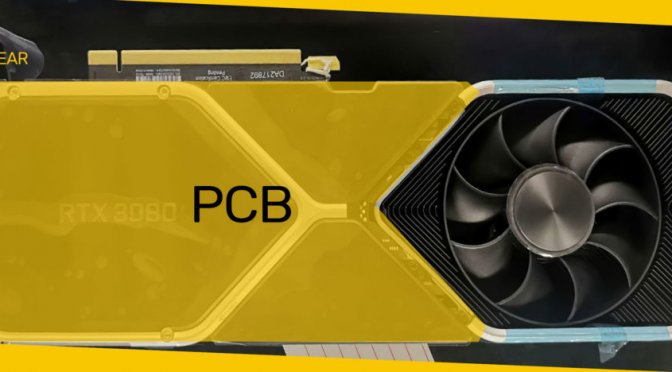
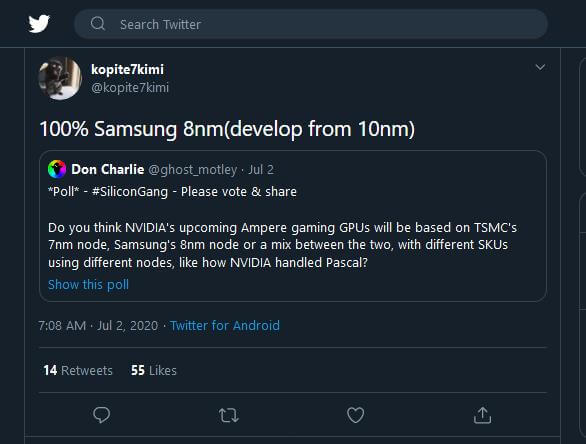
According to kopite7kimi, a source with a very high accurate record with rumors in the past, Nvidia’s upcoming Ampere RTX 3000 series cards will be manufactured on Samsung’s 8nm process, and not TSMC’s 7nm node as previously rumored. While this won’t have any performance implications this far down the line, it does mean that AMD will still retain the process leadership for another generation though.
Samsung’s 8nm node is a highly optimized derivative of the 10nm process node used to fab chips like the Samsung Galaxy S8’s Exynos 8895 SoC. Though, in relation to the 10nm process, transistor density hasn’t been increased substantially.
Like mentioned above, the 8LPP silicon fabrication node by Samsung is an extension of the company’s current 10LPP (10 nm) node. Both have almost the same fin pitch, but reductions are being made in the areas of gate pitch (which is down by 6%), thus resulting in a transistor density of over 61 million/mm². Apparently nvidia’s entire high-end product lineup, including the GA102 silicon that powers at least three flagship consumer cards are expected to be based on Samsung’s 8LPP node.
Despite Nvidia being a generation behind on the fab process node, the green team has still delivered superior graphics performance in the past. The 12nm Turing GeForce RTX 2080 Ti is currently the fastest consumer GPU on the market by some margin.
However, the decision to leverage Samsung’s 8nm process could explain the past rumors of an extremely high Ampere power draw of the ga102 silicon with TDPs in excess of 300W, which makes more sense now. Nvidia will have to increase power consumption to feed these new upcoming chips.
If they’re indeed being built on Samsung’s 8nm process node, then the Ampere parts will likely be less efficient than AMD’s next-gen 7nm RDNA2 graphics cards. However, we don’t know much about the 7nm rdna2 architecture and also Big Navi yet, so we simply don’t have enough reference points to make any sort of categorical statements or comparisons.
Lastly, and since this is an unconfirmed leak, take it with a grain of salt.
Hello, my name is NICK Richardson. I’m an avid PC and tech fan since the good old days of RIVA TNT2, and 3DFX interactive “Voodoo” gaming cards. I love playing mostly First-person shooters, and I’m a die-hard fan of this FPS genre, since the good ‘old Doom and Wolfenstein days.
MUSIC has always been my passion/roots, but I started gaming “casually” when I was young on Nvidia’s GeForce3 series of cards. I’m by no means an avid or a hardcore gamer though, but I just love stuff related to the PC, Games, and technology in general. I’ve been involved with many indie Metal bands worldwide, and have helped them promote their albums in record labels. I’m a very broad-minded down to earth guy. MUSIC is my inner expression, and soul.
Contact: Email

Nvidia has already proven process node is not as important as some people think.
NVidia isn’t intel. They don’t just chillax for 10 years inventing zero new technology because the competition doesn’t exist. So at 8nm their GPUs will still be way more powerful than anything from AMD at 7nm. I mean AMD is still struggling to achieve the level of performance of 2016’s 1080Ti and it’s 2020.
Exactly, nVidia Allways innovate. AMD Allways trying catch up and copy. And Allways do a hell of a bad job. AMD is totay trash and never learn to make even drivers. Long time since I went AMD, and never belive I will touch their POS again 😀
But surely some competition would do good for us all. So heres hoping RDNA 2, doesent suck as much!
Need that HDMI 2.1 Ampere for my new LG C9. Hurry up nVidia. Cant frikking wait 😀
Nvidia will still retain the FLAGSHIP GPU crown in the high-end at least
not just that. they will retain the most sales on every segment from high end to low end.
I can’t disagree on this point, but it sucks to know and predict that AMD can never match or outpace intel’s high-end offerings.
They will dominate the mainstream budget market though.
This would certainly explain the rumored TDP. Power hungry chips to be sure.
Knowing Samsung, they’ll hinder the card and consumers will have to jailbreak a video card to it’s full potential.
What do you mean by that ?
just because nvidia use 8nm process then they will be less efficient than AMD that use 7nm process. pascal is built on 16nm and polris/vega is on 14nm node. which architecture is more power efficient? and i do remember back then some people said AMD will beat nvidia to the pulp when it comes to efficiency because they were using 14nm process instead of 16nm.
Regardless of the process node, I think Nvidia will still retain the FLAGSHIP GPU crown in the high-end at least. Can’t comment about mainstream budget entries, unless AMD beats Nvidia in price/perf ratio with Navi 2.
In other news someone from Persona 4 Golden dev team dropped a Hot Fix patch with Denuvo Free .exe
D-Free .exe – 7mb
Malware D .exe – 124mb
LMAO
lol
Denuvo .exe being 117 bigger, i see no problem !
what’s LPP node btw ?
low power
Just a different process node based on the silicon and power parameters. Each fabrication process is different.
Samsung usually goes by their enhanced nodes such as: “14/10 LPE/LPP/LPU” which means “Low-power early” (first gen), “low-power plus”, and “low-power ultimate”. Similar to Intel’s 14nm, 14nm+, and 14nm++.
https://fuse.wikichip.org/news/567/iedm-2017-intel-details-22ffl-a-relaxed-14nm-process-for-foundry-customers-targets-mobile-and-rf-apps/
On other hand, Intel’s 22FFL = 22 nm FinFET Low Power.
TSMC uses this nomenclature: G, LP, HP, HPM, HPC, SOC, FF, FFC, general purpose (G), low-power (LP), high-performance (HP), high-performance mobile (HPM), high-performance compact (HPC),
For context, FF = FinFET, FFC = FinFET compact. The ‘C’ in various TSMC processes stands for ‘Compact’.
https://community.cadence.com/cadence_blogs_8/b/ii/posts/tsmc-symposium-new-16ffc-and-28hpc-processes-target-mainstream-designers-and-internet-of-things-iot
Breakdown, but list is not exhaustive.:
Samsung : LPS, LPP, LPH, FDS
TSMC : G, LP, HP, HPM, HPC, SOC, FF, FFC
INTEL : FFL
GloFo : FDX, LP
Thanks metal. That was helpful, awesome ! noted it down to lol
only for 1499
But will it really make any huge perf difference even if nv goes for the 7nm node ? I mean, they are going to beat AMD regardless of tech imo…
I’ve been seeing this trend from this so many years, so that’s why I’m not optimistic about AMD’s navi cards. Though, I would be more than happy if they prove me wrong.
AMD—-I’m counting to you.
Hopefully this means they won’t up the prices again.
They will, even the low end of spectrum. Its just how corporations work nowadays. For them, it’s either absolute consumerism or bust their a*s out of investors sight… Frankly, who cares, the last few years were total crapshow with how little the game industry has paced forward. Same rehashed stuff + bam lootboxes. Imo, too much focus on graphical fidelity instead of animations, AI and other holes ridden stuff.
To be fair even the graphics has NOT had a considerable jump from 2013 to 2020.
The question for me is how this will impact the overall performance of the chip itself, hence the upcoming 3800. Will the shift to 8nm from 7nm be that significant.