
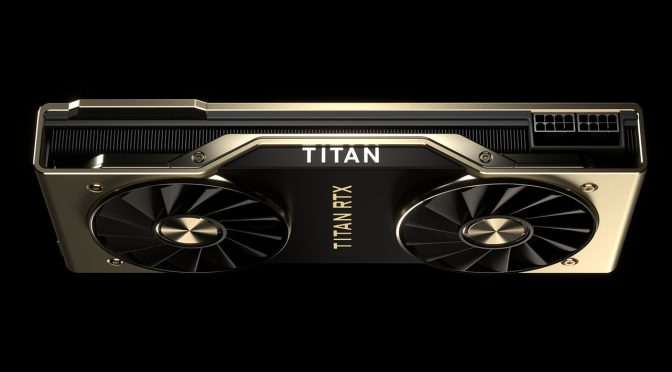
NVIDIA Titan RTX is 2.6X faster than the Titan V in 3D Mark Port Royal, RTX 2060 as fast as Titan V

A lot of gamers were shocked when they found out that the Titan V was able to run the RTX effects in Battlefield 5. As we’ve already said, the RT cores are meant to improve overall performance and while this was the case in DICE’s shooter, it’s more evident in Futuremark’s latest real-time ray tracing benchmark, 3D Mark Port Royal.

OC3D Forum’s member Kaapstad has shared two results; one with the NVIDIA Titan V and the other with the Titan RTX. The NVIDIA Titan RTX was 2.6X faster than the Titan V due to the RT cores that the former features.

What’s also really interesting here is that the NVIDIA Titan V offered similar levels of ray tracing performance to an RTX 2060; a GPU that only costs $350 (meaning that it is almost 10X less expensive) than the Titan V GPU.

These results should give you an idea of the performance boost that NVIDIA’s RT cores bring to the table. As we’ve said in our Battlefield 5 article, the RT cores are not a gimmick. 3D Mark Port Royal uses extensively real-time ray tracing and it’s incredible witnessing a $350 GPU matching the performance of a $3000+ GPU.

Kudos to our reader Metal Messiah for bringing this to our attention!

17 thoughts on “NVIDIA Titan RTX is 2.6X faster than the Titan V in 3D Mark Port Royal, RTX 2060 as fast as Titan V”

    1. I think most users of this site know that Port Royal is a raytracing benchmark, but you’re right that it’s always better to be clear.

  1. ” it’s incredible witnessing a $350 GPU matching the performance of a $3000+ GPU.”

    You guys go on about the titan v, but how much more powerful is that from the original titan?

  2. Just don’t tell that to retailers because they will sell us the 2060 at 3000€ just looking at what they are doing lately.

    1. i don’t know why he’s not doing a youtube channel, i don’t know if he’s shy or he has accent or whatever but he’s so wrong about not doing youtube.

  3. How about mentioning Ray Tracing performance in the title for the less aware. I know you are trying to get clicks but we expect better from you John.

  4. But Titan V was never designed for gaming to begin with. It was designed to be a poor man’s card for researchers and scientists who couldn’t afford strictly professional cards.

    How well would the RTX 2060 perform against the Titan V for researchers and scientists?

    1. the only thing that makes titan v special against those RTX were it’s FP64 capabilities. if it’s about AI to my knowledge there is no handicap on those RTX.

      1. When I start wandering off into professional cards or semi-professional cards I admit I don’t know a lot about it but I think there is more to the Titan V than just the FP64 performance which is clearly there as you said:

        RTX 2060 201 GFLOPS
        Titan RTX 509 GFLOPS
        Titan V 7,450 GFLOPS

        There is also the raw potential to do more:

        RTX 2060 $350
        Turing Architecture
        1,920 CUDA cores
        240 Tensor Cores

        Titan RTX $2,500
        Turing Architecture
        4608 CUDA Cores
        576 Tensor Cores

        Titan V $3,000
        Volta Architecture
        5,120 CUDA Cores
        640 Tensor Cores
        and HBM2 memory

        I get it that the article was mostly aiming at validating the RT cores as being more than a gimmick, which I agree with. I just don’t see any reason to compare the Titan V to any RTX card price wise. The Titan V has been dragged into the gaming sphere from the beginning and it was never intended by Nvidia to be for gaming any more than a $10,000 Tesla card is intended for gaming. That’s why the Titan V has never been listed on the GeForce site.

        1. in the past the geforce counterpart usually got crippled in capabilities for market segmentation purpose. take the original titan vs GTX780. both are based on the same chip but GTX780 FP64 performance is being capped. the difference between volta and turing is volta have FP64 while turing lack one but have RT cores. apart from that shader config (like the capability to run both FP and INT operation) and tensor cores are just the same between the two. there were independent test showing that the tensor cores inside those geforce RTX are not being limited in anyway to favor more professional card. hence if your only concern is only about AI then even the geforce variant might be sufficient for your need. the only caveat is you can’t ask for professional support from nvidia like one comes with tesla and quadro.

          1. I remember when the Kepler Titan was released and I remember thinking who the heck is going to pay $1,000 for a gaming card but after a little research it was clear what Nvidia was doing. They were releasing a relatively cheap working card for people who needed one but couldn’t afford the professional cards. It turned out to be a smart move on their part and the Titan “sold like hotcakes” according to Jensen Huang.

            The only buyers remorse came from those that bought the card strictly for gaming when the 780 Ti released 9 months later with 7% more shaders and was about 10% faster than the Titan in games for $300 less than the Titan and could be overclocked more than the Titan with the superior non-reference coolers on the 780 Ti.

            FP64 on the 3 cards for comparison

            GTX 780 173 GFLOPS
            GTX 780 Ti 222 GFLOPS
            Titan 1,570 GFLOPS

Leave a Reply

Your email address will not be published. Required fields are marked *