
Valve feature

Valve and five other PC game publishers have been fined $9.4M for illegal geo-blocking practices

According to a recent report, the European Commission has fined Valve and five other major game publishers a combined of €7.8 million ($9.4 million) for breaching EU antitrust rules.

The fines have been levied against Valve, Bandai Namco, Capcom, Focus Home, Koch Media, and ZeniMax. All five publishers and Valve were found to have being engaged in “geo-blocking practices” by restricting cross-border sales of certain PC titles based on where players were living within the European Economic Area (EEA).

The geo-blocking practices investigated since 2017 concerned around 100 PC video games of different genres, including sports, simulation and action games. As per the Commission’s report the companies geo-blocked around 100 PC games, preventing them from being activated and played outside certain EU countries. This broke the EU’s Digital Single Market rules.

The European Commission says the geo-blocking was to prevent games from being activated outside Czechia, Poland, Hungary, Romania, Slovakia, Estonia, Latvia and Lithuania.

“Valve and the publishers restricted cross-border sales of certain PC video games on the basis of the geographical location of users within the European Economic Area (‘EEA’), entering into the so called ‘geo-blocking’ practices,” the European Commission said.

Margrethe Vestager, executive vice-president in charge of policy explains:

“Today’s sanctions against the “geo-blocking” practices of Valve and five PC video game publishers serve as a reminder that under EU competition law, companies are prohibited from contractually restricting cross-border sales. Such practices deprive European consumers of the benefits of the EU Digital Single Market and of the opportunity to shop around for the most suitable offer in the EU.”

Simply put, the commission claims the six companies deprived PC gamers of the benefits of the EU Digital Single Market and the opportunity to shop around for the best deals in the EU.

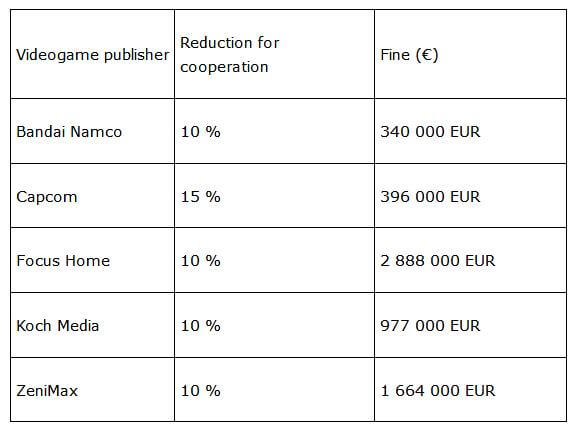
In addition to Valve, who have been fined just over €1.6M, Focus Home was fined almost €2.9 million (around $ 3.5 million), ZeniMax over €1.6 million (around $2 million), Koch Media almost €1 million (around $1.2 million), Capcom €396,000 (around $480,000), and Bandai Namco €340,000 (around $410,000).

The European Commission has now reduced the fines on the five violating publishers because the companies have now decided to cooperate, however, Valve chose to not cooperate with the European Commission (and thus has been fined €1.624 million as per the rules).

The breakdown of the fines imposed on the publishers is as follows:
European Commision fine for Valve and other publishers-1

Executive Vice-President Margrethe Vestager, in charge of competition policy, said:

“More than 50% of all Europeans play video games. The videogame industry in Europe is thriving and it is now worth over € 17 billion. Today’s sanctions against the “geo-blocking” practices of Valve and five PC video game publishers serve as a reminder that under EU competition law, companies are prohibited from contractually restricting cross-border sales.

Such practices deprive European consumers of the benefits of the EU Digital Single Market and of the opportunity to shop around for the most suitable offer in the EU”.

The European Commission continues on to explain:

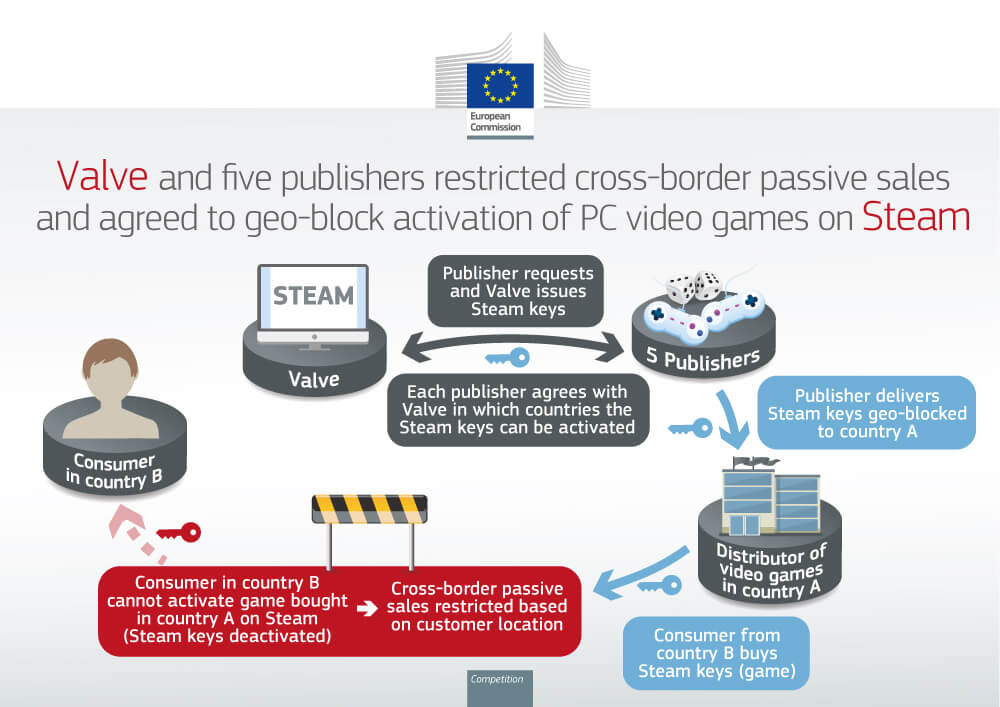
“Bilateral agreements and/or concerted practices between Valve and each of the five PC video game publisher implemented by means of geo-blocked Steam activation keys which prevented the activation of certain of these publishers’ PC video games outside Czechia, Poland, Hungary, Romania, Slovakia, Estonia, Latvia and Lithuania, in response to unsolicited consumer requests (so-called “passive sales”).

These lasted between one and five years and were implemented, depending on the cases, between September 2010 and October 2015.

 Geo-blocking practices in the form of licensing and distribution agreements concluded bilaterally between four out of the five PC video game publishers (i.e. Bandai, Focus Home, Koch Media and ZeniMax) and some of their respective PC video games distributors in the EEA (other than Valve), containing clauses which restricted cross-border (passive) sales of the affected PC video games within the EEA, including the above-mentioned Central and Eastern European countries.

These lasted generally longer, i.e. between three and 11 years and were implemented, depending on each bilateral relationship, between March 2007 and November 2018.”
European Commision fine for Valve and other publishers-2

This may not be the end of the action for damages, as the Commission outlined, “any person or company affected by anti-competitive behaviour as described in this case may bring the matter before the courts of the Member States and seek damages.”

These fines might initially appear small, but it’s a step in the right direction to curtail these companies’ anti-consumer actions.

Basically, for example some countries like Romania usually see a reduced price for a PC game, which means that interested users from France could then save money by purchasing a key from a Romanian outlet instead, and simply activate it on Steam afterwards.

Stay tuned for more!

46 thoughts on “Valve and five other PC game publishers have been fined $9.4M for illegal geo-blocking practices”

  1. The Region lock is a shady part of the industry that haunted millions of gamers for years. Korean gamers can’t play Homefront series, and the Western gamers can’t play Super Robot series. The list goes on and on. It is one of the most frequent reason why legit customers forced into look for piracy because legally they cannot purchase or play certain titles. I understand regional prices, and why publishers don’t approve key-resellers, but sooner or later this whole concept of region lock must be abolished in this digital age. This is 21st century, let customers purchase games they want, without being barred by picky political reasons.

    1. “Korean gamers can’t play Homefront series”

      Hmm, why should they play a game where they kill their fellow Koreans, even slandering them as murderous genociders?

      1. I can think of very few people in South Korea who hold much love for North Korea. I can think of a helluva lot of them who probably wouldn’t appreciate you confusing the two, likely from both countries.

          1. I know what you mean, but by all intents and purposes they already hijacked the western system and morals.

  2. I’m perfectly fine with that, I find it a disgrace that certain countries get digital software for less than others, why the hell should I pay 50% more for a game? it’s the same code.

    1. Because of economics ? If i was to buy games according to their “value” in dollar each game would cost like 1/3 of the minimun monthly wage of my country, how can i ever justify buying games at that price, and people wonder why piracy is still around…

        1. Yeah sure, I guess they should stop having any kind of fun and die working in factory or as a farm slave. We all know that’s how west got rich, nobody did anything for fun until they got rich . Pubs, bars ,radio, movies, baseball, football etc. were always for rich. What a moron!

          1. You can still have fun without money. Gaming costs a lot of money, so you should not waste money on it.

      1. I understand that, but you fail to grasp my point. if games were the same price across all regions, the lost sales would force publishers to reduce prices, instead, my first world country gets abused by your third world prices for the same exact code. do you not see how that is a stupid way to do business?

        it’s the entire reason why sites like G2A / cdkeys exist, and in turn Valve and other online shops try to counteract them with geo blocking, but if the EU insists that such a thing is illegal, so should different regions paying different prices.

        1. my god you are an idiot. The taxes you pay in your first world country are higher than in third world countries. Everything will be cheaper without taxes. The amount of money a retailer makes from each copy sold in a first world country are more than a third world country because the living costs are higher, apply this logic to the entire game and now you know why prices different. Do you think a sandwhich costs the same in a first world country and in a third world country? Who is making that sandwhich and why are they paid differently?

          1. I still feel like you aren’t quite grasping what I’m saying, so let me try to explain this again. games, especially AAA titles… are wildly overpriced as is, if in the short term countries like RO have to pay more for publishers to get it through their heads that people are unwilling to pay 100$ for a game with never-ending DLC then so be it. that was my point, that’s it. also fckin Lol at your sandwich analogy which is totally outside of the scope of this.

          2. n64 games costed up to 80bucks.

            Now take into account theinflation do you tihnk it has gotten cheaper or make games?

    2. Not sure how it works with different countries in the EU, but purchasing power has to be taken into account. Here in India 60 dollars is too much money and makes games unattainable for a lot of people, so some companies do regional pricing to fix that. But yeah, most companies don’t, which is why buying games has become hard, especially if you’re just gonna be playing single player in, say, Call of Duty.

    3. I find it a disgrace that certain countries pay less for the the same jobs, why the hell should people get 5-10 times less for a job? It’s the same qualification / responsibility / lvl of danger etc.

      1. My country, Portugal is a total shame for me,I’m absolutely ashamed of being Portuguese,corruption at extreme,on a country thar should be wealthy,but its not because of c*nt idiots,who rather have they’r own population in misery,and our c*nt president ”
        Marcelo”is a corrupt idiot!

  3. oh noes companies whose games cost 50 million to make each were fined for a a few hundred bucks when they made billions out of all of those hundreds of games sold…how will they ever recover.

    on a related note Ross the guy who did freeman’s mind and the game dungeon bought nfs 2015 in poland where he was at the time and that version is only in polish and nothing can be done to change it.

    1. “how will they ever recover.”

      It’s not supposed to bankrupt them Trumptard, meanwhile when’s the last time they got fined for antitrust violations in america?

      “bought nfs 2015 in poland where he was at the time and that version is only in polish and nothing can be done to change it.”

      Lmao buyer’s posting their L’s online.

      1. Actually for what its worth, I think Valve should defo redesign their regional pricing policy. They do now, but only for bigger markets (eg.Russia) and that is somewhat discriminative. Of course if we understood they are private business and technically can behave market-conscious.

  4. Except that some (if not all) of those countries, like Romania and Hungary, while having much smaller average salaries, still have to pay the same prices as any western country, where average salaries are much higher (as in 60 EUR on new games).
    For example, Romania and Hungary have a similar economy to Ukraine, but Ukrainians pays 50% of less for their games, including new titles.
    This is hypocritical as it defeats regional pricing. Publishers including Valve refuse to create regional prices for Eastern Europe (and many other regions in the world actually). They like to believe that all countries from the EU have the same GDP.

  5. ” some countries like Romania usually see a reduced price for a PC game”

    That is wrong. I have lived in Romania my whole life and I’ve been buying games from Steam for almost a decade now. And I don’t remember ever seeing a reduction in game prices(outside of the usual sales). We still have to pay 60 euros for a newly released AAA game. The same applies to large online stores like eMAG which sell the games at the same prices, they just convert it into the local currently.

  6. This is imo really a mixed bag – On one side low salary country workers should not have to spend several day’s working just to get a single game but on the other it’s not fair someone should spend 5x to 10x more in another

    Suspect we will most likely see prices raised in the low salary country’s and that will most likely end up with more piracy, cant think of many who see several work days for a game as anything other than a rip off

  7. whats the issue? not all countries can afforad expencive games , like albania where slaries are miserable poor…

Leave a Reply

Your email address will not be published. Required fields are marked *