
Back in October, Intel officially revealed its upcoming 11th Gen Rocket Lake-S desktop CPU lineup, based on the Cypress Cove core architecture. Rocket Lake (RKL) is a planned microarchitecture designed by Intel as a direct successor to the 10th gen Comet Lake-S series of desktop CPUs and high-performance mobile devices.
RKL processor family will release in the first quarter of 2021, and is expected to share the same socket and motherboard compatibility as the current 10th Gen Comet Lake processors, thus providing an upgrade path even for those rocking the flagship Core i9-10900K Comet lake CPU.
Rocket Lake-S desktop platform should hopefully be the last CPU architecture to be based on an advanced 14nm process node. The new Rocket Lake-S silicon or SoC is going to be known as ‘Cypress Cove’. Rocket Lake-S will offer PCIe Gen 4.0 support, enhanced overclocking and double-digit percentage IPC benefits over Comet Lake-S lineup.
Intel’s Rocket Lake will use a 14nm back-port of the 10nm Sunny Cove cores found in the Ice Lake processors. With Rocket Lake processors, Intel is targeting a raw instruction-per-clock uplift in the double digit range.
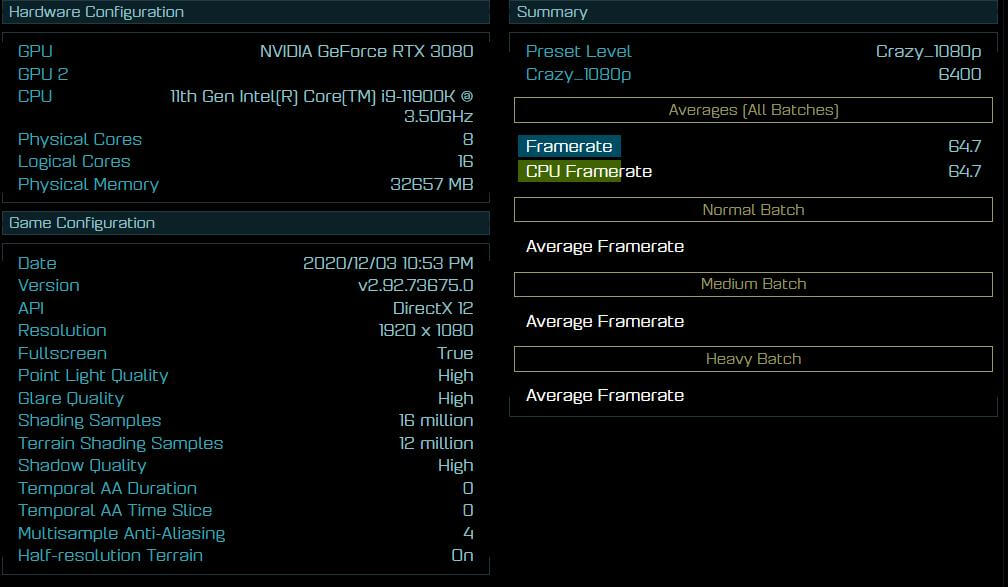
Now an alleged CPU entry has been spotted within the Ashes of The Singularity benchmark database, by TUM_APISAK, which appears to be for Intel’s flagship Rocket Lake-S desktop CPU, the Core i9-11900K. This chip could also be an early Engineering sample/ES, so final clock speeds may vary.
11th Gen Intel(R) Core(TM) i9-11900K @ 3.50GHzhttps://t.co/y62LKl3x8phttps://t.co/JJH1JTDXaZ pic.twitter.com/k4wxeKVJB1
— APISAK (@TUM_APISAK) December 4, 2020
The Intel Core i9-11900K CPU features 8 cores and 16 threads, and a 3.50 GHz base clock speed value. The entry has appeared recently which means that Intel’s partners might be already testing the CPU sample. This CPU also sports 16 MB of L3 cache, and 4 MB of L2 cache.
Below are the respective 1080p, and 1440p scores. The Intel Core i9-11900K CPU scored 62.7 FPS in the 1440p test, and 64.7 FPS on 1080p. Both tests were run on the Crazy preset which is the highest quality you can set in this “Ashes of The Singularity” benchmark.
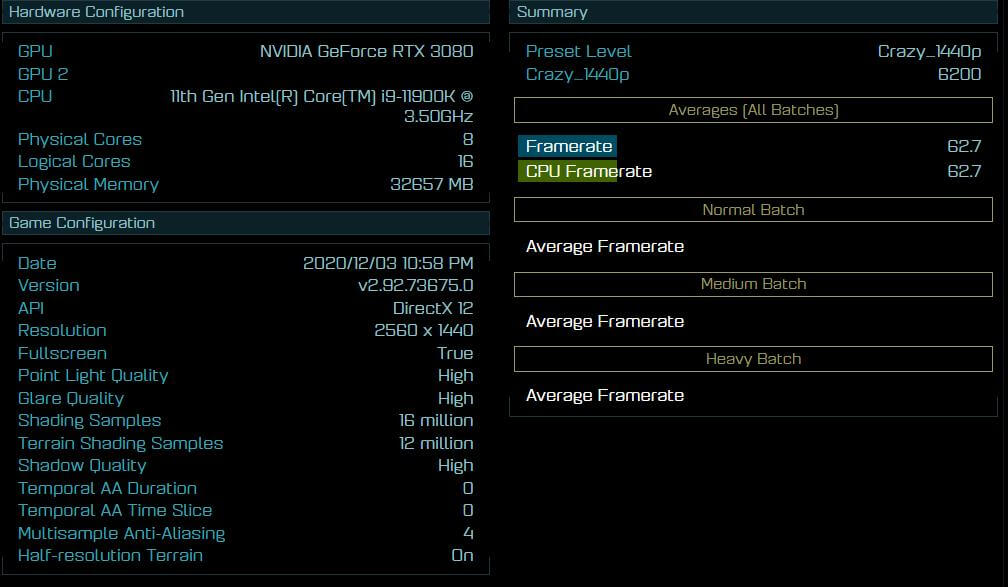
Interestingly, one Twitter user immediately responded to the findings posted by TUM_APISAK, and shared results of his Ryzen 9 5950X CPU which scored 71.9 FPS at 1080p with the Crazy preset.
From his benchmark score, it appears that the AMD Ryzen 9 5950X is around 10-11% faster than the Core i9-11900K in this particular benchmark. The AMD processor scored 7100 points, but does feature a higher number of cores and threads 16/32 vs 8/16 found on this recent Intel RKL CPU sample entry.
5950X faster still pic.twitter.com/k7zYfyBr1O
— Magic (@___iMagic) December 4, 2020
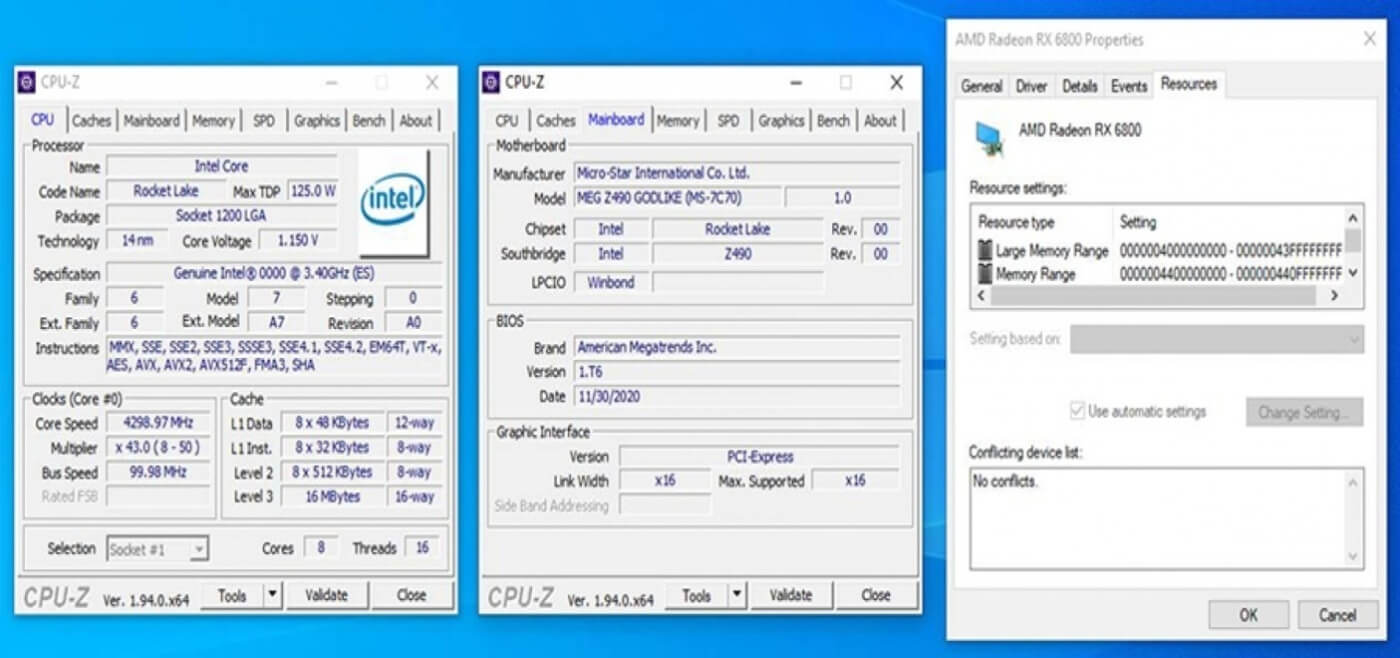
On some other Rocket Lake CPU leak, MSI manufacturer has inadvertently revealed an 8-core/16-thread Intel Rocket Lake-S entry as evident from the CPU-Z specification screenshot shared in a recent press release.
The leaked CPU-Z screenshot confirms that this particular sample features 8-cores and 16-threads, and is clocked at 3.4 GHz base/4.3 GHz boost. But since the maximum multiplier is 50, the turbo clock can also boost up to 5.0 GHz.
The CPU-Z screenshot also reveals that the Rocket Lake-S engineering sample supports AVX512F and SHA instructions, which the current 10th gen Comet Lake-S core series lack. The screenshot also confirms that this 8 core Rocket Lake-S CPU has a max TDP of 125W. MSI has pulled back and taken down the press release from their website though.
AVX512F, TDP 125W etc… 👍 pic.twitter.com/RTg3iYQcGM
— 포시포시 (@harukaze5719) December 4, 2020
According to Intel, Rocket Lake-S will have a PL1 state value of 125 W and a PL2 of 250 W. Intel has also bumped the memory clock speeds up to DDR4-3200, an increase over the current DDR4-2933 speed supported on Comet Lake processors.
RKL lineup will also feature enhanced Intel UHD graphics that will use the company’s new Xe GPU architecture, which is projected to provide a 50 percent performance gain over Intel’s Gen9 graphics used on ninth-generation Intel Core processors.
The RKL CPU lineup will max out at 8 cores/16 threads. This is all because of the backporting the large CPU cores originally designed for 10nm to the older legacy 14nm node, which means two cores and four threads less than the current Comet Lake CPU lineup.
But the reduction in core count could also mean that Intel plans to rely on increased single-threaded performance, thus boosting overall system performance through single-threaded gains.
Single-threaded performance will help Intel to compete more in the CPU market segment, even if AMD can deliver higher core count SKUs. Not all applications or tasks are highly multi-threaded in nature, which makes the single-threaded performance all the more important.
Few months ago one VLSI engineer who goes by the name @Retired Engineer on Twitter, @chiakokhua, tweeted one of his old findings from November 2019 last year. According to him the upcoming Rocket Lake-S processors are going to feature ‘multi-chip modules/MCM’ of core and uncore GPU dies built on different silicon fabrication nodes.
Maybe I should talk about Intel stuff a bit more….. for balance.
Disclaimer: This is 1000% my own speculation, and almost certainly wrong. I post this in the hopes that @wccftechdotcom, @VideoCardz, or someone from ChipHell will either confirm or deny it. 🙃 pic.twitter.com/JaBRlsncNx
— RetiredEngineer® (@chiakokhua) November 12, 2019
This is speculation from his side, but he has a strong record of accurate prediction in the past, when he spoke about the 3rd gen Ryzen Matisse AM4 processors being multi-chip modules as well.
Apparently, it might be possible that Intel is also designing these socket LGA1200-based Rocket Lake processors to feature multi-chip modules, similar to Matisse in some way.
According to the block diagram posted by @chiakokhua, we can see that the Rocket Lake-S architecture is a multi-chip module/MCM consisting of a 14nm die that holds the ‘CPU cores’; and a 10 nm die that holds the ‘uncore’ components.
But in the case of Rocket Lake the uncore die is more advanced that the CPU die. The CPU die is fabbed on a 14 nm node on Rocket Lake-S, and a system agent, which are connected together by a Ring-bus interconnect. And the system agent connects to the 10nm uncore GPU die via EMIB.
The 10 nm GPU uncore die on the other hand features the Gen12 XE iGPU with up to 96 EUs, a dual-channel DDR4 memory controller, a PCI-Express 4.0 controller, as well as display and media engines. Rocket Lake-S MCM may provide a total of 20 or even 24 PCI-Express lanes, out of which 16 are assigned as PEG (PCI-Express Graphics), and 8 lanes are assigned as chipset bus.
You can see the Block diagram as posted below. This is not the first time Intel is taking the MCM approach. Clarkdale, first-gen desktop processor supporting the LGA1156 package was an MCM having a 32 nm CPU die, and a 45 nm uncore graphics and integrated memory controller die.
It remains to be seen whether Intel really chooses the MCM approach with the Rocket Lake- S lineup of desktop processors.
Stay tuned for more!

Hello, my name is NICK Richardson. I’m an avid PC and tech fan since the good old days of RIVA TNT2, and 3DFX interactive “Voodoo” gaming cards. I love playing mostly First-person shooters, and I’m a die-hard fan of this FPS genre, since the good ‘old Doom and Wolfenstein days.
MUSIC has always been my passion/roots, but I started gaming “casually” when I was young on Nvidia’s GeForce3 series of cards. I’m by no means an avid or a hardcore gamer though, but I just love stuff related to the PC, Games, and technology in general. I’ve been involved with many indie Metal bands worldwide, and have helped them promote their albums in record labels. I’m a very broad-minded down to earth guy. MUSIC is my inner expression, and soul.
Contact: Email