
Intel recently announced its Comet Lake-S series of processors for the Desktop in i9, i7, i5 and i3 flavors. It has come to our attention (via TechPowerUp) that some of the Intel Comet Lake Core i5 processors are not exactly the same as other SKUs, meaning the “silicon” beneath the heat spreader can be different based on the chip it is manufactured.
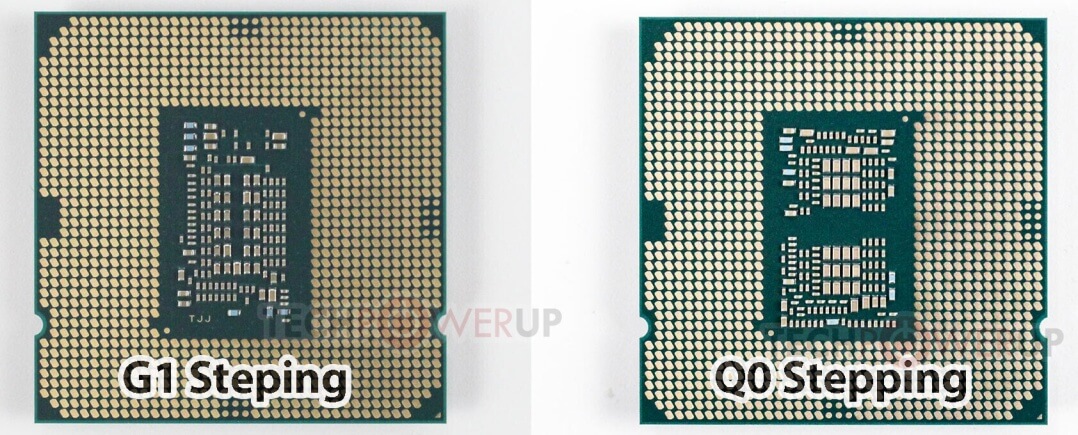
There are actually two “steppings” of the 10th generation Intel Core i5 desktop processors which are Q0 and G1. Some of the Core i5 SKUs are based on a different stepping, either Q0 or G1, which gives us a hint that these might be native six-core or a cut-down 10-core chip variants. The specs seems to be identical but there are physical differences.
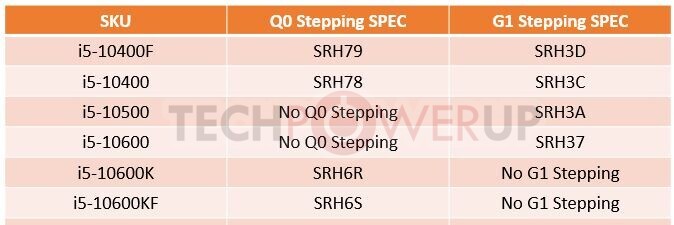
According to INTEL, “The Core i5-10400 and Core i5-10400F use two manufacturing processes,” and this particular info is posted over at Intel ARK within the “Ordering and Compliance” section for each chip. As an example. TechPowerUp has also detailed these two processors, which are Core i5 10400 and Core i5 10400F respectively.
Almost every detail is identical between the two steppings though, including the clock speed and pricing. Some reports are hinting that the thermal solution used on the Q0 stepping matches that of the flagship 10th Gen SKUs, i.e. thinner die and a soldered interface material, since it based on a 10-core chip with four cores disabled. The Q0 stepping of Core i5 seems to be based on the 10-core variant of the “Comet Lake-S” silicon.
The G1 stepping, on the other hand, seems to be based on a native six-core chip, a 6-core variant of “Comet Lake-S. This is using a “thermal paste”, instead of the new STIM solution. Nevertheless, this shouldn’t affect the performance of the G1 processor, since we are talking about non-K CPUs which can’t be overclocked.
If we take a look at the back of the Chip, we can clearly see that the Q0 stepping has two separated groups of “capacitors”, while G1 is more or less a single big block. These two even have different SPEC codes, as evident from the ARK. According to TechPowerUp, for the Core i5-10400F, the Q0 stepping variant’s SPEC code is “SRH79” and the G1 stepping variant’s code is “SRH3D.”
The SPEC code is also printed on the IHS though. Only the “non-K” Comet Lake SKUs have 2 steppings, but there shouldn’t be any performance difference between them, except for the “Thermals“, or heat output ! As a consumer, gamer, or end user you shouldn’t have to worry much about this change in the manufacturing process though.

Hello, my name is NICK Richardson. I’m an avid PC and tech fan since the good old days of RIVA TNT2, and 3DFX interactive “Voodoo” gaming cards. I love playing mostly First-person shooters, and I’m a die-hard fan of this FPS genre, since the good ‘old Doom and Wolfenstein days.
MUSIC has always been my passion/roots, but I started gaming “casually” when I was young on Nvidia’s GeForce3 series of cards. I’m by no means an avid or a hardcore gamer though, but I just love stuff related to the PC, Games, and technology in general. I’ve been involved with many indie Metal bands worldwide, and have helped them promote their albums in record labels. I’m a very broad-minded down to earth guy. MUSIC is my inner expression, and soul.
Contact: Email