
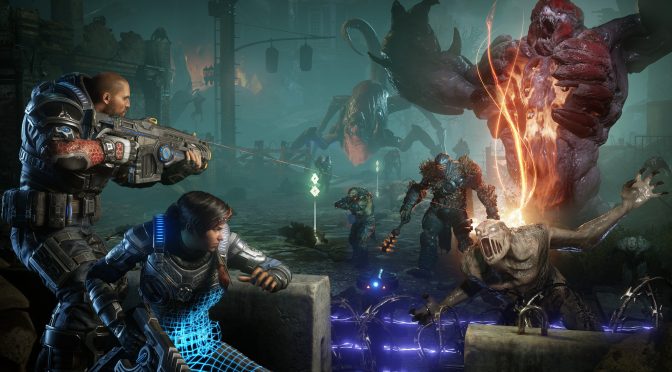
Gears 5 will support Asynchronous Compute and AMD FidelityFX Tech

Microsoft and The Coalition have shared some new PC tech details about Gears 5. According to the teams, the PC version will support Asynchronous Compute, Multithreaded Command Buffering, as well as AMD’s new tech, FidelityFX.

Going into more details, Asynchronous Compute will allow GPUs to execute multiple tasks at the same time. This GPU multi-threading capability enables efficient graphics and visual effects workload distribution, resulting in higher framerates.

On the other hand, Multithreaded Command Buffering ensures instructions from the CPU reach the graphics card faster. This will result in higher performance, better graphics and reduced latency.

Last but not least, The Coalition will add support for AMD’s FidelityFX via a post-launch update. This feature will offer a dynamic sharpening filter that draws out detail in low-contrast areas for a sharper gaming experience. FidelityFX aims to deliver improvement in image clarity, counteracting the softening caused by other post-process effects.

Gears 5 currently targets a September 10th release. The game will be using Unreal Engine 4, and will support both Windows 10 and Windows 7. From what we’ve seen so far, Gears 5 promises to be a really polished product on the PC, and we can’t wait to get our hands on it!

6 thoughts on “Gears 5 will support Asynchronous Compute and AMD FidelityFX Tech”

  1. I remember a lot of talk about Asynchronous Compute back in the GCN days. At the time it was a feature Nvidia chips didn’t have while AMD’s chips did. Is Gears 5 the first game to support to Asynchronous Compute cause I haven’t seen it mentioned in years?

    1. No, actually Ashes of the Singularity was the first game to use ASYNC Compute.

      The Nitrous Engine that powers Ashes of the Singularity makes extensive use of asynchronous compute and uses it for up to 30% of a given frame’s workload.

      Talking about hardware support for ASYNC in future games, AOTS’s developer has stated that they believe this will be a common approach in future games and game engines, since DirectX 12 encourages the use of multiple engines to execute commands from separate queues in parallel.

      By the way, A GPU that supports asynchronous compute can use multiple command queues and execute these queues simultaneously, rather than switching between graphics and compute workloads. AMD supports this functionality via its Asynchronous Compute Engines (ACE) and HWS blocks on Fiji.

      Asynchronous computing is, in a very real sense, GCN’s secret weapon.

      While every GCN-class GPU since the original HD 7970 can use it, AMD quadrupled the number of ACEs per GPU when it built Hawaii, then modified the design again with Fiji.

      Where the R9 290 and 290X use eight ACEs, Fiji has four ACEs and two HWS units. Each HWS can perform the work of two ACEs and they appear to be capable of additional (but as-yet unknown) work as well.

      On the other hand, Nvidia’s GTX 900 series and above GPUs do have the hardware capability to support asynchronous shading/computing.

      A question arises however if that can only be achieved through the heavy use of pre-emption and context switch, which in turn adds substantial latency and defeats the purpose of the feature which is to reduce latency / improve performance. AMD claims that this is indeed the case. Nvidia however has not yet provided with an answer to this question.

      https://uploads.disquscdn.com/images/8a356bdfc5a76d51400cb8f370051231c35354689142378b349fa290a08fdad0.png

      1. I sure hope it becomes the standard for most games, it’s amazing technology and I wonder why it’s been basically not really used that much since then. DirectX12 games are becoming far more common as time passes on.

  2. get that console-grade tech in there AMD , good for you

    RayTracing is next , only after next consoles comes AMD will have RayTracing but 1st for consoles

  3. wow. Asynchronous Compute. now that’s something i didn’t hear in a long time.

    remember when dx12 and Asynchronous Compute would be the new industrial revolution.
    what was of it?

Leave a Reply

Your email address will not be published. Required fields are marked *