
AMD Zen logo

AMD Ryzen 5 CPUs are now available and while slower, they offer a great performance/price ratio

It’s no secret that AMD’s Ryzen 7 CPUs were unable to compete – in gaming – with Intel’s top quad-core and six-core offers. Still, some indicated that AMD’s Ryzen 5 CPUs were the ones actually meant for gaming, that they would be – perhaps – faster than the Ryzen 7 CPUs. Well, AMD’s Ryzen 5 CPUs are currently available and according to third-party benchmarks, these CPUs are slower in gaming than both AMD’s Ryzen 7 and Intel’s CPUs.

First things first. AMD is offering four CPU models; Ryzen 5 1400, Ryzen 5 1500X, Ryzen 5 1600 and 1600X. The first two models feature 4 CPU cores and support 8 threads, while the latter two feature 6 CPU cores and support 12 threads.

The AMD Ryzen 5 CPUs are slower than Intel’s top quad-core offers, though some models (like the AMD Ryzen 5 1600X can sometimes top AMD’s lowered-tier Ryzen 7 CPUs).

What’s also interesting that in games that rely heavily on a single CPU core, AMD’s Ryzen 5 and Ryzen 7 CPUs perform similarly. As we’ve already said, one such game is Far Cry: Primal and as we can see below, Intel’s CPUs can easily top AMD’s CPUs.

The situation is similar in both Battlefield 1 and Mafia 3.
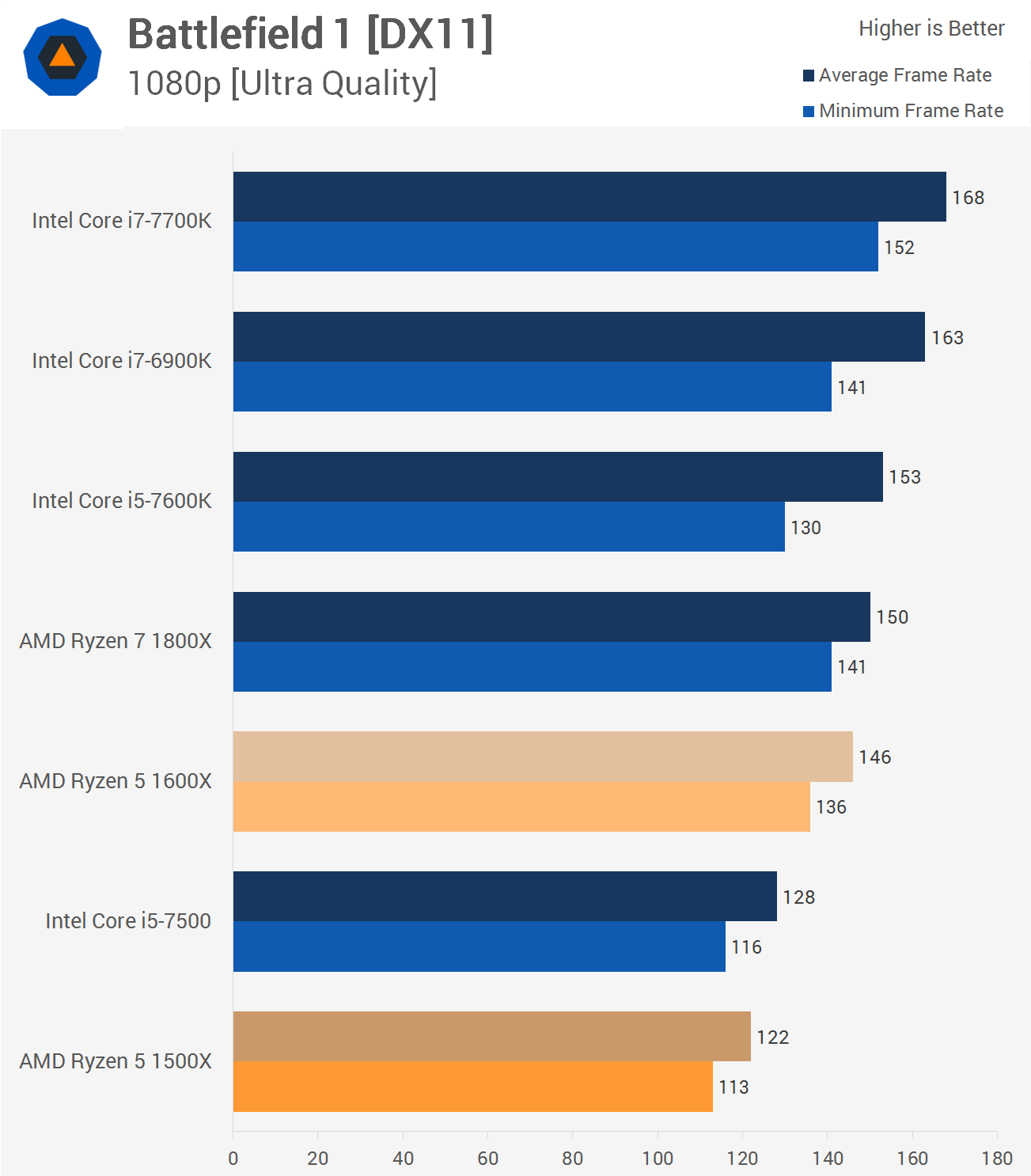
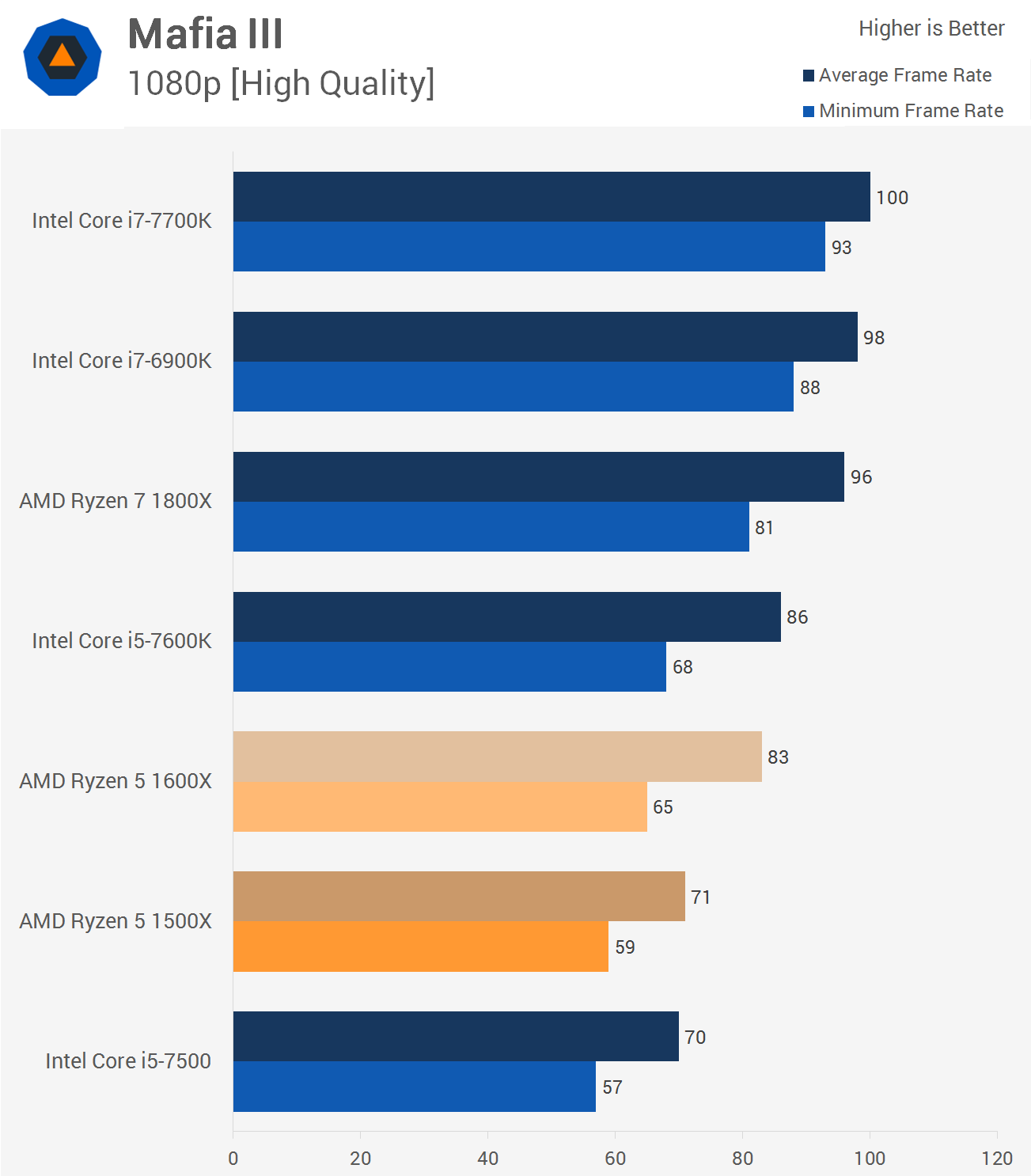
So yeah, the AMD Ryzen 5 CPUs do not impress with their overall gaming performance, especially for enthusiast gamers. However, AMD has really nailed its performance/price ratio.

The AMD Ryzen 5 1500X CPU in particular is a no brainer, though there are some games in which Intel’s counterpart, the i5 7600K is faster. Still, the i5 7600K does not support Hyper-Threading so in the long run, the AMD Ryzen 5 1500X will perform similar (or even better) in newer games that require more than three or four CPU threads.

Thanks Guru3D, Techspot and PCPer

45 thoughts on “AMD Ryzen 5 CPUs are now available and while slower, they offer a great performance/price ratio”

  1. Summary: If all you do is game on your PC, you would still be better off with a 7700k. However, if your computer doubles as your workhorse or perhaps you do other things like 3D Design or Video Editing, the R5’s a much smarter choice.

    At present, the reviews are now recommending the R5’s over the i5’s. The i7 still reigns supreme for gaming.

    1. the only difference between i5 and i7 is a hyperthreading which is nigh useless for gaming at best, down to making FPS worse. Intel just increased stock frequency of 7700k to make it at least somehow “different” from i5 for the general user – which if you buy a K CPU to begin with is pointless.

      Which brings us to the next bit.
      Apparently AMD CPUs have big trouble doing anything higher than 4 GHz when overclocked whereas recent Intel CPUs can go as high as 5 GHz leaving any AMD offering in the dust. At least when it comes to games.

      1. “hyperthreading which is nigh useless for gaming at best, down to making FPS worse”

        Another big one, keep it up guys

      2. it doesn’t matter much if it’s 4.8 or 5. Point here is that AMD architecture seems to be running at its limit, while Intel offers quite a big headroom (up to 20% performance increase). And being gamers there’s no point for us not to go for OC, especially since it’s so easy and safe to do nowadays.

        Granted AMD’s price/performance offering is quite good and while not beating Intel (gaming-performance-wise) – they will force Intel to drive prices down eventually and the next Intel’s CPUs will probably offer more than a marginal increase in performance.

        But one question remains… If it took AMD 8 years to finally be able to compete with Intel (not even reliably beating it) and Ryzen CPUs are already out of OC juice – what are the chances AMD will get stuck again like it did in and post Phenom II era?

    2. A 7700K offers the best game performance but it’s overpriced if all you do is play games. A 7600K costs over a third less, while performance is about a fifth worse, sometimes a fourth. Diminishing returns.

    3. i7 3770k and 6700k owner here, hate to burst your bubble, but 7700k will stay relevant for the “not too distant future” for quite some time.

      I can in fact overclock my 3770k to beat the stock performance of my 6700k easily.

      Remember when the AMD Bulldozer came out? All the hype and performance?

      Pepperidge Farm’s remembers..

      Intel’s current tick/tock cycle for improvements has become nothing more then just refining and improving the existing design. So far it has allowed them to stay ahead of AMD, especially when it comes to gaming performance. Intel has had little incentive to really innovate, instead they play it safe with yearly increments and improvements to a good platform.

      You can hate on it all you want, the point is 7700k will stay around for a while as evidenced by the maturity of the original platform and the fact you can still compare Intel chip-sets several years apart.

  2. autistic screeches incoming!

    but still i would like to see a review of 1600 and 1600X face to face to se if theres any worthwhile difference

  3. “It’s no secret that AMD’s Ryzen 7 CPUs were unable to compete – in gaming – with Intel’s top quad-core and six-core offers”

    Obviously amd cpus are weaker but they worth their price, unlike intel, also known as “we put high prices because we like our golden toilets and you stupid enough to pay all that money for a cpu”

    1. They are worth their price if you’re doing video editing / rendering / 3D art, whatnot. They are NOT worth their price for gaming.

      1. I think the 1600X is well worth the price for gaming (if game engines start using more threads) and general use though. For U$S 249 you get 6 cores and 12 threads and you lose 10~20 FPS in some games at 1080p, most of the times being well above 60 FPS.

        If you are on a monster SLI/CFX and need 120/144 FPS then yeah, you’ve to go Intel to get those framerates. But that’s a tiny minority, you’ll be bottlenecked by your video card mostly.

        1. “if game engines start using more threads”

          Yeah, IF. And they won’t. I mean, they will use more threads for additional tasks but that only goes so far and it’s already been done in some engines, look at Crysis 3. Yet single core performance is still and always will be the bottleneck.

          1. Yes they will, in time. Crysis 3 is a four year old title man. The new consoles all feature 8 cores I believe, and developers and engines will start taking advantage of them in order to pull better graphics and framerate.

            I won’t go as far as some here saying that a 7700K with 4 cores and 8 threads won’t be relevant in the near future, but I’ll say that the higher core/thread count in a Ryzen processor will become increasingly relevant in the future.

          2. I’m not so optimistic. First of all both consoles reserve one core for their operating system so games have access to 7 cores, not 8. And then more importantly those cores are laptop tier garbage. You can run on one PC core what it takes a console several. Console development may continue to lead the way (already was the case with the PS3) in forcing devs to work with multiple cores but I doubt much of it will make its way to PC soon. Console ports will perform great on PC, no doubt, unlike last gen. But because of the extreme limitations these consoles suffer the tech won’t actually do anything exciting, just like Xbox 360 ports didn’t do anything exciting post 2006. The power just isn’t there. New tech whether it be graphics, phyics or AI will always be pioneered on PC.

      2. It’s not worth $220 for a 6C/12T CPU in the 1600? News to me, as it’s pretty damn neck and neck with i5’s in most benchmarks, with room to grow as the platform matures and games are better optimized for the architecture.

        1. Even then you won’t need 6/12. “Optimized for the architecture” will mean more utilization of each core, not of 6 cores. The main game thread will always be the bottleneck. Gamedevs aren’t going to magically figure out true multicore gaming just because AMD once again launched CPUs with more cores than any game needs. If that were how it works games would already be optimized for 6 cores, for many years by now. So no, unless you do video editing etc. you wasted some money getting a 6 core when you will only ever use 8 threads in games with this system. 5 years from now games will still be limited by their main thread. Having more additional cores of the same performance level won’t help.

          1. “Gamedevs aren’t going to magically figure out true multicore gaming just because AMD once again launched CPUs with more cores than any game needs. If that were how it works games would already be optimized for 6 cores, for many years by now.”

            You’re high if you don’t think games will be taking advantage of higher core/thread counts in 3-5 years. Just a couple of years ago, people would call you crazy if you’d said i7’s had an advantage in gaming; now it’s common knowledge they do. Comparing today’s situation to the past is a false equivalency. Game devs have been building game engines from the ground up for DX12 and Vulkan for the last couple of years, and we’ll see those games come to fruition over the next couple of years. And before you say DX12 is crap, that’s because all we have seen it in are engines build around DX11 with DX12 shoehorned into them (except for AotS). Even in existing DX11 engines, a 1600(X) is damn near neck and neck with a 7600k when both are OC’d.

            Since we were talking about 1600 vs 7600k in another thread, I’ll just respond here for simplicity.

            “Right now it still gets beaten by a 7600K in games so how is that a good deal? I wouldn’t buy hardware for hypothetical alleged future performance with a bunch of big IFs attached. If the performance is only going to be there in the future then why buy now? Prices are only going to drop.”

            I’d argue for the 1600 because it’s less expensive than the 7600k at most retailers, not to mention a B350 MOBO is much less than a Z170 (both necessary for overclocking). Take another look at the above benchmarks: is anyone really going to notice 150 vs 146 fps, or 86 vs 83? The only exception to this is Far Cry Primal, which heavily relies on high IPC (even more so than most other titles). Even with that, I can point to Gamer’s Nexus’ benchmark for Metro: Last Light and show that the i5’s stutter massively due to their low core/thread count, so they trade blows on a game by game basis.

            TL;DR is the performance is basically the same today, the 1600 is slightly cheaper but slightly slower in most cases, but it’s got a helluva lot more room to grow as games become more multithreaded (and you’re lying to yourself if you don’t think that’s the direction we’re headed).

          2. >You’re high if you don’t think games will be taking advantage of higher core/thread counts in 3-5 years.

            They will, nobody is denying that trend, but the fundamental paradigm, that single core performance trumps all else in games, will remain.

            >Just a couple of years ago, people would call you crazy if you’d said i7’s had an advantage in gaming; now it’s common knowledge they do.

            False equivalence. An i7 with HT off (aka a 4 core, 4 thread CPU) still beats an i5. It’s not about the threads, it’s about the i7 being the pinnacle of performance in every arena. Btw, I’m not one of those people, I bought an i7 for gaming in 2010 and I’m using it to post this right now.

            >it’s got a helluva lot more room to grow as games become more multithreaded

            People said the same thing about the FX 6300, yet that CPU is not going anywhere. I’m sure all Ryzen CPUs will AGE better than all current Intel CPUs, no doubt about that. But I remain skeptical towards assertions (not necessarily by you) that performance will get BETTER. The main thread of a given game just has to be executed in linear fashion, multicore will never help with that.

            Regardless, even IF Ryzen CPUs start overtaking the 7600K in 2018’s games, hypothetically, then it’s still a bad deal to pay the current price. Why buy it now when you only really get to use it in 2018 or later? There’s no reason to buy in right now. That’s my whole point.

          3. “People said the same thing about the FX 6300”

            Except that had noticeably worse performance than similarly priced Intel CPU’s at its release (for games at least), which is not the case here.

            “Why buy it now when you only really get to use it in 2018 or later?”

            I’m not sure what you mean by this. If I buy it today, I’m paying nearly the same price for nearly the same performance as the 7600k. Sure, there’s always an advantage to waiting for price drops, but plenty of people are in the market for a new CPU today. If you can’t or don’t want to wait, an R5 1600 is a better long term buy with virtually no short term drawback.

            You said in another thread “The market is dominated by these 4c/4t CPUs and the next step after that is 4c/8t, not straight to 6/12. 6/12 is an anomaly for now, future tech no game dev has reason to optimize for. It’s simply not worth it optimizing your game for 12 threads when half your users are only running 4 and another third is running 8 threads.”

            You do realize 45% of the market is still on dual core? Does that mean games don’t utilize more than 2 cores, or don’t have worse performance on them?

          4. >Except that had noticeably worse performance than similarly priced Intel CPU’s at its release (for games at least), which is not the case here.

            The 1800X and 1700X flagships both perform worse than a 7700K while costing more. That’s exactly the same thing.

            >Sure, there’s always an advantage to waiting for price drops, but plenty of people are in the market for a new CPU today.

            Why? Did you previous CPU break? What’s forcing you to upgrade now when prices are high and no game takes advantage of your new CPU?

            >You do realize 45% of the market is still on dual core? Does that mean games don’t utilize more than 2 cores, or don’t have worse performance on them?

            Many games really don’t, check out some comparisons of that Gsomething Intel dual core that came out a while ago. It kept up with quad cores (hyperthreaded or not) in many games at the same clock speed. Many games do pretty much nothing with a third thread, or are so bottlenecked by the main thread that you can almost consider them single-threaded.

          5. “The 1800X and 1700X flagships both perform worse than a 7700K while costing more. That’s exactly the same thing.”

            Way to move the goal posts. This article, and all of my comments in it, pertain to Ryzen 5. No one outside of fanboys are arguing that Ryzen 7 is a good buy for gaming specifically, because it isn’t.

            “Why? Did you previous CPU break? What’s forcing you to upgrade now when prices are high and no game takes advantage of your new CPU?”

            I’m not talking about myself, I’ve got a 4790k. Newcomers to PC gaming, and existing users, are always looking to buy new parts at any given time. Maybe someone’s on a pre Sandy Bridge chip, or an older AMD SKU. Maybe they build a budget PC specifically for LoL or DOTA and now want to play more demanding titles on it. There’s all sorts of reasons people decide to upgrade, and decide at what point making that upgrade is right for them.

            “Many games really don’t, check out some comparisons of that Gsomething Intel dual core that came out a while ago. It kept up with quad cores (hyperthreaded or not) in many games at the same clock speed. Many games do pretty much nothing with a third thread, or are so bottlenecked by the main thread that you can almost consider them single-threaded.”

            Yes, some games don’t take advantage of more than 2 cores. How does that invalidate my claim that some games do, in a very noticeable way?

        1. It’s only fewer frames because of lower clock. It’s a marketing trick by AMD to get people to buy more cores than they need.

    2. I prefer to spend 1000 bucks on a CPU now and not having to worry for countless GPU gens rather than to change my PC every 2 years, AMD r3tard.

  4. 1600X performs exactly like 1800X in games and has the same clock speeds. Then with a drop in clock speed comes a noticable drop in performance if we move down to the 1500X. Core and thread count are irrelevant here, game performance is clearly unchanged going from 8/16 down to 6/12. While the 1600X is a more acceptable deal than the 1800X it’s still a workstation CPU with 2 cores, 4 threads you will never take advantage of in games. It’s yet another sacrifice on the altar of AMD’s “more cores” religion.

    I’m not paying extra for features I don’t need. The deal AMD are offering is “same game performance, additional cores you don’t need, slightly higher price”. I find that preposterous and I blame hypefags, the kind of people who bought 1700 and higher for gaming simply because AMD rolled those out first. It’s the same as with games, people are waaayy too eager to jump on an offer without comparing it and understanding it in context. The deal I want is the same game performance as a 7600K at a lower price. And a 1500X could deliver exactly that if only it ran at 4 GHz. So how well does a 1500X overclock?

    1. “While the 1600X is a more acceptable deal than the 1800X it’s still a workstation CPU with 2 cores, 4 threads you will never take advantage of in games”

      Now this is a big one lol

      1. It gets worse. Here in Germany the 1600X is actually NOT the same price as the 7600K, it’s 280 € while the 7600K is 255 €. AMD are as high as their fanboys.

        1. 1600X just came out, give it a week or a month better, it’ll cost 20€ less, and while an i5 is a dead cpu because 4/4 are already at their maximum capabilities, and even exceeding in some case, 1600x is a 6/12 which is on par and most of the time even better than a 7600K in gaming, especially at resolutions above FHD. I can buy a 7600K for 230€ here in Italy, fyi. Give it some time it’ll get in line with release prices.

          1. Reviews Ive seen seem to place 7600k ahead in gaming in almost all games.

            In Uk the 7600k is showing up anywhere up to £40 cheaper that 1600x

            Longer term, we may see 1600x get more cores utilised and it’s clearly better CPU for non gaming purposes, but I’m not seeing the bang for buck being claimed by people for 1600x at this point in time anyway.

            I built my brother’s pc before Xmas and payed £200 back than for his 7600k.

    2. You realize they also came out with the 1600, which is cheaper than the 7600k (at least in the US) and identical to the 1600X in all but clock speeds (easily remedied if you OC)?

      1. Right now it still gets beaten by a 7600K in games so how is that a good deal? I wouldn’t buy hardware for hypothetical alleged future performance with a bunch of big IFs attached. If the performance is only going to be there in the future then why buy now? Prices are only going to drop.

  5. I look at it this way:

    -If you’re gaming on a high refresh rate monitor, go for an i7
    -If you only care about reaching 60 fps, go for the R5 1600

    We’re already seeing a lot of games fully utilize 4C/4T chips. The 1600 has enough resources to throw at future titles which will almost certainly take advantage of them, and we should continue seeing platform and game specific optimizations for Ryzen going forward. I almost never advocate for buying based on tomorrow’s performance rather than today’s, but there’s generally a pretty negligible difference between the 1600(X) vs the 7600k and you can get an overclockable MOBO cheaper for the former if you settle for B350.

    1. >We’re already seeing a lot of games fully utilize 4C/4T chips. The 1600 has enough resources to throw at future titles which will almost certainly take advantage of them

      The market is dominated by these 4c/4t CPUs and the next step after that is 4c/8t, not straight to 6/12. 6/12 is an anomaly for now, future tech no game dev has reason to optimize for. It’s simply not worth it optimizing your game for 12 threads when half your users are only running 4 and another third is running 8 threads.

      >I almost never advocate for buying based on tomorrow’s performance rather than today’s

      Yet there you go doing it any way. Buying a 6 core 12 thread CPU that right now gets outperformed by an old i5 in games is anti-consumer trash only a marketing department can think up. If Ryzen 5 starts beating the i5 in the future then buy it in the future at its then lower price! Not now!! Why are consumers such sheep, holy hell! Same as people who bought 16 GB DDR3 RAM. Now they all have to throw away 16 GBs of RAM that never helped them in games and replace it with faster DDR4. Unbelievable idiocy.

  6. Can someone tell me 1 config best CPUGPUMemory lower price for play 30FPS 1080P stable granted with Fallout4,GtaV,TheWitcher3 at ultra settings please ? (I don’t care 2k-4k-60fps-hdr-freesyncgsync ecc.)
    p.s. i don’t want buy the new xbox.

  7. Considering how i still use a I5 2500.. even the cheapest Ryzen will be amazing for me 😛 Its good to see that the FPS/Price difference is not too bad. I can actually consider AMD again!

    Last time i did was when their GPU’s were called ATI.. Yea, that long ago.

  8. Disgusting Intel schilling in the comments.

    The Core i5 line is done. Deal with it. 4c/4t lmao, it’s 2017, get with the times.

    1. Next step: They add HT to i5 and boom, competitive again. Wow, that was hard.

      I’m not shilling for Intel, you’re shilling for AMD. I only look at the facts and the facts are that no Ryzen CPU beats a damn i5 in all games, no matter how expensive and no matter how many cores and threads. So there’s no reason to buy a Ryzen for gaming now. There may be in the future but we don’t know that for a fact so just wait and see. That’s the rational thing to do. Buying into hype isn’t.

      1. Keep shilling hard for your masters.

        Nobody with an IQ over 80 is going to pick up a 4c/4t over a 6c/12t just because it has a 5fps advantage in 2 out of 10 games.

        Be mad.

        1. If I tell people not to BUY RYZEN RIGHT NOW I must be telling them to buy Intel instead RIGHT NOW.

          Corporate fanshill logic.

          I’m not telling anyone to buy anything, I think it’s really stupid to buy a CPU for gaming right now. There’s still no competition because AMD still refuses to compete. They refuse to offer a high clock 4/8 CPU that would compete with the i5 in price and performance. Instead they’re giving you the choice between an overpriced 6 core that can compete and a fair-priced 4 core that apparently can’t (or why clock it at 3.7 max?).

      2. Naming schemes are arbitrary. The next gen of i5 could equate to right now’s i7s (by having HT). That’s what I meant.

        >Ryzen doesn’t perform as well but overclock and get the RAM speed up and it closes the gap by quite a bit.

        Are you comparing overclocked Ryzen’s to overclocked i5s, or are you leaving the i5 conveniently at stock clock or a more moderate frequency? Your average Ryzen goes up to 4 GHz on air tops, an i5 goes much higher. Also high speed RAM costs even more extra money. You’ve got to explain why anyone should buy expensive RAM and an expensive CPU right now when even after all that the gaming performance won’t even beat an i5.

        In case you’re hypnotized with the same shill logic as the other guy – I’M NOT TELLING ANYONE TO BUY INTEL, I’m telling people to hold on to their money until there’s a better offer.

        1. They could also just drop their prices so the lowest i7 appeals to the i5 audience. They probably won’t have to though. As long as the new i5 still beat Ryzen in games (which they obviously will) people will still buy i5s. That must be the great injustice AMD fans are mad about. But it’s AMD’s fault at the end of the day. Users can’t see the future. They can only see benchmarks of existing games, that’s how purchase decisions are made.

  9. “It’s no secret that AMD’s Ryzen 7 CPUs were unable to compete – in gaming – with Intel’s top quad-core and six-core offers.”

    Depends on who you ask. R3tarded AMD apologists qho can’t face reality will still say “OMG BUT RYZEN IZ BETTER AT GAMINGZ!!1”.

  10. This RICH KID is running an i7 from 2010, possibly manufactured in 2009. I’m holding on to my money just like those people you claim to be able to relate to so well. Really think about that example you brought up of someone still using a dual core right now. What does that tell you about him? To me it says that that person is conservative when it comes to spending. It’s irrelevant whether he has money or not, what matters is clearly he’s not into throwing it around.

    And buying a CPU for gaming right now is throwing money out the window. The AMD crowd correctly assesses the current Intel offerings as bad deals because Intel has been stagnating for quite a while now (thanks to lack of competition) and the current CPUs will age badly once a genuinely new batch comes out. On the other side, the Intel crowd correctly identifies flaws in the Ryzen lineup. The best candidates for gaming are gimped (1500X and below) and the rest is overpriced. The light bulb moment we all need is the realization that there are more than two options: Buy Intel, buy AMD and buy nothing at all. Reviewers will always recommend to buy SOMETHING. But buying nothing is also an option and right now it’s the correct choice.

  11. Ryzen 1600 is a no brainer. A future proof 6/12, that costs less than 7600K ($220 vs $240), and has a good stock cooler (Wraith Spire) sufficient for moderate overclock. Also, it performs similar to 8/16 in games. And it’s possible to change it on Ryzen+ if necessary when the time comes.

    i5 is dead. I don’t know who is in their right mind would buy a 4/4 CPU for gaming today. Many modern titles are using all 4 cores on 100%, and 8 threads on 70% (Witcher 3 in cities, Dishonored 2, pretty much every Ubisoft title, etc.).

Leave a Reply

Your email address will not be published. Required fields are marked *