
In a recent interview with TheStreet, AMD’s Executive Vice President, Computing and Graphics Business Group, Rick Bergman shared some details on the Ray tracing performance, and AMD’s approach to a super sample resolution technique for their upcoming Radeon RX 6000-series RDNA 2 GPU lineup.
According to Rick Bergman, AMD’s RX 6000 RDNA 2 GPU ray tracing performance goal is at 1440p screen resolution. AMD is targeting 1440p as the standard resolution for its ray-tracing solution.
AMD did not reveal any details on the ray tracing performance of their GPUs during the official announcement before, though the company recently confirmed that the RX 6000-series RDNA 2 ‘Big Navi’ GPU lineup will support Ray Tracing in existing titles.
AMD confirmed that they would be only supporting the industry standards, which basically includes Microsoft’s DXR API and Vulkan’s raytracing API, respectively.
Next week on November 18th the first reviews of the RX 6800-series GPUs are going to be published, so we might learn more about the Ray tracing potential of this new RDNA 2 GPU architecture.
To quote Rick Bergman: “Let me talk a little more broadly. In 12 days, of course, everyone will have boards, and they’ll be able to see the performance at that time. So as you know, [the RX 6000 line] uses the RDNA 2 underlying architecture, and that’s what Sony and Microsoft also use. Probably more than any other feature, that’s where we’re going to get leverage from being the silicon provider for the game consoles as well as PC [graphics cards].”
“Obviously, [Sony and Microsoft] influence the [ISVs -independent software vendors] tremendously in terms of platform direction, and in terms of the best way to implement ray-tracing…the right balance of which features you implement for the right performance levels, and so on.”
“And our goal was at 1440p [resolution], to have a great ray-tracing experience. And that was kind of the performance level that we targeted. Now it depends on particular games and everybody’s systems and so on, but I think you’ll find that we have very good ray-tracing performance overall.
And the game support will be strong as we go through 2021, because again, we get that great leverage. It’s just built in: You support ray tracing on Microsoft or Sony [consoles], you’re supporting AMD on the PC side as well.”
Rick Bergman also hinted at a new RDNA 2 GPU feature dubbed as FSR/FidelityFX Super Resolution which happens to be AMD’s response to Nvidia’s DLSS technique.
To quote Eric Bergman:
“We don’t have a lot of details that we want to talk about. So we called [our solution] FSR — FidelityFX Super Resolution. But we are committed to getting that feature implemented, and we’re working with ISVs at this point. I’ll just say AMD’s approach on these types of technologies is to make sure we have broad platform support, and not require proprietary solutions [to be supported by] the ISVs. And that’s the approach that we’re taking. So as we go through next year, you’ll get a lot more details on it.”
Rick Bergman talked about the future next-gen RDNA 3 GPU architecture as well, and the performance per watt improvements this new arch is going to offer.
Bergman: “Let’s step back and talk about the benefits of both. So why did we target, pretty aggressively, performance per watt [improvements for] our RDNA 2 [GPUs]. And then yes, we have the same commitment on RDNA 3.”
“It just matters so much in many ways, because if your power is too high — as we’ve seen from our competitors — suddenly our potential users have to buy bigger power supplies, very advanced cooling solutions. And in a lot of ways, very importantly, it actually drives the [bill of materials] of the board up substantially This is a desktop perspective. And invariably, that either means the retail price comes up, or your GPU cost has to come down.”
“So [there are] actually a lot of efficiencies…if you can improve your perf-per-watt substantially. On the notebook side, that’s of course even more obvious, because you’re in a very constrained space, you can just bring more performance to that platform again without some exotic cooling solutions…We focused on that on RDNA 2. It’s a big focus on RDNA 3 as well.”
Lastly, Bergman also talked about the new Infinity Cache feature on future RDNA 3-based GPUs, and stated that if the current RDNA 2 RX 6000 GPUs deliver huge performance uplift in games, then AMD will surely consider this as an option for future gaming cards as well.
“On Infinity Cache, it’s somewhat linked to that as well, to a certain degree. If you’ve been in graphics for a long time, you realize there’s a pretty good correlation between memory bandwidth and performance. And so typically, the way you do it is you jack up your memory speed and widen your [memory] bus to open up performance. Unfortunately, both of those things drive up power [consumption].”
And so we looked at what we actually did in CPUs, where we do kind of have the equivalent of an L3 cache and so, can we bring that type of technology into our GPUs?
We want to look forward and see what architecture will scale going forward. [With] Infinity Cache, the performance benefits, the performance-per-watt benefits, the cost benefits [made it] a pretty easy decision to make….I don’t want to talk about our next generation [of products], but as you can imagine, when you get those benefits, it’ll certainly be on the table for our next generation.”
In case you didn’t know, the new Infinity Cache takes advantage of the GPU’s data paths to maximize performance while minimizing the data movement and power within the GPU itself.
According to AMD, Infinity Cache delivers a 10% increase in power efficiency and it also doubles the bandwidth (almost 117% increase), all at a lower power than traditional memory.
Infinity Cache is based on the Zen CPU’s L3 cache design. Infinity Cache boosts performance-per-clock scaling as frequency increases largely because the GPU is now less constrained by external memory bandwidth limits. The Infinity Cache also boosts ray tracing performance, as more of the data set is kept closer to the compute units to feed.
AMD Infinity Cache – “A high-performance, last-level data cache suitable for 4K and 1440p gaming with the highest level of detail enabled. 128 MB of on-die cache dramatically reduces latency6 and power consumption7, delivering higher overall gaming performance than traditional architectural designs.”
AMD Radeon RX 6000 series also feature Ray Accelerators. One official slide elaborates on the hardware component that Radeon RX 6000 Series GPUs leverage for ray tracing – the Ray Accelerator (RA). Each Compute Unit carries one Accelerator as shown below:
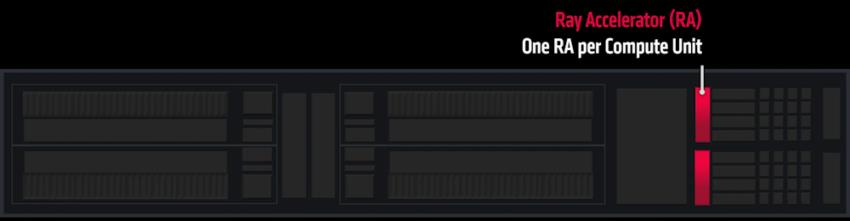
These RA units are responsible for the hardware acceleration of ray tracing in games. The RX 6900 XT features 80 RAs, RX 6800 XT features 72, and RX 6800 has 60. The same Ray Accelerators can be found in RDNA2-based next-gen gaming consoles.
“New to the AMD RDNA 2 compute unit is the implementation of a high-performance ray tracing acceleration architecture known as the Ray Accelerator,” a description reads. “The Ray Accelerator is specialized hardware that handles the intersection of rays providing an order of magnitude increase in intersection performance compared to a software implementation.” via AMD.
AMD will launch the Radeon RX 6800 and RX 6800 XT series of graphics cards on November 18th. The AMD Radeon RX 6900 XT flagship card will be available on December 8th and will cost around $999 USD.
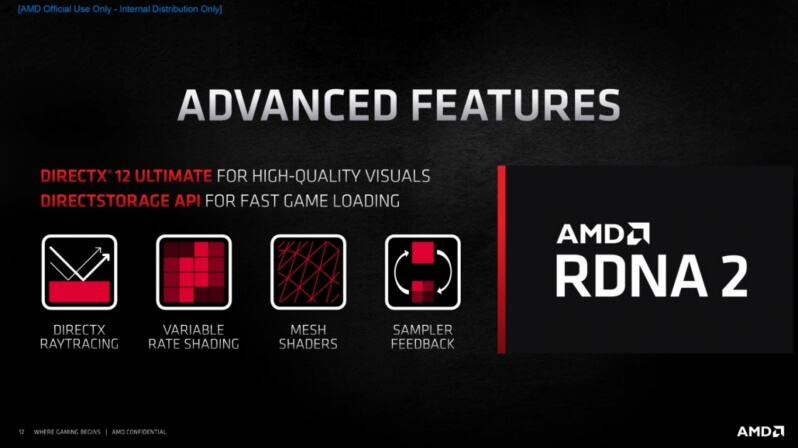
Lastly, AMD’s Radeon RX 6000 GPUs will also support the DirectStorage API, which might help reduce the game load times.
Stay tuned for more!

Hello, my name is NICK Richardson. I’m an avid PC and tech fan since the good old days of RIVA TNT2, and 3DFX interactive “Voodoo” gaming cards. I love playing mostly First-person shooters, and I’m a die-hard fan of this FPS genre, since the good ‘old Doom and Wolfenstein days.
MUSIC has always been my passion/roots, but I started gaming “casually” when I was young on Nvidia’s GeForce3 series of cards. I’m by no means an avid or a hardcore gamer though, but I just love stuff related to the PC, Games, and technology in general. I’ve been involved with many indie Metal bands worldwide, and have helped them promote their albums in record labels. I’m a very broad-minded down to earth guy. MUSIC is my inner expression, and soul.
Contact: Email