
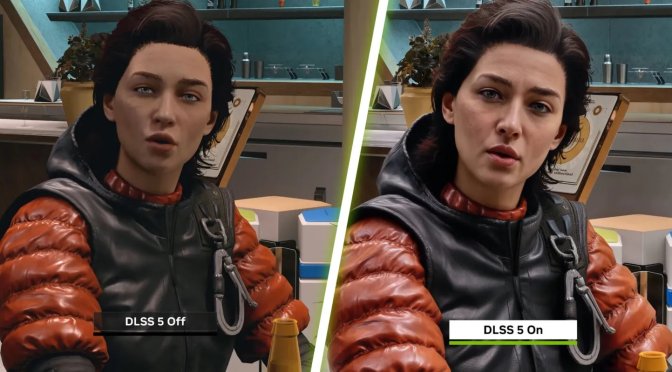
Now here is something that came out of nowhere. NVIDIA has just announced DLSS 5. This new version of DLSS promises to bring major visual improvements to PC games. And below, you can find some examples of what DLSS 5 can achieve.
But what is DLSS 5? According to NVIDIA, DLSS 5 introduces a real-time neural rendering model that infuses pixels with photoreal lighting and materials. Bridging the divide between rendering and reality, DLSS 5 will empower game developers to deliver a new level of photoreal computer graphics previously only achieved in Hollywood visual effects.
Jensen Huang, founder and CEO of NVIDIA, said:
“Twenty-five years after NVIDIA invented the programmable shader, we are reinventing computer graphics once again. DLSS 5 is the GPT moment for graphics — blending hand-crafted rendering with generative AI to deliver a dramatic leap in visual realism while preserving the control artists need for creative expression.”
DLSS 5 will take a game’s color and motion vectors for each frame as input. It will then use an AI model to infuse the scene with photoreal lighting and materials that are anchored to source 3D content and consistent from frame to frame. DLSS 5 will run in real time at up to 4K resolution for smooth, interactive gameplay.
As NVIDIA explained:
“The AI model is trained end-to-end to understand complex scene semantics such as characters, hair, fabric, and translucent skin, along with environmental lighting conditions like front-lit, back-lit, or overcast — all by analyzing a single frame. DLSS 5 then uses its deep understanding to generate visually precise images that handle complex elements such as subsurface scattering on skin, the delicate sheen of fabric and light-material interactions on hair, all while retaining the structure and semantics of the original scene.
DLSS 5 provides game developers with detailed controls for intensity, color grading and masking, so artists can determine where and how enhancements are applied to maintain each game’s unique aesthetic. Integration is seamless, using the same NVIDIA Streamline framework used by existing DLSS and NVIDIA Reflex technologies.”
NVIDIA DLSS 5 will be supported by the biggest publishers and game developers, including Bethesda, CAPCOM, Hotta Studio, NetEase, NCSOFT, S-GAME, Tencent, Ubisoft, and Warner Bros. Games. It will arrive this Fall. And although NVIDIA did not share the first games that will support it, it did share some comparison videos. So, we can assume that Starfield, Resident Evil Requiem, EA SPORTS FC, and Hogwarts Legacy will be among the first to support it.
Digital Foundry has also shared a video for DLSS 5. So, make sure to also watch it!
UPDATE:
In a separate email, NVIDIA confirmed the first games that will support DLSS 5. These games are AION 2, Assassin’s Creed Shadows, Black State, CINDER CITY, Delta Force, Hogwarts Legacy, Justice, NARAKA: BLADEPOINT, NTE: Neverness to Everness, Phantom Blade Zero, Resident Evil Requiem, Sea of Remnants, Starfield, The Elder Scrolls IV: Oblivion Remastered, Where Winds Meet, and more.



John is the founder and Editor in Chief at DSOGaming. He is a PC gaming fan and highly supports the modding and indie communities. Before creating DSOGaming, John worked on numerous gaming websites. While he is a die-hard PC gamer, his gaming roots can be found on consoles. John loved – and still does – the 16-bit consoles, and considers SNES to be one of the best consoles. Still, the PC platform won him over consoles. That was mainly due to 3DFX and its iconic dedicated 3D accelerator graphics card, Voodoo 2. John has also written a higher degree thesis on the “The Evolution of PC graphics cards.”
Contact: Email