
The Elder Scrolls Online feature

The Elder Scrolls Online will be the first game to support NVIDIA DLAA (Deep Learning Anti-Aliasing)

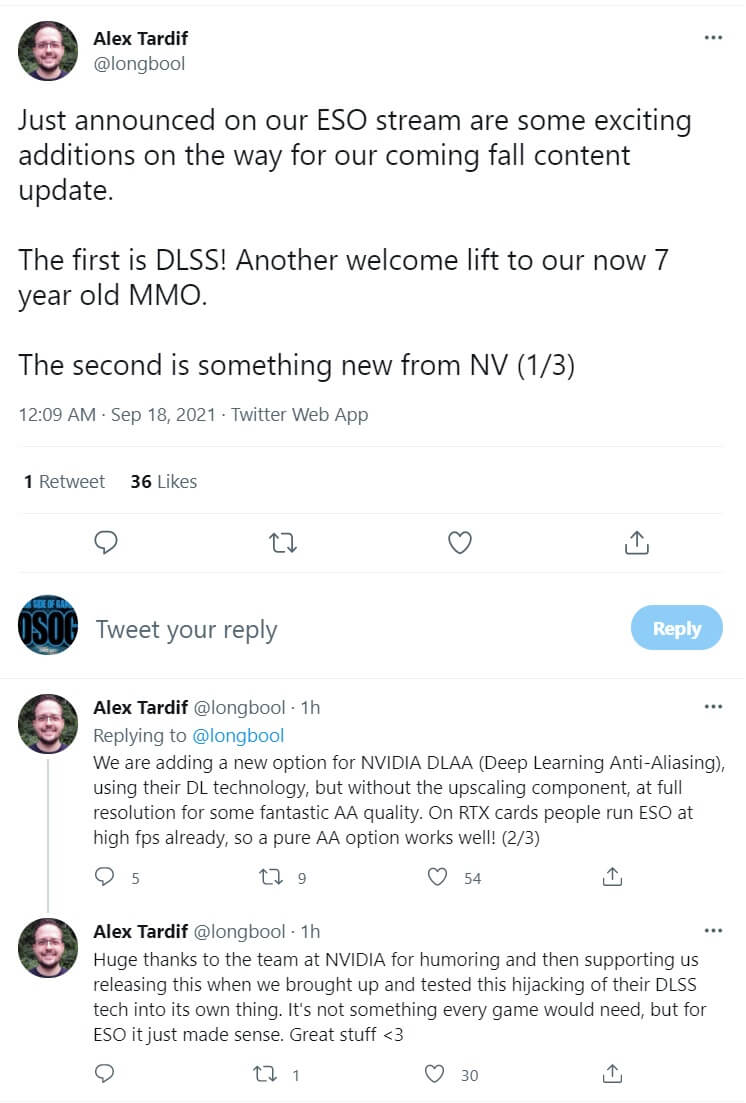
Alex Tardif, Lead Graphics Engineer at ZeniMax Online Studios, announced that The Elder Scrolls Online will support NVIDIA’s DLAA tech. In addition, the team will also add support for the more “traditional” deep learning technique, DLSS.

DLAA stands for Deep Learning Anti-Aliasing. This basically means that the game will use AI techniques at full resolution in order to provide better anti-aliasing results.
ESO DLAA support

DLAA also sounds like what NVIDIA advertised as DLSS 2X (back when it announced its Turing GPUs). As the green team stated back then.

“In addition to the DLSS capability described above, which is the standard DLSS mode, we provide a second mode, called DLSS 2X. In this case, DLSS input is rendered at the final target resolution and then combined by a larger DLSS network to produce an output image that approaches the level of the 64x super sample rendering – a result that would be impossible to achieve in real time by any traditional means.”

Now I’m pretty sure DLAA won’t approach results similar to 64X supersampling. Despite that, though, it appears to be working in a similar way with DLSS 2X.

As we’ve seen, DLSS can match or even surpass native resolutions. Not only that, but it introduces new details thanks to its deep learning techniques. So, theoretically, DLAA should provide a way better and crisper AA than TAA or most common AA methods.

There is currently no ETA on when this DLSS/DLAA patch will go live. Naturally, though, we’ll be sure to keep you posted!

10 thoughts on “The Elder Scrolls Online will be the first game to support NVIDIA DLAA (Deep Learning Anti-Aliasing)”

  1. Now I’m pretty sure DLAA won’t approach results similar to 64X supersampling.

    I’m pretty sure you couldn’t tell the difference 😉

  2. Finally, been waiting for a game to do this. A lot of DlSS’s weak points come down to having to work with a lower resolution input and interpolating information that doesn’t exist into something with 2.25x as many pixels.

    DLSS is already the closest thing to decent AA approaching SGSSAA. Most TAA is hot garbage for so many reasons I could talk forever about. (Not that DLSS doesn’t share some of them) Hoping more games opt to add this option (always with an adjustable sharpness slider for those people who like over sharpening everything).
    It’d be nice if Nvidia could create a shim layer in the driver with functions for compatibility to hook into any game like with the old DX9 AA compatibility layer. Let the community do the rest, just put it in there.
    https://docs.google.com/spreadsheets/d/1ekUZsK2YXgd5XjjH1M7QkHIQgKO_i4bHCUdPeAd6OCo/edit?usp=sharing

    1. The thing is dlss actually have more pixels to work with after a few frames (on scene change) than the lower base resolution due to its temporal component (IE uses several frames data and that’s why motion vectors are so important to a good dlss implementation).

      Damnable TAA blur really makes it easy for Dlss to win even when its up sampled in the majority of titles (after dlss v2.x)

  3. Why not try it on a game that needs actual AA and isn’t CPU bound. Try it on that new Mass Effect Legendary Edition where they have AA and post effect garbage so bad that you have jaggies all over the place even at 4k. Don’t waste time on a game that can be supersampled or have SMAA eliminate any jaggies, while not blurring the game with the garbage FXAA it uses. ANYTHIGN would look good compared to the FXAA it uses. CMAA would look brilliant as well, which is what WoW uses and is just edge aliasing which is all the game needs.

  4. puzzled as to why DLSS does not always come with a “enhance” option to just maximize image quality. a huge portion of games don’t NEED a reduction in render resolution since they’re not GPU-bottlenecked or run so well it wouldn’t be fair to attest them any bottleneck at all. why shouldn’t tensor cores on the GPUs of 10% of PC gamers be utilized to improve image quality in those games?
    When DLSS 3.0 hits and becomes compatible with all games that have TAA / motion vectors the prospect of a new superior AA method might really make me buy one of those overpriced tensor UFOs from nvidia even though my 1060 runs everything okay already. If you think about it perfect image quality is a BIGGER selling point than upscaling for performance. You can always get more performance by just upgrading to more brute force. You CANNOT get more image quality by just paying more unless you count downsampling which has its own problems and runs into a performance ceiling quickly.

Leave a Reply

Your email address will not be published. Required fields are marked *