
At the recent CES 2021 event, Intel officially announced its 11th gen Rocket Lake-S core series of processors during the press briefing, notably the Core i9-11900K flagship SKU. Official announcement slides were leaked as well, which showed an almost 19% IPC boost with this new CPU.
Intel’s 11th gen desktop processor lineup will feature both Rocket Lake-S and Comet Lake-S “refresh” CPUs. The 11th generation lineup includes 13 Rocket Lake/RKL and a total of 13 Comet Lake refresh desktop CPUs.
Rocket Lake lineup features the core i9, i7 & i5 variants, while the Comet Lake refresh desktop CPUs will come in Core i3, Pentium & Celeron variants.
Intel has officially confirmed that its 11th gen Rocket Lake-S desktop CPUs will be launching on the 30th of March, 2021. In response to Hardwareluxx, an Intel spokesperson confirmed the Rocket Lake CPU’s launch schedule. The review and sales NDA ends on the 30th of March at 6 AM (Pacific Time), so you have to wait for two more weeks for the reviews to go live.
But as I mentioned before, German retailer Mindfactory has been selling these 11th gen core processors even before the official embargo date. Almost 1 month ahead of launch. It now appears that AnandTech has also managed to grab one of these retail processors for their testing and review.
The retail Core i7-11700K sample obtained by AnandTech for review appears to be the first comprehensively tested Rocket Lake CPU, even before its official announcement and release.
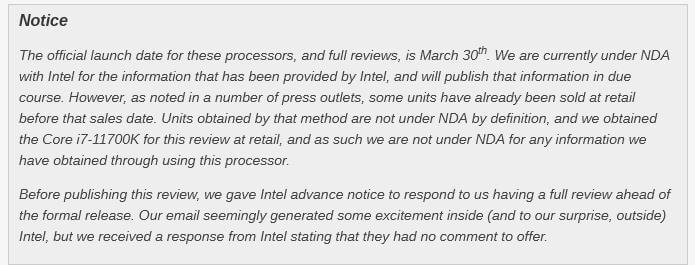
But before continuing you should read this notice posted by AnandTech, because reviewers are still under NDA.
These are the full specs of this processor.
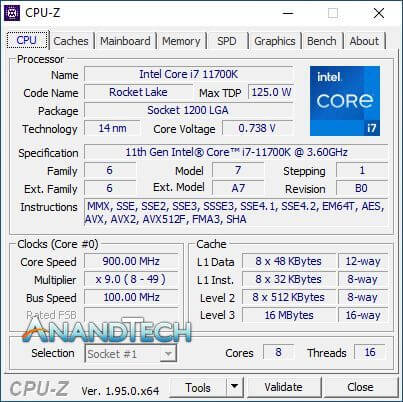
The Intel Core i7-11700K is a desktop processor with 8 cores, using the Rocket Lake-S architecture based on the socket LGA 1200. But thanks to Intel hyper-threading the core-count is effectively doubled, to 16 threads. Core i7-11700K has 16MB of L3 cache and operates at 3.6 GHz by default, but can boost up to 5 GHz, depending on the workload. Intel is building the Core i7-11700K on a 14 nm production process.
With a TDP of 125 W, the Core i7-11700K consumes a lot of power, so good cooling is definitely needed. Intel’s processor supports DDR4 memory with a dual-channel interface. The highest officially supported memory speed is 3200 MHz, but with overclocking (and the right memory modules) you can go even higher.
For communication with other components in the computer, Core i7-11700K uses a PCI-Express Gen 4 connection. This processor features the UHD Graphics 750 integrated graphics solution.
Hardware virtualization is available on the Core i7-11700K, which greatly improves virtual machine performance. Additionally, IOMMU virtualization (PCI passthrough) is supported, so that guest virtual machines may directly use host hardware.
Programs using Advanced Vector Extensions (AVX) will run on this processor, boosting performance for calculation-heavy applications. Besides AVX, Intel is including the newer AVX2 standard, too, but not AVX-512.
Now, we have some early gaming benchmark results courtesy of AnandTech, but full system specs were not disclosed because of NDA. The system BIOS used was also not likely final, so the gaming performance might slightly differ (once tested on a system using a compatible BIOS).
As AnandTech’s Dr. Ian Cutress said, “As per our processor testing policy, we take a premium category motherboard suitable for the socket, and equip the system with a suitable amount of memory running at the manufacturer’s maximum supported frequency.”
“While we can’t disclose the motherboard used due to NDA reasons, it has already been announced by the manufacturer. Meanwhile, the BIOS used is likely not the final variant that will be used for Rocket Lake’s retail launch later this month, and further BIOSes may contain potential minor adjustments to performance or turbo responses.”
I will only focus on the main gaming benchmarks, and I suggest you to read the full review article posted by AnandTech, if you want to get more information on this Rocket Lake processor’s performance.
The test system featured an Nvidia RTX 2080 Ti FE graphic card used for the gaming tests. Core i7-11700K and Ryzen 9 5800X were both tested using DDR4-3200 memory, but the i7-10700K and Core i9-9900KS were tested with DDR4-2933 and DDR4-2666 memory kits, respectively.
The test most likely appears to have being done on a Z590 motherboard platform. ADATA’s 16 GB DDR4-3200 (CL22) memory kit and a True Copper heatsink with dual SST-FHP141-VF fans were also used for this system.
So without further ado here are the gaming benchmarks. I’m only sharing the lower resolution benchmarks, since they are more CPU-bound, with the game quality settings set to low/min.
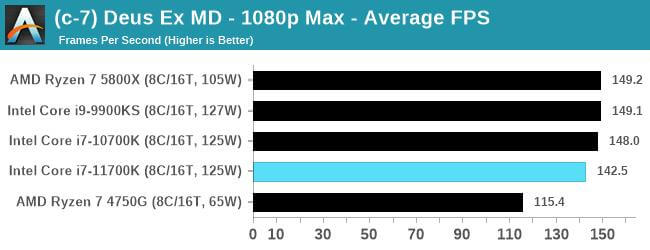
Deus Ex Mankind Divided. For this title, Anandtech tested the following resolutions: 600p Low, 1440p Low, 4K Low, 1080p Max.
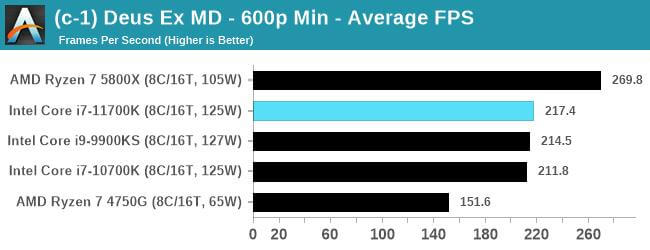
DEMD is often considered a CPU-limited title, so when the 11700K is better than the older Intel CPUs is at the low resolution, low quality setting, that confirms that. But as we ramp up the resolution, and the quality, the 11700K falls behind ever so slightly in both averages and percentiles.
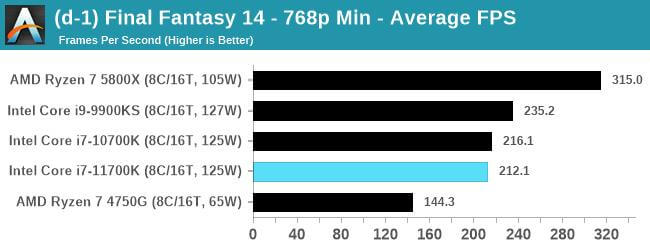
Final Fantasy XIV. For this title, Anandtech tested the following resolutions: 768p Minimum, 1440p Minimum, 4K Minimum, 1080p Maximum.
As the resolution increases, the 11700K seemed to get a better average frame rate, but with the quality increased, it falls back down again, coming behind the older Intel CPUs.
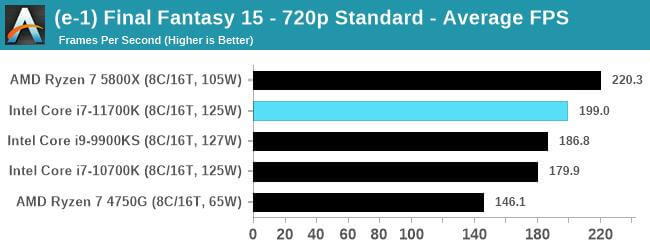
Final Fantasy XV. Anandtech tested the following resolutions: 720p Standard, 1080p Standard, 4K Standard, 8K Standard.
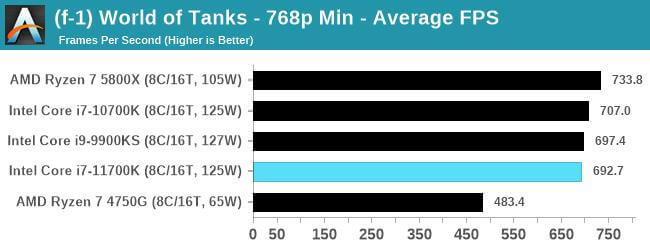
World of Tanks. Tested on 768p Minimum, 1080p Standard, 1080p Max, 4K Max (not a preset).
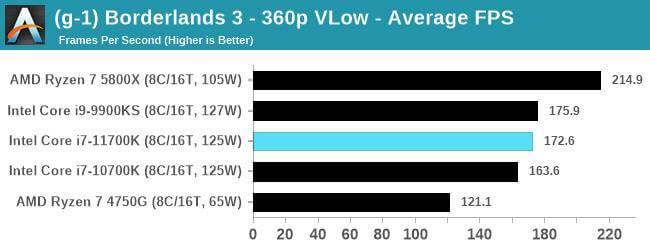
Borderlands 3. As BL3 supports resolution scaling, AnandTech used the following settings: 360p Very Low, 1440p Very Low, 4K Very Low, 1080p Badass.
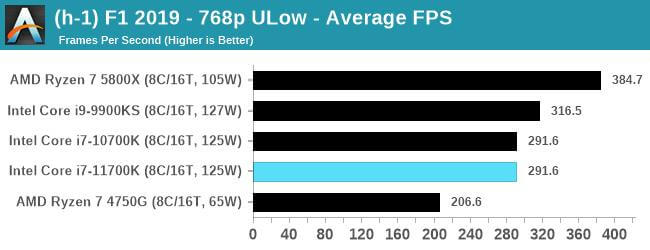
F1 2019. Tested on 768p Ultra Low, 1440p Ultra Low, 4K Ultra Low, 1080p Ultra. The Ego engine is usually a good bet where cores, IPC, and frequency matters. Despite this, the 11700K isn’t showing much of a generational improvement.
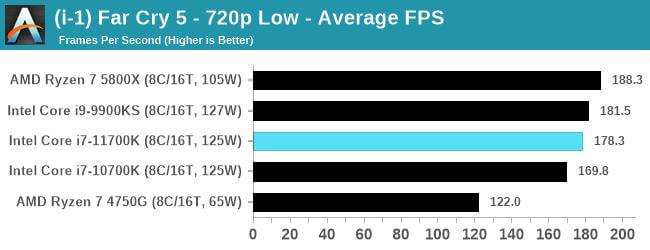
Far Cry 5. Tested on 720p Low, 1440p Low, 4K Low, 1440p Max.
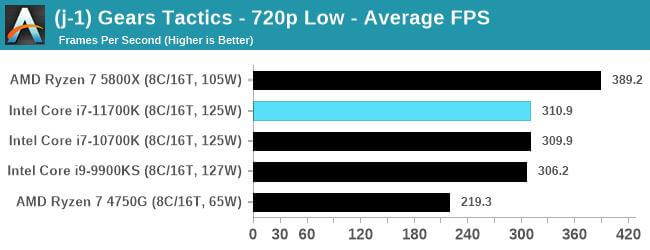
Gears Tactics. Tested on 720p Low, 4K Low, 8K Low, 1080p Ultra. Gears is the one test where 1080p maximum settings shines ahead of the pack. Although at high resolution, low quality, although all five CPUs are essentially equal, it still sits behind AMD’s Ryzen APU.
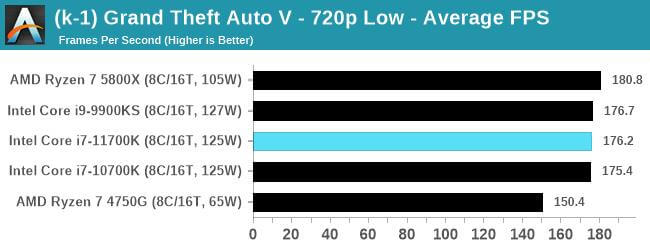
GTA 5. Testing done on 720p Low, 1440p Low, 4K Low, 1080p Max.
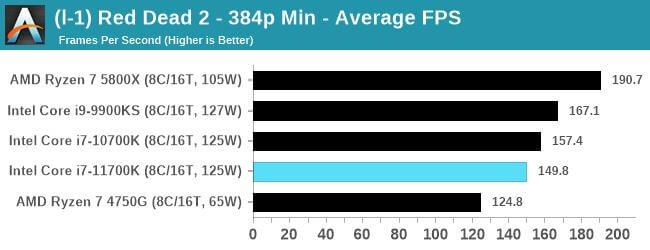
Red Dead Redemption 2. Game tested on 384p Minimum, 1440p Minimum, 8K Minimum, 1080p Max.
Strange Brigade. Strange Brigade supports Vulkan and DX12, so both were tested on 720p Low, 1440p Low, 4K Low, 1080p Ultra.

As we can see from the above gaming benchmarks, Rocket Lake-S CPU shows rather disappointing results, which is surprising given the 19% IPC increase claim by Intel over the previous 10th gen Comet Lake CPU lineup.
The improvements Intel has made to its processor seem to do very little in these gaming tests, and in a lot of cases, we see performance regressions rather than improvements. If Intel is touting a +19% IPC, then why is gaming performance so adversely affected?
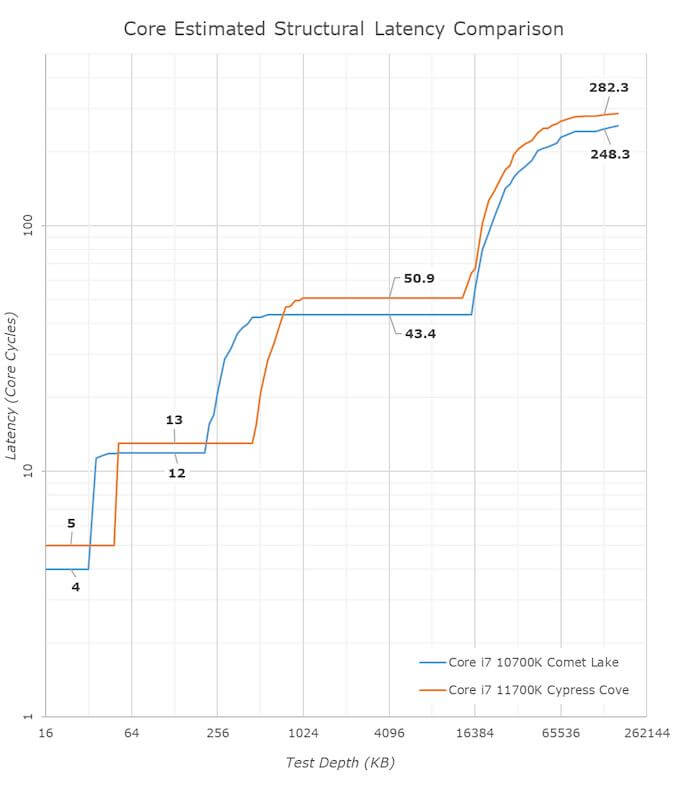
The reason given by Anandtech is that Rocket Lake has some regressions in core-to-core performance and its memory latency profile, which made it slow in gaming. It appears that the Intel Core i7-11700K suffers from increased L3 cache latency. From 43 cycles on Comet Lake-S to 51 cycles on the Rocket Lake.
“The biggest change is that the L3 latency is now ~51 cycles, rather than ~43 cycles. This is probably where a lot of the core-to-core latency performance drop comes in, as we are now seeing latencies of 28-30 nanoseconds on most cores, rather than 18-24 as observed on Comet Lake.
The much slower L3 in raw cycles is contrary to what we saw on the Sunny Cove version of this core, and with no obvious answer as to why this might be the case, but it does lend itself a lot as to the gaming performance. Intel may at a later date disclose the exact reasons for this structural change.”
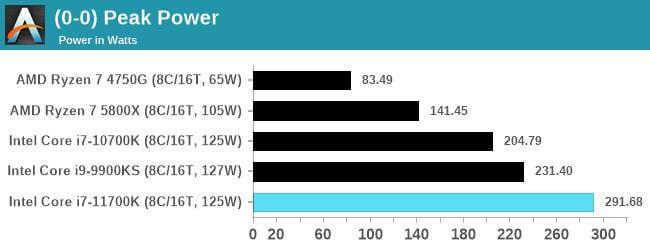
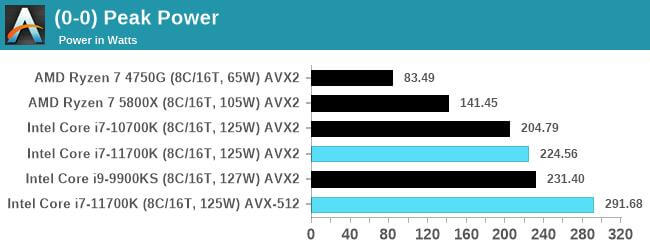
Lastly, we have the power consumption and temperature numbers. The CPU has a default TDP of 125W but it reached 225W during AVX2 workloads, with a temperature value of 81C. General workload was around 130-155 W at 60C. However, the CPU also peaked at 292W during the AVX-512 workload.
This was during an all-core AVX-512 workload, automatically set at 4.6 GHz, and the CPU hit 104C momentarily. There’s no indication that the frequency reduced when hitting this temperature, and the cooler used was easily sufficient for the thermal load, which means that on some level we might be hitting the thermal density limits of wide mathematics processing on Intel’s 14nm node.
Rocket Lake is going to be hot and power-hungry and will definitely require you to invest in a beefy AIO liquid cooler, alongside a high quality rated PSU.
According to SiSoftware’s own benchmark results, the new Intel Core i7-11700K was slower than AMD’s Ryzen 7 5800X, and also more inefficient than Skylake and power-hungry too.
These results clearly show that Intel’s performance, albeit substantial, still trails its main competitor, AMD. In a core-for-core comparison, Intel is slightly slower and a lot more inefficient as well.
There are rumors circulating that Intel could aggressively price these chips at around $400 USD for the Core i9 and $300 USD for the Core i7 SKU, which is necessary if they want to compete with AMD’s flagship Zen 3 processors.
Stay tuned for more tech news!

Hello, my name is NICK Richardson. I’m an avid PC and tech fan since the good old days of RIVA TNT2, and 3DFX interactive “Voodoo” gaming cards. I love playing mostly First-person shooters, and I’m a die-hard fan of this FPS genre, since the good ‘old Doom and Wolfenstein days.
MUSIC has always been my passion/roots, but I started gaming “casually” when I was young on Nvidia’s GeForce3 series of cards. I’m by no means an avid or a hardcore gamer though, but I just love stuff related to the PC, Games, and technology in general. I’ve been involved with many indie Metal bands worldwide, and have helped them promote their albums in record labels. I’m a very broad-minded down to earth guy. MUSIC is my inner expression, and soul.
Contact: Email