Intel vs AMD header

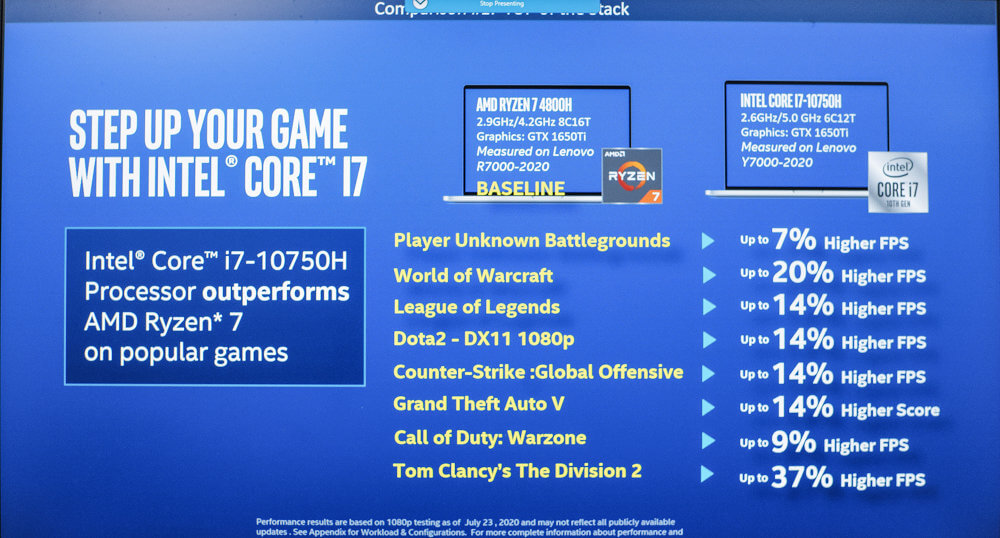
Intel claims 37% faster Gaming Performance with its 10th Gen Comet Lake-H CPU, when compared with AMD’s APU

Intel has released a new set of Gaming and real-world benchmarks which compares its 10th Gen Comet Lake-H CPU lineup against AMD’s Ryzen 4000 processors codenamed as ‘Renoir’. These are part of Intel’s internal ‘Real World Performance’ testing methodology, which has been criticized heavily in the past. We have already seen examples where Intel used different configurations when testing their own CPUs against the competing chips from AMD, giving their CPU lineup an unfair advantage in the end.

Now, in a latest set of benchmarks as published by Benchlife, coming via Wccftech,  Intel is shown comparing its own 10th Gen Core i7-10750H Comet Lake-H mobile CPU against AMD’s Ryzen 7 4800H Renoir APU.

The Intel Core i7-10750H CPU packs 8 cores and 16 threads, and is based on a 14nm process node having 2.60 GHz base and 5.00 GHz boost clocks, and the TDP is configured at 45W. Whereas the AMD Ryzen 7 4800H is an 8 core and 16 threads APU, fabbed on a 7nm process node, and is having 2.9 GHz base and 4.2 GHz boost clock speeds, respectively. One important thing to note here is that the 45 Watts TDP of the core i7 CPU is the PL1 state value derived at 2.60 Ghz clock speed, which is less than the actual PL2 TDP rating of 80 Watts, which is measured at 5.00 Ghz clock speed. So we need to take this info into consideration, because the AMD Ryzen 7 4800H APU maintains its clock frequencies within the 45 Watt TDP envelope.

Coming to the Gaming and real-world benchmarks, Intel has used two similar laptop configurations for both these CPUs this time. The following laptop Models were used, the Lenovo R7000-2020 (AMD) and Lenovo Y7000-2020 (Intel). The full specs are listed below courtesy of ‘Benchlife’.

Lenovo Y7000-2020:

  • Intel® Core i7-10750H Processor (2.6 GHz base up to 5.0 GHz, 6C/12T, 45 W TDP) measured on Lenovo Y7000-2020
  • 16GB DRAM (2 x 8 GB DDR4 2933MHz)
  • 512G SSD
  • 1920 x 1080 display
  • Nvidia GeForce GTX 1650Ti 4GB
  • OS: Microsoft Windows 10 Home V1909 18363.836
  • Battery 60WHr

Lenovo R7000-2020:

  • AMD Ryzen 7 4800H Processor (2.9 GHz base up to 4.2 GHz, 16T/8C, 35 W TDP) measured on Lenovo R7000-2020
  • 16GB DRAM (2 x 8 GB DDR4 3200MHz)
  • 512G SSD
  • 1920 x 1080 display
  • Nvidia GeForce GTX 1650Ti 4GB
  • OS: Microsoft Windows 10 Home V1909 18363.836
  • Battery 60WHr

Both the laptop models feature an NVIDIA GeForce GTX 1650 Ti discrete GPU, 16 GB of DDR4 Dual-Channel memory, a 512 GB SSD, 1080P HD display and were running on the same Windows 10 Home V1909 18363.836 OS version, with the only exception being the Memory spec which was configured at 3200 MHz for the AMD platform vs 2933 MH on the Intel system. Intel tested a total of 36 games at their default settings.

Out of 14 games which were tested, the Intel Core i7-10750H got 10% higher FPS on average than AMD’s APU. Tom Clancy’s Division 2 saw a 37% gain in performance, which was the highest. Intel also claims that its own CPU showed an overall better gaming performance than AMD’s Ryzen 4000 APU in several popular e-Sports gaming titles, such as PUBG, World of Warcraft, League of Legends, Dota 2, CSGO, GTA V and Call of Duty Warzone. Apart from this, in 21 gaming titles which were tested, the Intel CPU got more than 3% better average performance than the AMD Renoir APU. ‘Rise of The Tomb Raider’ game on the other hand saw a tie in performance between these two CPUs.

Intel also claims a 25% better performance in productivity workloads as well, such as Powerpoint, Excel, Chrome, and other popular synthetic benchmarks. But Intel did not go for any multi-threaded intensive benchmark, in which AMD easily dominates, so their testing methodology remains controversial. Back in June, Intel’s CEO Bob swan stated that the industry should stop focusing on benchmarks, and they should instead focus on the ‘Benefits and Impact’ of the Technology. But despite all this, INTEL is still relying on its own internal benchmarks. Nevertheless, the following PC games were tested:

Games with performance difference of more than 10%: 

  • Assassin’s Creed Odyssey
  • Counter-Strike: Global Offensive
  • Dota 2
  • F1 2019
  • FINAL FANTASY XIV: Shadowbringers
  • Grand Theft Auto V
  • JX3
  • League of Legends
  • Team Fortress 2
  • Tom Clancy’s Rainbow Six Siege
  • Tom Clancy’s The Division 2
  • Total War: Warhammer 2-Campaign
  • War Thunder Tank Battle
  • World of Warcraft

Games having performance difference of more than 3%, but less than 10%: 

  • ARK: Survival Evolved
  • Ashes of the Singularity: Escalation
  • Battlefield 1
  • Battlefield V
  • Borderlands 3
  • Call of Duty: Warzone
  • Far Cry 5
  • Far Cry New Dawn
  • FINAL FANTASY XV
  • HITMAN 2
  • Justice
  • Middle-earth: Shadow of War
  • Monster Hunter: World
  • Moonlight Blade
  • Mount & Blade II: Bannerlord
  • PLAYER UNKNOWN’S BATTLEGROUNDS (PUBG)
  • Red Dead Redemption 2
  • Shadow of the Tomb Raider
  • Total War: THREE KINGDOMS
  • World of Tanks encore
  • World War Z Vulkan

Game(s) having almost the same performance, on par:

  • Rise of the Tomb Raider

Intel 10th Gen Comet Lake-H CPU vs AMD APU gaming benchmarks-1Intel 10th Gen Comet Lake-H CPU vs AMD APU gaming benchmarks-2

28 thoughts on “Intel claims 37% faster Gaming Performance with its 10th Gen Comet Lake-H CPU, when compared with AMD’s APU”

  1. I’d really like to know how they benchmarked The Division 2. On desktop, Intel and AMD are usually very, very close (mostly because the game is primarily GPU limited). I would expect a 37% gap to come from a game like Far Cry 5.

    1. I think Division 2 favors AMD’s CPU and GPU ? But How can far cry 5 have a 37% gap in performance ?

  2. I been using Intel cpu’s for years but now once I ll do an upgrade there is no way I m going to intel (they became a laughing stock). I dont need another spectre meltdown where CPU loses some % of computing power, And ofcourse it happened when I bought a new i7-6700 😀

    1. Make a note though: Even AMD CPUs can be the victim of security vulnerabilities. No hardware is future-proof for sure. But I agree intel has been plagued by a lot of securities issues than AMD in the recent years.

  3. And why lol haha?
    What, you don’t want AMD to have competition? You know that prices are lower, and products are better, when there is competition between businesses striving for the same customer, don’t you?

    1. Ignore that guy over here. He is a big Moronic idiot who rants and spews out nonsense in the comment section, under each article. no point in arguing with him.

  4. I had people asking me why I went with a 9900K this upgrade cycle vs. the faster AMD chips and my answer is simple, I want the best GAMING performance. Sure, hell yes, AMD stomps Intel in terms of core/threads for the price and AMD does smash it when it comes to highly threaded applications but for my uses? I game. I mean, outside of internet browsing and media consumption this computers only other task is gaming so I want the highest frame rates possible.

    Not to mention several reviewers and forums have found that AMD CPU’s create frameskipping issues across the board. Don’t know if this has been fixed somehow but I saw Digital Foundry not that long ago address this issue with the 10-series Intel review.

    So yeah, AMD just isn’t there yet with gaming. Sure they work just fine and 200fps vs. 240fps average might not be that big a deal but 60fps vs. 50fps average is. That mixed with frameskipping and, nah, I’m good fam.

    Don’t get me wrong either though, I certainly have no issue with AMD at all, in fact with PCI-e 4.0 on their newer boards and me having dual 1TB nVME’s in RAID 0 I’d love to run AMD so I could get full bandwidth. I’ve owned AMD in the past, back in the early 2000’s AMD was straight budding heads with Intel with their Athlon XP’s of which I owned several and then their Athlon 64’s kicked Intel around like it was nothing, awesome CPU’s.

    Since then however and still to this day Intel came back and still is the best for gaming.

    Intel is still gaming King.

  5. Call me a cynic, but this dubiously looks like Intel attempting to stem recent stock losses. Pretty bold claims by them, and of course they have a history of misleading, so we will see.

    (I run both AMD and Intel rigs, and next upgrade will be AMD this time around. The last Intel build was too costly.)

    1. How about gaming performance, does Intel faster than AMD, or difference is just negligible/not worth the price tag. Because I’m thinking of upgrading my rig.

      1. Currently thank God, you can do AMD just fine. Better price vs performance at the moment.

        AMD was king for a while in the late 90’s through about 2009 if you count FX mid range rigs, and they just , stopped progressing. You had to dump a fortune for Intel cpus for the next so many years.

        AMD seems to be back again, finally. There’s purists who rightfully will point out the highest end Intel cpu as the best of the best, but c’mon, a few frame rates arent worth all that extra money for us normal shlubs.

    1. Are you really that naive that you actually believe a corporation like ASUS would sabotage their own brand and name because “evil Intel paid them!!”

      LOL

    2. This image is 100% fake, here is actual disassembly and you can see through the vents, they perforated properly.

      Only a tin foil nut can believe in such conspiracy, if it was real, it would of been insane public damage and every tech web site and pro-conspuer organization would bet talking about it.

      https://www.youtube.com/watch?v=fp0xyJQVIlU

    1. Sure, if you look at just that one resolution and that one average frame rate. What about the difference between 20fps and 30fps? 50fps and 60fps? Intel, regardless, provides the best gaming performance and if you’re a PC gamer, especially running lower-end/lower-priced, Intel is the way to go.

      The differences between my 9900K and 3900x on my 2080Ti and a 100Hz 1440p monitor literally boils down to “do I keep 100fps+ most of the time or keep less than 100fps most of the time”.

      Sure the 3900x is still completely capable but it’s gaming performance can make or break steady performance in a lot of titles.

      1. Thats very odd to hear. Me and a friend of mine have very similar systems, largely in part due to the fact that he really liked my system and wanted to replicate it. Ony difference is that he also went with a 9900K and i got a 2700X. In the games we play either together or single player games we both are playing, his fps is only within 2-7fps higher than mine at 1440p. we both have the 2080 xc ultra and are running 32GB of 3200mhz ram. Only real difference is he spent 500 on his 9900K and i spent 175 on my 2700X. He also had to buy an expensive liquid cooler where I got a dark rock slim for 38$.

        1. Sure, might not matter as much in averages in your one instance but people play at all different types of resolutions and frame rates. Also AMD still has the frame pacing issue which I most definitely don’t want regardless of resolution or frame rate.

  6. 37% you say? Hold on, let me run this through my bulls**t decryption machine I invented. Oh…… more like 0.3% under perfect conditions that benefit your dinosaur design in completely unrealistic use conditions…..

    Never change, Intel. I mean that. Never change, so I can see your arrogance, laziness, and contempt for customers over the past 10 years, wrapped around your neck, and watch you hang by it.

    F**k you.

    1. Well, Intel still leads in gaming. That is all tho. Zen 3 round the corner. Tick tock 14 nm, tick tock.

  7. Didn’t the CEO issued a statement not to believe any benchmarks and rely on “real performance simulation”, yet they pulled out random graph without numbers, just plain percentages to cover up their fake a** difference. What a pathetic corporation lmao…

Leave a Reply

Your email address will not be published. Required fields are marked *