
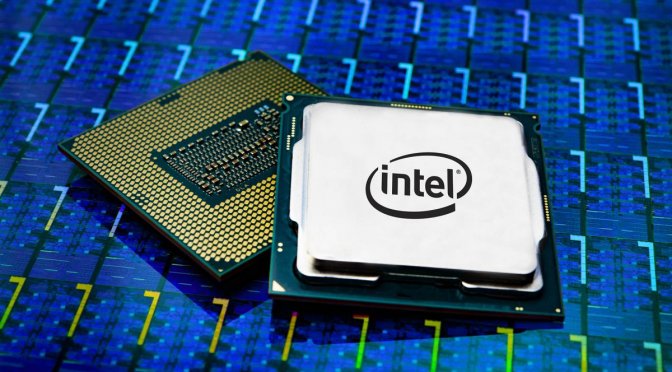
INTEL has been using the same iteration of the” 14nm” FinFET process node with the Skylake Architecture for many years. Comet Lake-S was also fabbed on this “aging” process node, which has held Intel back in terms of IPC uplift and efficiency gains over AMD’s Ryzen lineup.
The Rocket lake-S desktop platform is going to be the last CPU architecture to be based on an advanced 14nm process node. Intel’s Rocket Lake will use a 14++ nm back-port of the “Willow Cove” core architecture. Intel’s Rocket Lake is going to be the desktop equivalent of Tiger Lake, just a bit more portly.
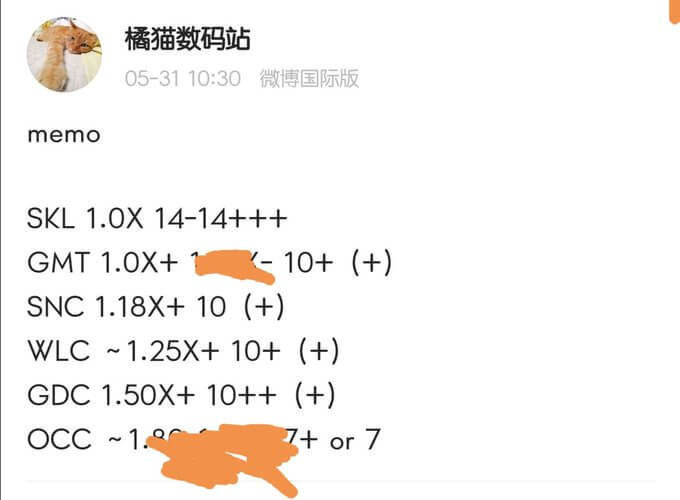
For the past 5 years or so INTEL has been relying on the same old “refined” process node without giving us any significant IPC and/or efficiency gains. Now, some new info on Intel’s next-gen CPU core µarchs has been posted by MebiuW on twitter, coming via a “Weibo” user in China. According to this new leak we get a short glimpse on Intel’s upcoming CPU architectures.
Though these IPC gain numbers/figures seem a bit vague so I suggest you take this article with a “grain of salt”. With that being said, can we now focus on this new leak/rumor ?
According to this leaked finding, “Willow Cove” core µarchitecture which will be featured on the upcoming “Tiger Lake CPUs” for the Mobility platform might bring a 1.25X or 25% IPC uplift over Skylake. For the desktop platform Intel’s “Rocket Lake-S” lineup is also rumored to feature new Willow Cove arch. So we can again expect a 25% increase in IPC with Rocket Lake-S.
The “Sunny Cove” CPU µarch which was used in ICE LAKE CPUs (mobile), already brought an average of 18% IPC improvement over Skylake. Lastly, the “Golden Cove” core architecture featured on the upcoming “Alder Lake-S” Desktop CPUs might give us 1.50X or 50% gain in IPC over the Skylake µarch.
There is also a future 2022-2033 CPU architecture codenamed as “Ocean Cove“, which might feature an 80% IPC increase over Skylake, but like mentioned before these figures are just based on rumors. Golden Cove cores would utilize 10nm++, while Ocean Cove cores would utilize the 7nm or 7nm+ process technology.
We are more interested in the next-gen DESKTOP CPU lineup which would be Rocket lake-S and Alder Lake-S respectively. The 11’th Gen Rocket Lake-S desktop CPUs are also going to be compatible with the current Z490 chipset and LGA 1200 socket motherboards.
Rocket lake-S CPUs are going to support the PCIe 4.0 standard and interface, and as per some rumors Rocket Lake -S might launch at the end of this year, or early 2021. But this places Intel’s Z490 platform longevity in a difficult position, since INTEL won’t be supporting even the LGA 1200 socket for long. LGA 1200 based motherboards are probably not going to stay for a long time, as Z490 is only expected to support Comet Lake-S and Rocket Lake-S CPU series, while Alder Lake-S is already rumored to feature the LGA1700 socket.
Intel’s Alder Lake-S on the other hand is going to be a successor to Comet Lake-S, and will feature a new socket LGA 1700. This socket will have support for at least three generations of Intel CPUs. Most importantly, Alder Lake-S is expected to feature a new “big core / small core” architecture, featuring Golden Cove and Gracemont cores.
Alder Lake-S will be the first Intel architecture to offer ARM’s big.LITTLE approach to desktop processors. These upcoming CPUs would be featuring up to 16 cores, in which 8 would be ‘Big’, and the rest would use the ‘Small’ architecture.
According to one report it is now speculated that these architectures are Golden Cove (Willow Cove successor) and Gracement (Tremont successor) respectively. Willow Cove is expected to appear in the upcoming Rocket Lake-S series of processors.
LGA 1700 socket is getting a support for 3 generations of Intel CPUs. This is something new for INTEL because the company has been known to support a short socket lifespan till now. These rumors indicate that Intel’s LGA1700 socket will compete with AMD’s AM5 socket in terms of platform longevity.

Hello, my name is NICK Richardson. I’m an avid PC and tech fan since the good old days of RIVA TNT2, and 3DFX interactive “Voodoo” gaming cards. I love playing mostly First-person shooters, and I’m a die-hard fan of this FPS genre, since the good ‘old Doom and Wolfenstein days.
MUSIC has always been my passion/roots, but I started gaming “casually” when I was young on Nvidia’s GeForce3 series of cards. I’m by no means an avid or a hardcore gamer though, but I just love stuff related to the PC, Games, and technology in general. I’ve been involved with many indie Metal bands worldwide, and have helped them promote their albums in record labels. I’m a very broad-minded down to earth guy. MUSIC is my inner expression, and soul.
Contact: Email