
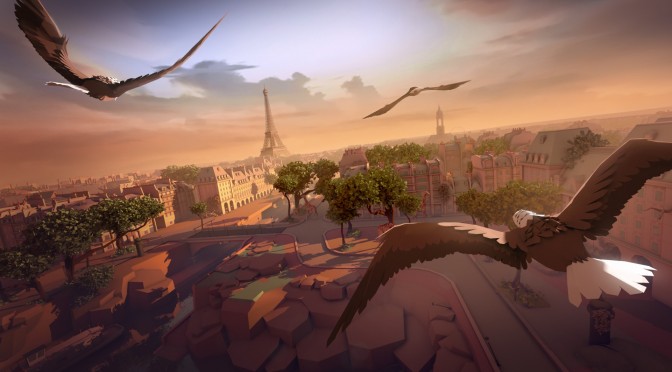
Ubisoft announced today that its first virtual reality game, Eagle Flight, is now available on Oculus Rift. Developed by FunHouse, a division of Ubisoft Montreal, Eagle Flight is set 50 years after humans have disappeared from Earth, where wildlife and nature have taken over Paris.
The game lets players explore one of the most visited cities on the planet from an entirely new point-of-view, as a bird of prey.
As an eagle, players glide past historic landmarks and weave through the narrow streets and secret passages. In single-player mode players refine their flying skills and learn new tricks by competing in challenges, and in multiplayer they can face-off in heart-pounding capture-the-prey dogfights for up to three vs three players.
As the press release reads, Eagle Flight, developed specifically for VR, emphasises accessibility and comfort. The game features a breakthrough in VR control technology that provides players with natural and precise movement controls. With this breakthrough players can comfortably hone their flying skills in order to achieve remarkable aerial maneuvers, and experience the true sensation of flight.
Patrick Plourde, VP of FunHouse, said:
“At Ubisoft we care deeply about innovation and new technology, so we’re excited to release Eagle Flight, our first Virtual Reality game. Eagle Flight is a fantastic game for newcomers to VR and experienced players alike. The game is very intuitive, so novice players can simply boot up the game and fly at their own pace with ease. For more seasoned players looking for a more intense experience, they can jump into the single player challenges or into a multiplayer match where they will have to expertly navigate the streets, skies and underground of Paris as they try to capture their prey and defeat their opponents.”
Enjoy!


John is the founder and Editor in Chief at DSOGaming. He is a PC gaming fan and highly supports the modding and indie communities. Before creating DSOGaming, John worked on numerous gaming websites. While he is a die-hard PC gamer, his gaming roots can be found on consoles. John loved – and still does – the 16-bit consoles, and considers SNES to be one of the best consoles. Still, the PC platform won him over consoles. That was mainly due to 3DFX and its iconic dedicated 3D accelerator graphics card, Voodoo 2. John has also written a higher degree thesis on the “The Evolution of PC graphics cards.”
Contact: Email
yea! more on rails VR “games”
Most VR games are on rails because it’s impossible to walk around with Rift/Vive alone, without having a treadmill (maybe WASD or analog sticks would do? I’m not sure, I haven’t tried VR in person). And they’re too expensive for now.
On most of the games For Vive You have both options, to teleport using controllers or to actually walk if you have a bigger room. I had no problems with most of the games where I could walk on my 7x5m room setup.It is not imposible to walk, It is really well done, and pretty immersive,Vive’s Lighthouse tracking tech is really amazing and precise as fukc!
In fact, I knew about those methods, I just thought teleporting wasn’t a viable method for, say, a serious RPG game. Devs always have to go with some “you’re a wizard”/”you have that teleporting device” plot, which is restrictive. Appearing someplace else instantly is also unnatural and restrictive on its own.
Real-life walking is pretty cool, although I’m wondering: what do you do when you approach a wall? Do you have some button to decouple your movement with your character’s?
And yeah, in the case of games like Tiltbrush you move around some point of origin so it’s not a problem.
Still the limitations are that you cannot walk further than your boundary without teleporting again.
There are some games that still use traditional thumbstick movement; Solus Project is one I played and does a good job. I am pretty tolerant of it, and it is the type of immersion I dreamed about when modern VR was first announced, but traditional FPS movement is a very risky way to develop a game in VR. I feel I am one of the few that can handle it, and even then I have to take a break every hour or I get the spins.
Locomotion in VR is still a tough debate. It is all about immersion vs nausea. So far eagle flight has put safeguards up, much akin to bumper bowling, and it works to increase its immersion capabilities. I do wish they were a little bit more customizable for more extreme players, but in practice has made this a very natural feeling game aside from lot of movement and turning.
Been playing it, it’s not on rails. Small in scope yes, but you can literally fly anywhere in its modest sized map.
Yeaaah! Because the VR market isn’t small enough, let’s make it exclusive ( to the smaller Occulus share no more instead of the Vive ). It will be hard to blame piracy to justify the failure on this one…
Vive and PSVR are also mentioned on the site.
Calm down, It supports Vive
https://uploads.disquscdn.com/images/3f91cbb840115f294224cc1905bcb21c7e934cfcae7a69900cf057612ca19a1e.png
I haven’t heard anyone complain like this since April.
As a person who still remembers the quick downfall of VR hype 20 years ago I’m not seeing much of a difference compared to the current hype.
And one particular thing with this VR wave strikes me the most – how the hail am I supposed to get immersed in the audiovisual VR experience when most games in VR look rushed out, graphically dated and with very simplified limited gameplay mechanics?
We gotta wait until omnidirectional treadmills are cheap, because games that are more sophisticated usually involve walking. And as for poor visuals – that’s a problem, too. Current computers are too weak to render VR images at a high frame rate without sacrificing the fidelity of graphics.
As also one who lived through the VR hype of yesteryear, today’s hype has a lot of noticeable differences. The only thing the same is people’s excitement. Back then technology was horribly underequipped for a serviceable VR experience. There was also a much smaller industry backing, both in the hardware and software side. The only thing I witnessed VR actually ever getting legitimately used for (I went to a computer media and animation school in 1997-98), was CAD and architectural stuff.
Today there is a sizeable industry market varying from cell phone, to console, to these high end sets. The technology is here to stay as there is a lot of support, and will only get better from here on out. The technology already exists in everyone’s pocket. It may take many forms, but if the excitement of the 90’s alluded to, and the resurgence of that excitement has proven: people want some form of VR. What form that will be in these early years can be debated, I can even agree to the possibility it will lose some of the excitement along the way, but for sure it is here to stay.
That ‘rushed look’ is typical of any new systems first year. You should know this. Since you remember the first VR wave, that means you should have witnessed almost every major gaming console release to date, and witnessed every new 3D graphics trend ever introduced in the PC platform.
A Ubisoft game called ” Eagle”? The first protagonist in Assassin’s Creed was called “Altair”, which means “Eagle”. Coincidence? I THINK NOT.