
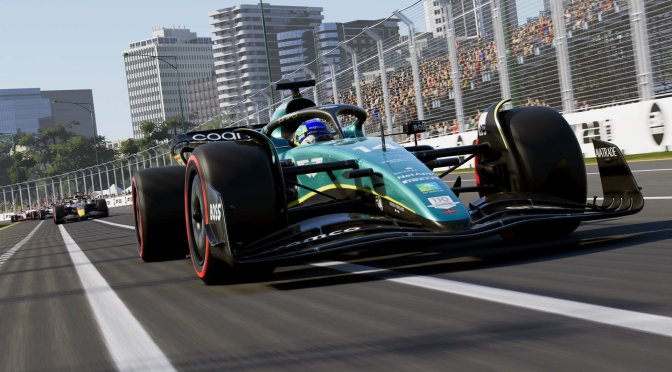
Codemasters has detailed the PC graphics settings for F1 23, confirming that the game will take advantage of Ray Tracing Dynamic Diffuse Global Illumination.
This is the first time that an F1 23 game supports Ray Tracing Global Illumination. And, tech-wise, we are now slightly more excited about this new F1 game.
Alongside RTDDGI, F1 23 will support Ray Tracing Shadows, Reflections and Ambient Occlusion. So, in theory, these RT effects should noticeably improve the game’s graphics.
Now the good news here is that F1 22 ran silky smooth on PC, even at 4K resolutions. Not only that, but NVIDIA added support for DLSS 3 via a post-launch update. Thus, we can expect F1 23 to also support DLSS 3 from the get-go.
EA will release F1 23 on PC on June 16th. Naturally, we’ll be sure to benchmark this new F1 game and share some comparison screenshots once it comes out.
Stay tuned for more!



John is the founder and Editor in Chief at DSOGaming. He is a PC gaming fan and highly supports the modding and indie communities. Before creating DSOGaming, John worked on numerous gaming websites. While he is a die-hard PC gamer, his gaming roots can be found on consoles. John loved – and still does – the 16-bit consoles, and considers SNES to be one of the best consoles. Still, the PC platform won him over consoles. That was mainly due to 3DFX and its iconic dedicated 3D accelerator graphics card, Voodoo 2. John has also written a higher degree thesis on the “The Evolution of PC graphics cards.”
Contact: Email