John Carmack Is Pushing Hard For Asynchronous Time Warp On The PC, Best Thing Coming From Mobiles

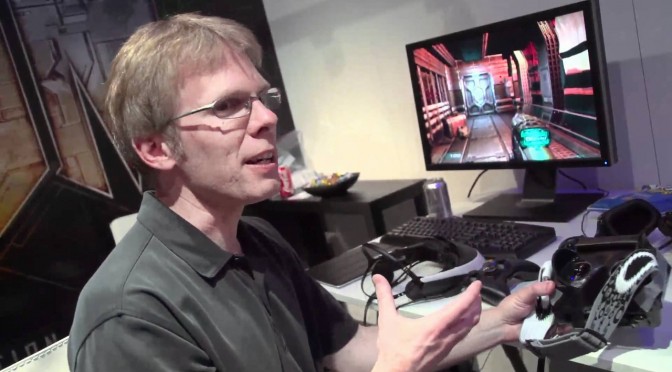
During Oculus Connect 2014, John Carmack took the stage and talked for one hour and a half about various topics. The guru programmer talked about his relationship with Samsung, solutions for various issues present in Oculus Rift’s DK2, the ability to fully enjoy a VR experience, as well as the most important result coming from the mobile environment that is no other than the asynchronous time warp notion.

Asynchronous Time Warp basically gives developers the ability to de-couple the refresh rate of a screen from the rendering of the eye buffers. Basically, what this means is that a screen will be refreshing at your native rates all the time, but the rendering of your game will be at a lower FPS. Thus, games will look smooth even while running at – say – 30FPS.

Obviously, this is not as good as ‘true’ 60FPS but it’s a great workaround for all games that suffer from weird and unexplained slowdowns. Most importantly, it’s a better solution than frame interpolation, as the latter is plagued with input latency issues. It’s also a great feature for less powerful GPUs, or for systems that aim to offer 4K or Oculus Rift experiences.

“Asynchronous Time Warp will allow you to, in theory, have a 30Hz game that’s get updated to the screen 60 times per second” said Carmack and continued:

“So we are trying to get that on the PC for a lot of these things because as we start looking at the 90Hz displays and 75Hz at DK2, these are hard to hit even on the PC with all that horsepower. And I’ve said it many times before and people don’t like to hear it, but the PC costs about a factor of 2X in sort of the overhead that you wind up incurring when you are dealing with latency, not with bandwidth.”

Carmack concluded that it will be really hard to bring Asynchronous Time Warp on the PC as all vendors will have to work together and agree on implementing such a feature.

“There are challenges on the PC so we are deeply engaged with NVIDIA and we expect them… there is the whole matrix that we’ll have to work through; NVIDIA, AMD, Intel and then PC, Mac and Linux. That’s a lot of work to get some of these really twitchy stuff working. The work is on going right now and there are varying levels of optimism and despair amongst different people in the company about how well this is actually going to work out on the PC.”

Of course Carmack wants to bring Asynchronous Time Warp for VR gaming on the PC, but we don’t see why this feature – in case it does come to our platform – won’t be featured in ‘normal’ games as well, especially since this will let developers – in the long run – achieve better visuals.

Naturally, mere words cannot give you a proper idea of what Asynchronous Time Warp is all about, so below you can find a video showing this technique in full effect.

We’ve also included Carmack’s entire speech for all those that want to sit back and hear what the programmer guru had to say.

Enjoy!

Asynchronous timewarp with the Oculus Rift

Keynote by John Carmack at Oculus Connect 2014

18 thoughts on “John Carmack Is Pushing Hard For Asynchronous Time Warp On The PC, Best Thing Coming From Mobiles”

  1. Sounds like a really good idea but I remember the biggest problem with interlaced displays where the headaches they induced. Id imagine that the Rift is going to cause eye strain anyway from extended use especially for people that are new to it, so I hope they plan on figuring out a way to combat interlace flicker too.

  2. Aim for native refresh rate or bust. Developers will have to actually optimize the CPU related aspects of their engine or their games won’t work for high framerate players. That’s just the bottom line. The alternative is more console ports with god-awful CPU optimization where you can scale down the graphics infinitely and still never hit 100 fps, or even maintain 80.

    Ever since I got my 144 hz display I’ve grown really disappointed with optimization. Before (on a 60 hz display) I was aiming for 80 fps and 100 felt no better or worse. I was used to slowdowns to 50 in console ports but I assumed it was down to my GPU. Now with a r9 280 I aim for 120+ and again and again I notice that even old games can’t maintain a steady 100 fps because noone bothered to optimize them beyond “functional”.

    Lack of CPU optimization is the reason 90 fps are a difficult target framerate, not raw power in the PC market. I think we all acknowledge that nothing that actually happens in games of recent years has had any right to exhaust contemporary PC CPUs. They’re a dozen times more powerful than the consoles those games were made for, the only reason engines fail to deliver high framerates consistently is that devs didn’t bother. If Carmack hadn’t sold out long ago he would admit that most devs just don’t care about framerates above 40 so when their game is barely playable on average hardware they call it a day and move on.

  3. I’ll be watching and waiting for the Samsung Gear VR to fail. Mobile is not your audience for VR. Gaming is where VR should be perfected first before moving to other platforms. John has obviously been coached by Samsung (biggest player in mobile) and Facebook (biggest player in social) to mention the Mobile ambitions over anything to do with consoles, despite Sony’s Morpheus still being the best opportunity the industry has at VR becoming mainstream. It’s a shame Oculus got bought up because their direction seems to come across differently now than before the buyout but that’s just my opinion. Bring on Doom VR, Mr. Carmack.

    1. Morpheus is the best opportunity for VR to become mainstream? Not sure where you dreamed that up.

      VR will never become mainstream when it is restricted to a closed platform. Oculus are interested in areas other than gaming, why wouldnt they be? Gaming alone will not make VR mainstream. Whats more, Palmer Lucky reaffirmed a few weeks ago that the device will be primarily for gaming, they even have their own in house game development going on. Though there is nothing wrong with exploring other avenues especially since the Rift does them so well.

      Sonys’ Morpheus success is hugely dependent on the success of the Oculus Rift.

      1. You’re entitled to your opinion, like I am, it doesn’t mean it will play out as true. Speculation is a magnificent thing, isn’t it?

        1. Im not giving an opinion. And yours isnt an opinion either, its a load of crap if im being honest. Apart from the bit about mobile (which I agree with).

          1. You are giving an opinion, your thoughts and conjecture are all over the place:

            “VR will never become mainstream when it is restricted to a closed platform.”

            Are you implying it was the PC audience that drove the motion control craze of the 2000’s? I’m pretty sure that was Nintendo all on it’s own and their wiimote, a closed system.

            “Oculus are interested in areas other than gaming, why wouldnt they be?”

            I’ll let Nate Mitchell from Oculus answer that question (June 2013):
            “The goal has been to build great consumer VR, specifically for gaming.” In fact, if you read the June 2013 article from allthingsD, they go on and on the entire interview, both Nate and Luckey, about gaming, gaming and exclusively gaming. Since the acquisition, their tune has changed and since Samsung’s unveil of the Gear VR, we’ve seen a decided emphasis on mobile in interviews. These are facts and I’m just giving my opinion on those facts.

            “Sonys’ Morpheus success is hugely dependent on the success of the Oculus Rift.

            Sure, I bet Sony thinks that too. I imagine you could go debate that on a console-focused website till you’re blue in the face and never get anywhere with that argument. Obviously mass market adoption is preferred by both companies but neither is reliant on the other for success.

            If you are so offended by my “crap” opinion, here’s a tip you can live by in the future. Just skip reading my comment as soon as it gets offensive to you, and certainly don’t reply. You clearly don’t have anything to add other than your opinion, which you are free to put in your very own comment. I prefer to dialog with people of a similar mindset, thanks.

          2. Oh god here we go…

            Look, im not going to argue with you. You clearly have some bias toward Oculus and no intelligent argument that would warrant me debating this topic with you. Therefore I see no point replying to your juvenile banter.

          3. Yet, you replied to my comment with guile in the first place. Then, you proceed to call my opinions crap and juvenile. Was this all in an effort to “not argue” too? You wasted everyone’s time here trying to enforce your ideals on me, not the other way around.

            At the very least, remember the lesson from my last comment, it’ll certainly help you put a more mature foot forward in the future.

          4. I agree with certain points you made. But, to say your comment is the one and only truth and others are just idiots…………….. WOW!

            I don’t think Morpheus success is dependent on Oculus at all. Both cater to different markets. One mainly for console gamers, and they other for PC. Given the huge success of the PS4, I think Morpheus will do alright. Personally I think VR is fad, just like 3D. It’s going to take a lot of make them the huge success motion gaming was with the likes of the Wii.

          5. Now your first comment makes absolutely no sense because you accuse me of saying that “my comment is the only truth and others are just idiots” …Well, thats a complete fabrication as I never said anything of the sort, I never called anyone an idiot and Im not sure who these ‘others’ are that you mentioned as until now, I only replied to one person on this subject.

            So anyway VR is/will be a fad you say? Thats exactly the point of why the Morpheus depends on the success of the Rift.

            If we have to rely on the Morpheus to push VR forward then it will only ever be a fad. The Rift has the advantage of being open to all and any kind of content that developers want to make for it and not just video games. Therefore with the Rift, VR has the chance to reach a wider audience and be more than a fad.

            Also, gaming is not a different market, only exclusives (which are few and far between) are restricted from one platform to another. Gaming as a whole is the same market across platforms. The success developers have on the Rift will mean more developers making/porting content over for the Morpheus and not the other way around. We all know how console manufacturers love their exclusives.

    1. We don’t even know if there are any long term side effects from eye laser surgery, let alone unreleased VR technologies.

      1. But we all gonna use it, just because Carmack thinks it is good idea (and put his money and effort there).
        But truth is there are and will be some interesting features that comes up from development (not only screen but also sound), because everything have to be “just right” (much better than atm for classic off-screens) for VR to work w/o issues.

    1. He is no longer involved in those projects as he is no longer works in id Software and Bethesda Softworks, or am I wrong? He still might consults but I think they have plenty other good programmers and Carmack obviously wanted to push development in some new pioneer area, which VR definitely is. Though I do not think this VR will be mainstream thing and usable for mainstream games.

Leave a Reply

Your email address will not be published. Required fields are marked *