
Remedy has just revealed the final PC requirements for Control Resonant. These requirements cover pretty much everything. As such, we now have the PC specs for the rasterized version, as well as for Ray Tracing and Path Tracing. So, let’s dive in.
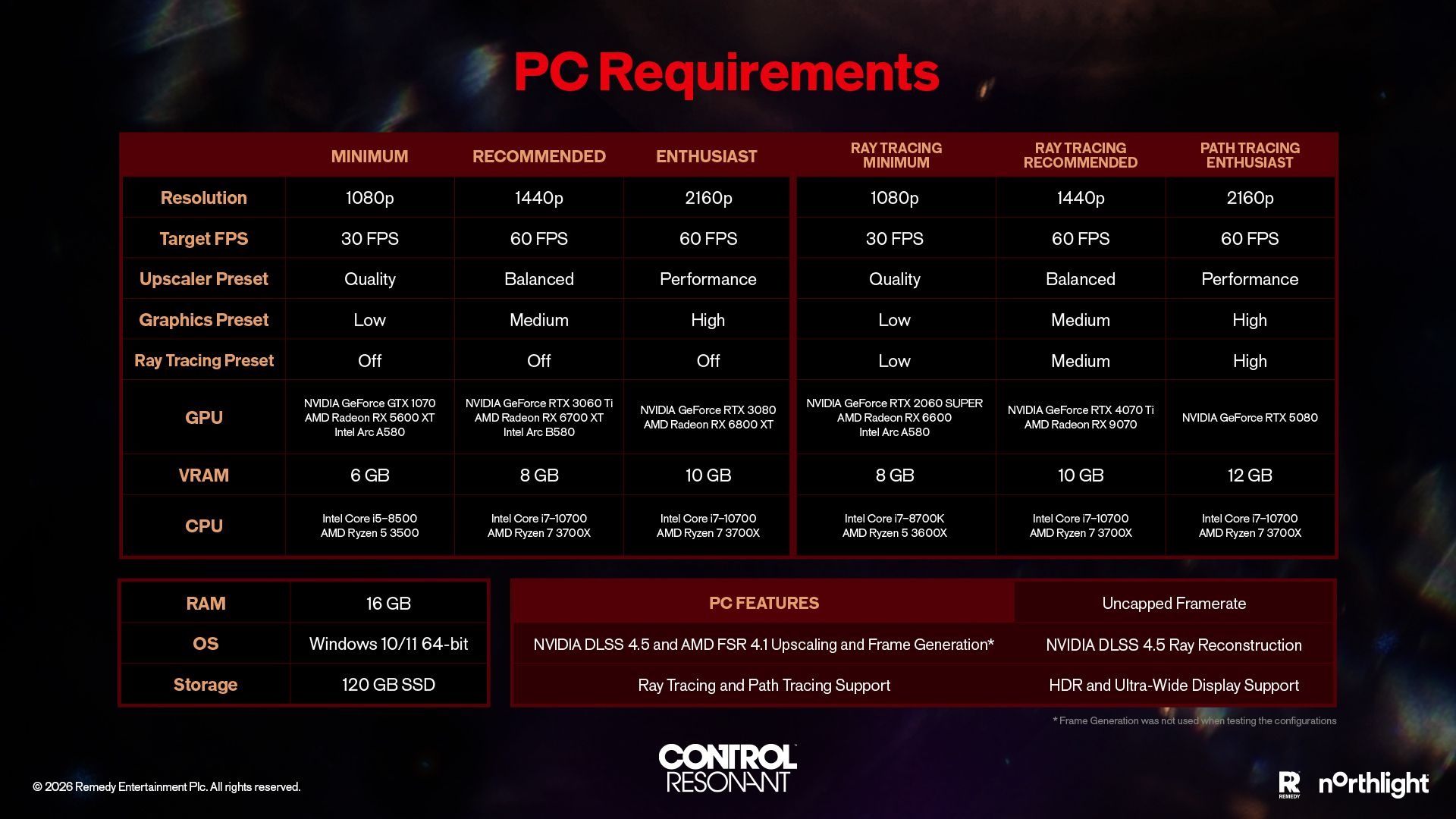
The previously released PC minimum requirements are for gaming at 1080p with 30FPS on Low Settings with FSR Quality. On the other hand, the recommended PC specs were for gaming at 1440p with 60FPS on Medium Settings with DLS/FSR Balanced.
For gaming at 4K/60FPS on High Settings with DLSS/FSR Performance, you will need an Intel i7-10700 or an AMD Ryzen 7 3700X with 16GB of RAM and an NVIDIA GeForce RTX 3080 or an AMD Radeon RX 6800XT.
To enable the Ray Tracing effects, you will at least need an Intel i7-8700K or an AMD Ryzen 5 3600X with 16GB of RAM and an NVIDIA GeForce RTX 2060 Super, and AMD Radeon RX 6600, or an Intel Arc A580.
For the Ray Tracing version, Remedy recommends using an Intel i7-10700 or an AMD Ryzen 7 3700X with 16GB of RAM and an NVIDIA GeForce RTX 4070Ti or an AMD Radeon 9070. With this PC system, you will be able to game at 1440p/60FPS on Medium Settings and Medium RT with DLSS/FSR Balanced.
Finally, for gaming at 4K/60FPS with Path Tracing, you will need an Intel i7-10700 or an AMD Ryzen 7 3700X with 16GB of RAM and an NVIDIA GeForce RTX 5080. Do note that you’ll also need DLSS Performance Mode to hit 60FPS.
Remedy will release Control Resonant on September 24.
Stay tuned for more!
Control Resonant Final PC Requirements

John is the founder and Editor in Chief at DSOGaming. He is a PC gaming fan and highly supports the modding and indie communities. Before creating DSOGaming, John worked on numerous gaming websites. While he is a die-hard PC gamer, his gaming roots can be found on consoles. John loved – and still does – the 16-bit consoles, and considers SNES to be one of the best consoles. Still, the PC platform won him over consoles. That was mainly due to 3DFX and its iconic dedicated 3D accelerator graphics card, Voodoo 2. John has also written a higher degree thesis on the “The Evolution of PC graphics cards.”
Contact: Email