
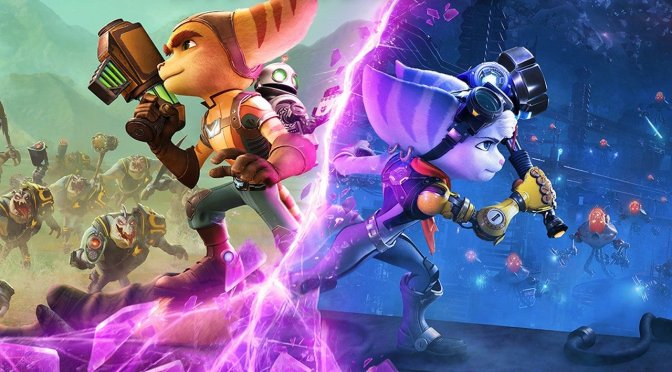
Ratchet & Clank Rift Apart feature

Ratchet & Clank: Rift Apart is faster on PC than on PS5, even without DirectStorage

A lot of headlines surfaced when Ratchet & Clank Rift Apart came out on PC, suggesting that the PS5 could load its portal scene faster than a high-end PC. Well, what if we told you that the PC can load the portal scene faster than the PS5 by simply deleting a single file? Hell, scratch that. What if we told you that the game runs faster on PC than on PS5, even without using DirectStorage?

Compusemble has discovered that by simply deleting the “cache.pso” file from the game’s folder, PC gamers can boost loading times. When Compusemble deleted that file, its PC system (an AMD Ryzen 7 7700X with 32GB of RAM and an AMD Radeon RX 6950 XT) was able to load the portal scene faster than the PS5.

Ratchet and Clank Rift Apart | PC CAN Load The Portal Sequence Faster Than The PS5 After All

Compusemble went one step ahead and completely disabled DirectStorage. And, even without DirectStorage, the PC was able to run the portal scene faster than the PS5.

What this ultimately means is that there isn’t any secret sauce that makes the PS5 run better than high-end PCs. And no, PS5’s dedicated hardware decompression tech is not enough to beat high-end PC systems.

The purpose of this article is to eliminate those inaccurate assumptions. Because, honestly, this whole thing has become a big farce.

At first, when Ratchet & Clank Rift Apart was still a PS5 exclusive, we’ve been hearing about how revolutionary the PS5 was. Then, when the game came out on PC, the narrative changed. Suddenly, people started claiming that the PS5’s dedicated hardware decompression tech was so powerful that it allowed it to run the portal scene faster than high-end PCs. However, as we’ve showcased above, that assumption has been busted.

In conclusion, high-end PCs are faster than the PS5, even without DirectStorage. And, to be honest, this shouldn’t come as a surprise. Current high-end PCs do not actually benefit from DirectStorage’s GPU decompression. That’s because most high-end CPUs are powerful enough to handle DirectStorage. After all, we’ve seen this in both Rift Apart and Forspoken. On the other hand, DirectStorage’s GPU decompression can benefit mid-tier and low-tier PC systems. And that’s why developers should be offering an in-game DirectStorage setting to choose between CPU and GPU decompression!

30 thoughts on “Ratchet & Clank: Rift Apart is faster on PC than on PS5, even without DirectStorage”

        1. The glorification of ps5 disk speeds. On pc we dont even have games to max ssd that are close to 500mbs and probably most of us have nvmes with speeds of 2000 to 3000mbs that are never used to their max potential. It was heavily marketed by this game the need of ps5 and thats not the case.

          1. The “PS5 glorification” was not just about its SSD speed, PS5 has a dedicated texture decompression chip and dedicated I/O system tailored to games, PC do not.

            SSD speeds seem irrelevant for gaming. NVMe SSD are barely faster at loading than SATA 3.0 SSD.

            M.2 is also a horribly annoying slot to use on PC, it was designed for notebooks, not desktops. Until PC get something better like U.2 I am sticking with SATA SSD.

            What was keeping loading speed from getting better was texture decompression, which was being entirely done on the CPU. PC with faster CPU loaded games faster. PS5 has a dedicated chip for that.

            With Nvidia nvCOMP and GDeflate, the GPU can do this decompression.

  1. That’s really impressive to see, even more so when considering that DirectStorage is at a technical disadvantage against the PS5, because all that game data still needs to pass through system RAM on PC first before it reaches the GPU, whereas the shared RAM between the CPU + GPU on the PS5’s APU doesn’t have that problem.

    Of course, the situation could have been even better on PC had NVIDIA been able to make DirectStorage work as originally intended in their reveal of RTX IO, where they promised that the game data could be directly loaded from the NVMe SSD to the GPU’s VRAM:

    https://uploads.disquscdn.com/images/dd7dcfbe8baffbbf68984acd11275405cf2004af76141fb0c1799c79e9c9fa2f.jpg

    Unfortunately for NVIDIA, Windows being Windows meant that they couldn’t make it work as originally intended, contrary to Linux, where loading data from a NVMe SSD to NVGPU’s VRAM already works in the enterprise world, as you can see here:

    https://uploads.disquscdn.com/images/7c1b95871bdf7e7a2ca33f85b6cfd4b5d5eb5161a37a512744a7931ba55f08a3.png

    In fact, DirectStorage on Windows is so simple that even Valve’s Steam Deck already has support for it:

    DirectStorage MetaCommands

    We can now make use of NV_memory_decompression to implement
    GPU accelerated GDeflate compression in DirectStorage.
    This is demonstrated to work in Ratchet & Clank: Rift Apart.

    We also worked around an NV driver bug when using the fallback GDeflate shader.

    The fallback works on RADV [Linux AMDGPU Vulkan driver].

  2. Thanks for the info john. As always console is weaker than PC in REALITY even in those hyped features like loading a game faster using direct storage .

  3. It’s been shown enough times already that the disk matter is real but too overhyped by Sony, it’s late for celebrations.

  4. And on a pcie gen 3 nvme which should be “slower”
    I wonder if the results will be the same on weaker/older cpu like a 9900k if i disable directstorage

    1. FWIW: I’m running the game on a 9700K/RTX 3080 with a Samsung PM981 SSD, portals seem much slower than in the video.

  5. The 30 seconds worth of splash screens each time you start a game, have become more annoying in many games than the actual loading of assets. Some games hide loading behind splash screens, but most do not.

    Japanese games especially have horrendously long splash screens that will literally pause if you try to alt-tab.

    Start-up times of games suck too, especially on Steam due to all the DRM. It’s better on GoG.

    Games on startup now show
    -the developer
    -which engine they used
    -how they got funding
    -who did localisation
    -AMD/Nvidia sponsorship
    -third party components used in the game

    Just start the damn game.

    Windows boots faster than many games of today.

    Imagine starting up a browser and seeing a splash screen of Mozilla or Google. Wtf.

    1. While I share your hatred of splash screens, “Start-up times of games suck too, especially on Steam due to all the DRM. It’s better on GoG.”

      Doubt. Examples please.

    2. They’re legally required to show that. If you hate them so much just delete the video files in the game’s directory.

  6. Hm I didn’t really notice inordinately long load times but I had it on nvme. Too short for the asking price they needed 2 game bundle, for a port they could have dialed down the graphics and put 2 games in one at the same size imo, just better native pc support over emus.

  7. Proving what some of us have known all along. Compression and fast theoretical speeds don’t really help all that much for most things. They are great when you are transferring a single extremely large file but when used with a bunch of smaller files you run into other limiting factors. For most things a PCIe gen 3 NVMe drive isn’t all that much faster than a SATA SSD

  8. the fact that people spent time on this comparison only to get a second or less of a difference baffles me go touch grass you basement dwellers.

Leave a Reply

Your email address will not be published. Required fields are marked *