
Written by Metal Messiah
When AMD released the Ryzen 3000-series processors last year, one of the key features was support for the fast PCIe 4.0 interface, but only if you bought the “expensive” high-end X570 Motherboard. Now with the recent announcement of B550 motherboards, AMD is bringing “limited” PCIe 4.0 support to this affordable mainstream platform as well.
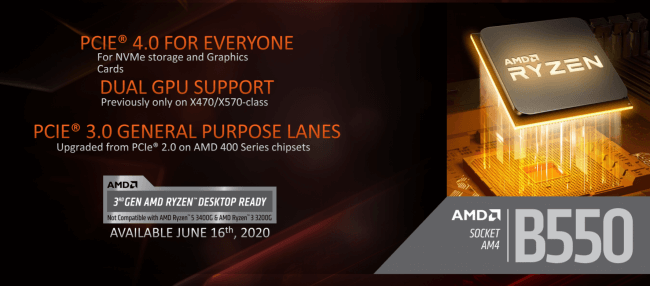
Previously, AMD’s high-end X570 chipset was the first to bring PCI Express 4.0 (PCIe 4.0) support. This new standard offered roughly up to 2X the “bandwidth” support for the next generation hardware, e.g. SSDs, network Adapters, GPUs etc. Now, the B550 chipset is bringing the “potential” of PCIe 4.0 to the “mainstream” market. Today many AM4 B550 motherboard are on the rollout, with several vendors listing their Models with an expected launch date of June 16th 2020.
Recently AMD announced that the company’s B450 and X470 chipset boards will have proper Zen 3 CPU Support, but that comes without the benefits of “PCIe 4.0”, and the associated increased bandwidth.
With this in mind, one of the major key points of the new B550 chipset is that it will support PCIe 4.0 and obviously Zen 3 CPUs, giving gamers and end users a more “affordable” option to upgrade. When compared to the “B450 chipset”, the B550 officially supports PCIe 4.0 devices within the full length PCIe slot thrown by the CPU.
This could actually mean that the top full-length slot will run at PCIe 4.0 x16, with some models also allowing for “x8/x8” configuration from a second full-length slot (could also support Nvidia SLI). Another benefit of the B550 chipset includes support for up to two USB 3.1 G2 ports, which B450 lacks.
One caveat is that B550 boards won’t support the previous 1st- and 2nd-gen Ryzen processors, or the Ryzen 3000 APUs like the Ryzen 5 3400G. While we do have the same AM4 socket, “ROM size limitations” makes it very difficult for board makers to include support for all current, future, and past Ryzen processors with a single “firmware” patch. Of course Motherboard vendors can possibly release BIOS patches, though we can’t count on this yet.
Regardless, you won’t get “PCIe 4.0” support unless you install a Zen 2 Ryzen 3000 CPU in one of these motherboards. You will get PCIe 4.0 support through the CPU, delivering sufficient lanes for fast NVMe storage and the GPU. “Dual-GPU” support is also included, though not many gamers are going to opt for an SLI/CrossfireX setup these days, given the current state of “game” engines.
Also included in B550 is the doubling of the bandwidth of the motherboard’s “general-purpose” PCIe lanes from the chipset. This “per-lane” throughput has actually allowed AMD to “reduce” the number of lanes between the chipset and CPU from six PCIe 2.0 lanes to four PCIe 3.0.
Even though the expensive X570 still gives more bandwidth on the “chipset” level, along with a faster uplink connection from the chipset to the CPU, but for majority of “gamers” and end users the bus bandwidth and other features offered by the B550 chipset should be more than enough. After all, most of the gamers are going to install a single GPU, along with few fast SSDs and other stuff.

User’s articles is a column dedicated to the readers of DSOGaming. Readers can submit their stories and the Editorial team of DSOGaming can decide which story it will publish. All credits of these stories go to the writers that are mentioned at the beginning of each story. Contact: Email