
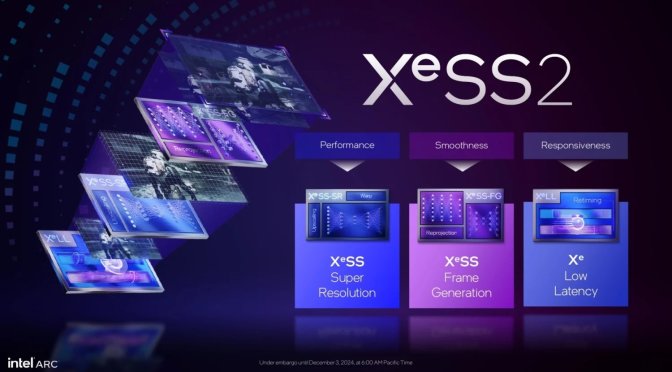
Intel has released a new SDK for Intel XeSS 2, which will allow developers to add support for it on non-Intel GPUs. This means that games with official support for XeSS 2.1 will work on NVIDIA and AMD GPUs.
Going into more details, Intel XeSS 2.1 will require Shader Model 6.4. This means that you will at least need an NVIDIA GTX-10 series GPU or an AMD Radeon RX 5000 series GPU. Older GPUs will not be compatible with it.
I should also note that the quality of Intel XeSS 2.1 on non-Intel GPUs will not be as good as what you’ll get on Intel GPUs. This is something that also happened with the previous version of XeSS. Still, this should be great news for those who want to use Intel XeSS 2.1 instead of AMD FSR 3.1.
For those unaware, Intel XeSS 2.0 supports XeSS Super Resolution, XeSS Frame Generation, and XeSS Low Latency. Non-Intel GPU owners will gain access to all of them. However, XeSS Low Latency is tied to XeSS Frame Gen. In other words, you won’t be able to just use XeSS Low Latency. That’s only for non-Intel GPUs. Those who own an Intel GPU will be able to freely enable XeSS LL at any time.
This is definitely great news for those who don’t own an NVIDIA RTX GPU. From what I’ve seen, Intel XeSS is more demanding than AMD FSR. So, while this is cool, I don’t know whether or not it will be THAT useful to those who don’t own an Intel GPU. Right now, AMD FSR 3.0 seems to be the way to go if you own an AMD or an NVIDIA GTX GPU. Nevertheless, it’s good to have options.
At this point, I believe all future games should support all three upscaling techs. There is no excuse for a game to only support DLSS or FSR. Once you implement support for one upscaler, it should be easy to add support for the rest of them. Since a lot of games use UE5, there are plugins that can add support for all of them. So, again, there is no excuse not to support all of them.
Stay tuned for more!
Intel® XeSS 2 is now supported on other vendors GPUs! Developers can offer AI-based frame generation with low-latency technology to many more gamers by using the updated XeSS 2.1 SDK available today.
Link: https://t.co/nwQJI2PVt0 pic.twitter.com/111bXJY5YE
— Intel Software (@IntelSoftware) August 1, 2025

John is the founder and Editor in Chief at DSOGaming. He is a PC gaming fan and highly supports the modding and indie communities. Before creating DSOGaming, John worked on numerous gaming websites. While he is a die-hard PC gamer, his gaming roots can be found on consoles. John loved – and still does – the 16-bit consoles, and considers SNES to be one of the best consoles. Still, the PC platform won him over consoles. That was mainly due to 3DFX and its iconic dedicated 3D accelerator graphics card, Voodoo 2. John has also written a higher degree thesis on the “The Evolution of PC graphics cards.”
Contact: Email