
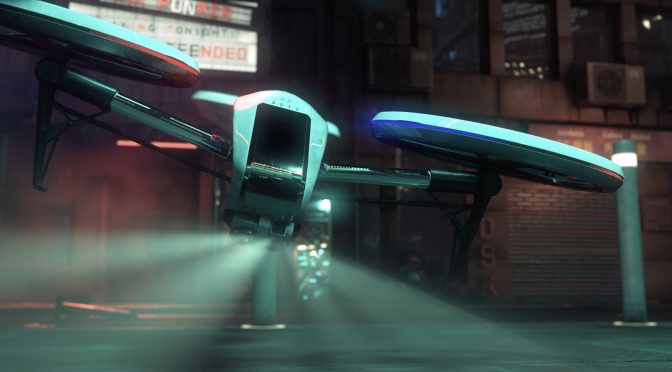
Crytek has just released a free ray tracing benchmark based on the ray tracing demo of the same name, which was made available as a video at GDC 2019. As you may have guessed, this tech demo is using CRYENGINE and works on both AMD and NVIDIA graphics cards.
PC gamers can download the benchmark from the CRYENGINE Marketplace. This demo will give a score to the user based on how their system performs rendering scenes produced by CRYENGINE’s new ray tracing feature in real-time. Needless to say that we highly recommend downloading this demo.
As the press release reads, the ray tracing technology that features in Neon Noir is both hardware and API agnostic. This is an extension of CRYENGINE’s SVOGI rendering tool that currently Crytek’s games use, including Hunt: Showdown. Developers around the world will be able to use this advanced alternative to other ray tracing methods, which are typically bound to GPU solutions with dedicated RT cores, when the feature ships in the next major CRYENGINE update in 2020.
Crytek plans to optimize this technique, to benefit from performance enhancements, in the future. This tech will support low-level APIs like Vulkan and DX12. Moreover, it will be compatible with all future graphics cards from all manufacturers.
Neon Noir follows the journey of a police drone investigating a crime scene. As a drone descends into the streets of a futuristic city, players will witness accurate reflections in the windows. The drone model also has self-reflecting properties on various surfaces, such as its wings. Further demonstrating how ray tracing can deliver a lifelike environment, the puddles reflect the neon lights below them, street lights flicker on wet surfaces, and windows reflect the scene opposite them accurately. Showcasing the benefits of real-time ray tracing, the demo does not have any screen-space reflections.
Ray tracing is a rendering technique that simulates complex lighting behaviors. CRYENGINE’s new ray tracing feature simplifies and automates the rendering and content creation process. As such, the engine can correctly reflect animated objects and changes in lighting. This eliminates the known limitations of pre-baked cube maps and local screen space reflections when creating smooth surfaces like mirrors. This also allows developers to create more realistic and consistent scenes. CRYENGINE’s implementation is a highly customizable and flexible system, which gives designers the control to specify exactly where they want to achieve the highest performance, and where they want the highest quality, to ensure a balanced and optimized scene.
Lastly, here are the PC requirements for running this tech demo.
Recommended Minimum Specs for the Neon Noir Benchmark:
- AMD Ryzen 5 2500X CPU/Core i7-8700
- AMD Vega 56 8 GB VRAM/Nvidia GTX 1070 8 GB VRAM
- 16 GB System Ram
- Win 10 x64
- DX11
Enjoy the following video!


John is the founder and Editor in Chief at DSOGaming. He is a PC gaming fan and highly supports the modding and indie communities. Before creating DSOGaming, John worked on numerous gaming websites. While he is a die-hard PC gamer, his gaming roots can be found on consoles. John loved – and still does – the 16-bit consoles, and considers SNES to be one of the best consoles. Still, the PC platform won him over consoles. That was mainly due to 3DFX and its iconic dedicated 3D accelerator graphics card, Voodoo 2. John has also written a higher degree thesis on the “The Evolution of PC graphics cards.”
Contact: Email
AMD fanboys will finally see the benefit of dedicated Ray Tracing hardware acceleration units.
No need to be a “fanboy” …
but still if you look back some discussion regarding this matter it is really funny when some people (fanboy or not) think they can get RT effect without performance hit at all. some even said that AMD upcoming Adrenalin will enabled DXR on Navi and Navi will going to have the same performance as 2070 or even 2080 with DXR enabled in any games that use it despite lack RT core. the proof? this demo where AMD can get good performance even without RT core.
RT cores aren’t used because it’s fake ray tracing.
https://uploads.disquscdn.com/images/93bb4f2a3a61022aef3ab6e437a2293a1423e2b7605aa6d3e1febd148d279377.png
I think that was his point. Though I could be wrong.
What are you talking about exactly ? The difference between object and reflection ?
That’s not faked it’s correct. What you are seeing is the reflection of reflections. ie – the casing has reflections on it. The puddle then reflects reflections on the casing’s shiny areas. The thing is, with shiny surfaces, light doesn’t scatter, it bounces at the same angle it came in. In this case you are seeing different results because light travels a different path in both cases
Go take a shiny reflective object like a spoon, and hold it to a mirror. Then look at the spoon and mirror image of spoon from different angles. The reflections on the spoon will look different in the mirror image. That’s because the path the light travels is different for the mirror reflections to reach your eye. This is not the case with rough objects, because light scatters in all directions instead of exact reflection.
I drew this picture in photoshop. It’s with mouse, so cut me some slack 😛
https://uploads.disquscdn.com/images/f94d7ee74684c68273b30ce91b34ef57ac03e1f5c354eafedaf1da9e211758e0.png
From the image, if you look at some point on the shiny ball, it will reflect whatever is at “A”. However, if you look at the mirror’s reflection of that same point on the shiny ball, you will see the ball surface (in the mirror) reflecting whatever is at “B”.
What are you talking about exactly ? The difference between object and reflection ?
That’s not faked it’s correct. What you are seeing is the reflection of reflections. ie – the casing has reflections on it. The puddle then reflects reflections on the casing’s shiny areas. The thing is, with shiny surfaces, light doesn’t scatter, it bounces at the same angle it came in. In this case you are seeing different results because light travels a different path in both cases
Go take a shiny reflective object like a spoon, and hold it to a mirror. Then look at the spoon and mirror image of spoon from different angles. The reflections on the spoon will look different in the mirror image. That’s because the path the light travels is different for the mirror reflections to reach your eye. This is not the case with rough objects, because light scatters in all directions instead of exact reflection.
I drew this picture in photoshop. It’s with mouse, so cut me some slack 😛
https://uploads.disquscdn.com/images/f94d7ee74684c68273b30ce91b34ef57ac03e1f5c354eafedaf1da9e211758e0.png
From the image, if you look at some point on the shiny ball, it will reflect whatever is at “A”. However, if you look at the mirror’s reflection of that same point on the shiny ball, you will see the ball surface (in the mirror) reflecting whatever is at “B”.
There was a whole article on why the guy saying it’s fake is completely wrong. I suggest you read it
no the ray tracing used in the demo is real but Crytek did some trick so they can get good performance without dedicated RT accelerator. what you’re seeing here is direct effect of that trick.
Too bad you will never know the BENEFITS of a BRAIN. You Dumb M*ha F*qr!
Lol i thot they went bankrupt….
The benchmark is impressive and runs very well on my 5700xt and ryzen 3600. Close to 80 average and sometimes hitting 90+
And without spending 1200 bucks on a GPU. Imagine.
Yes. But with significantly worse result. RTX 2080 Ti would run it also with significantly better framerate if they use DXR. But you guys can still pretend that it is the same.
No ody gives a sh*t about Crytek anymore