AMD Ryzen 9000 series feature

AMD shared the first gaming benchmarks for the Ryzen 7 9800X3D

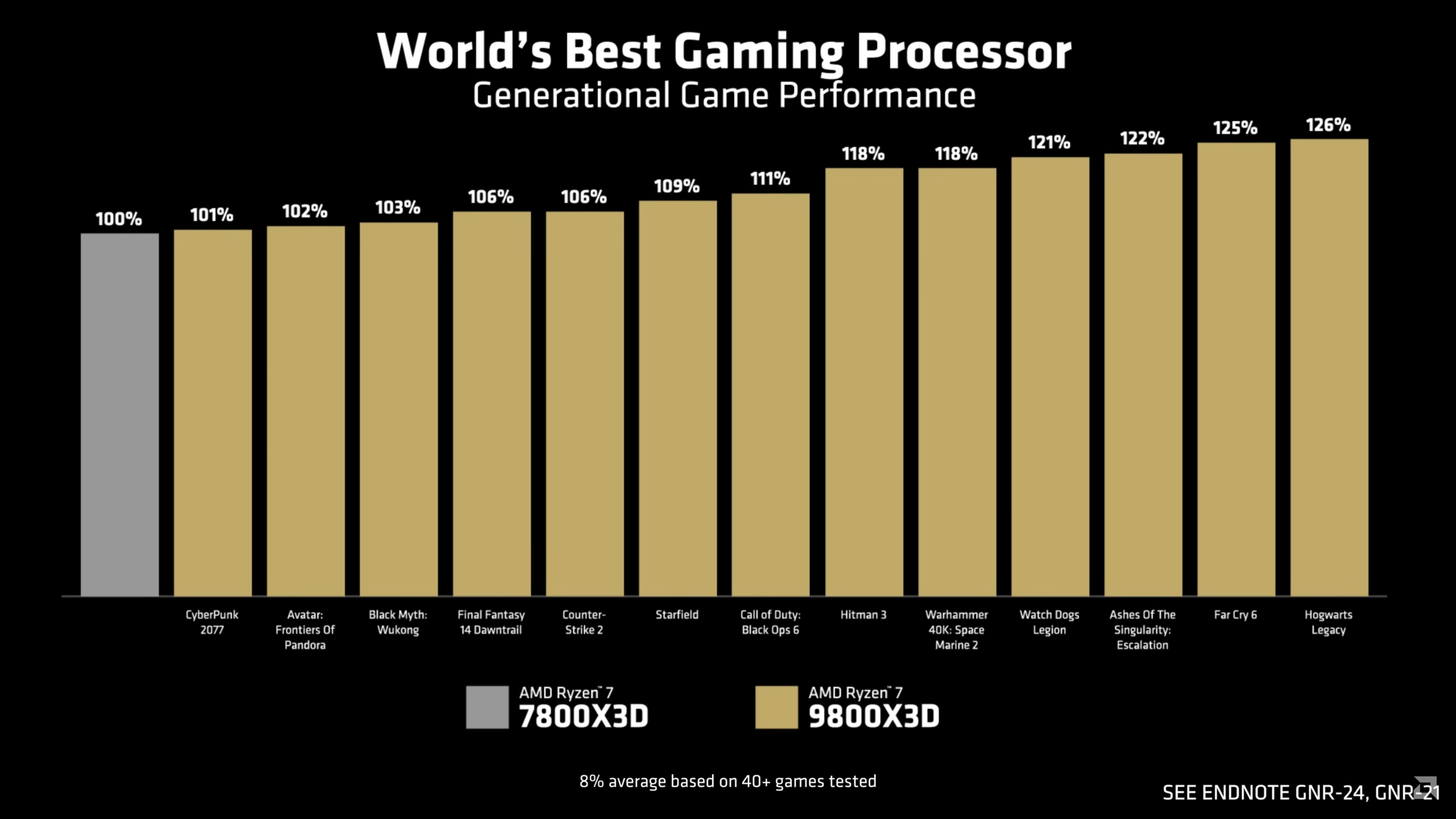
AMD has just shared the first official gaming benchmarks for its upcoming Ryzen 7 9800X3D CPU. According to the red team, this CPU will be 20% faster than the Intel Core Ultra 9 285K, and 8% faster than the AMD Ryzen 7 7800X3D.

Going into more details, the red team has benchmarked these CPUs in 40 games. AMD shared the following graphs, showcasing the performance difference of these three CPUs in some of them.

Overall, AMD claims that the new AMD Ryzen 7 9800X3D is 8% faster than the Ryzen 7 7800X3D. This means that those who have a 7800X3D will have nothing to worry about. I mean, we’re talking about less than 10% gains.

On the other hand, those who want to get a new CPU will be able to get the 9800X3D over Intel’s latest high-end CPU. The Intel Core Ultra 9 285K already struggled to compete with the AMD Ryzen 7 7800X3D. And, since the 9800X3D is slightly faster, it will manage to widen the performance gap between them.

The AMD Ryzen 7 9800X3D will have 8 CPU cores, and it will support 16 threads. The CPU can hit frequencies up to 5.2GHz, and it will have 104MB of total cache. AMD will sell this new CPU for $479.

The AMD Ryzen 7 9800X3D processor will be available starting November 7th. The review embargo for the third-party benchmarks and reviews will be lifted on November 6th.

Enjoy and stay tuned for more!
AMD Ryzen 7 9800X3D first-party benchmarks-1AMD Ryzen 7 9800X3D first-party benchmarks-2

Meet the AMD Ryzen 7 9800X3D Processor

34 thoughts on “AMD shared the first gaming benchmarks for the Ryzen 7 9800X3D”

    1. I just got a 5800XT (the 5800X3D was out of stock everywhere, and I didn't want the lower productivity performance of the 5700X3D) and I've been pretty happy with it. It's unfortunate I was late to the Zen 3 party, because my old 3800X kind of sucked and wasn't compatible with my RAM.

      1. This isn't your blog. And he obviously isn't interested in having a conversation with you. Hence the lack of a reply.

      2. I used to have a 3700X and the memory controller gave me problems too, no bueno. I also had the USB problems for a very long time, It kept me from playing with VR and Hotas at the same time. I bought the 5800X3D a year and a half ago and absolutely 0 problems so far.

    2. This made me go into a rabbit hole and from what I read, the DDR6 spec is going to be finished in what's left of 2024 or maybe first half of 2025, so it's going to arrive much earlier than the time it took from DDR4 to 5…

      DDR5 spec was done in late 2020 and Zen 4 adopted it in mid 22, and Zen 5 exclusively mid 24 with a slight delay.

      So 6 should start to show up in the market with some compatible motherboards and processors in about mid 26, or miss a processor cycle and go into 2027.

      The 7800X3D can be already a good 20+% faster than the 58 in some games… So, the 58 will be somewhat left behind in at most a couple more processor gens, but depending on the games and quality you run them at, you might very well be good enough. I'd probably be good with it and save the jump for DDR6 too in 2026 or 27.

      1. The same rabbit hole I went not long ago, came out with a similar time line. If mobos start coming out at late 2026, I can probably wait if I don’t move from 1440/120.

    3. If you're already that good at lying to yourself about the quality of your hardware, why not wait until DDR7?

  1. I would take any benchmarks from AMD or Intel with a grain of salt. Better to wait for reviews on TPU where you will see a thorough unbiased test.

    1. Processor benchmarks from both tend to turn out quite accurate, they're not too bullsh*tty. It's in graphics cards where they're very BS.

        1. Wasn't that a Windows issue specifically?

          From the benchmarks I saw on Linux, Zen 5 performed as predicted by AMD.

          1. No, the configuration didn't matter. Well, it sorta did but only because Windows was holding back both the 9000 series and the 7000 series… as well as the 5000 series. So when the patch dropped they all saw a performance boost.

        2. No no, of course I didn't, but it's been the general rule for a few long years. Both AMD and intel plus reviewers and consumers know that IPC and overall performance isn't advancing much lately, and they haven't really inflated the performance gains in their previews, and even do them detailing separate apps and games unlike say a decade ago, so it's quite clean.
          In this last case, it was really botched at launch, but fixed later by them and Microsoft, and the gains reached what was claimed which still wasn't much to begin with.
          PS: And yes, it faired much better in Linux.

  2. I still have a Ryzen 5600x and a Rtx 4070 most games i play at 3264 x 1836 using Nvidia nis to upscale and Complete rt and get around 40 fps on most games happy with what i got.

  3. By the way, unlike the previous two X3D processors, the 5800X3D and 7800X3D, this new Zen 5 variant actually uses a new and refined ""2nd Gen 3D V-Cache technology".

    So I'm curious to see how good this new Zen 5 chip performs in the long run in both gaming, and productivity apps, because this X3D chip can now also be overclocked/OC'd easily.

    And, AMD also seems to have changed the topology and design of the 3D cache chiplet/die.

    Because these new Ryzen 9000X3D CPUs employ the 3D V-Cache stacked underneath the Zen 5 CCD, unlike the previous gen V-cache chips.

    So this means less thermal issues, and more headroom for OC as well, due to better transferring of the heat from the CPU cores to the IHS.

    So now we have CCD on top, and the L3D cache die stacked below it (via an inverted design). But how this pans out in real world gaming remains to be seen though.

    For reference, both the previous gen 7800X3D and the 5800X3D chips had the L3D chiplet stacked on top of the CCD, which restricted it from boosting its clocks, and led to thermal/heat issues.

    .

    1. I didn't know AMD released any info about the Gen2 V-Cache yet, having the cores a bit further from the socket wouldn't affect latencies in some way?

    2. Nobody cares what you have to say nugger brain. JOHN FIRED YOU FROM THE SITE, STAY GONE! HIS LIZARD IS DEAD BECAUSE OF YOU.

  4. Some odd performance discrepancy noted in the CP 2077 game.

    Compared to the Core Ultra 9 285K, the flagship Arrow Lake CPU, the Ryzen 9800X3D is up to 59% faster in Cyberpunk 2077.

    But only 1% faster vs the Ryzen 7 7800X3D in the same game.
    .

    1. The 7800X3D also performs significantly better than the Core Ultra 9 285K in a number of games. Intel's latest CPU's just have lackluster gaming performance, which allows for some weird looking marketing slides from AMD. They really should have advertised them against Intel's 14th gen.

    2. No discrepancy, the 285 runs CP2077 terribly badly, like it has a big problem with that specific game. The numbers are actually like that.

  5. I still have a Ryzen 5600x and a Rtx 4070 most games i play at 3264 x 1836 using Nvidia nis to upscale and Complete rt and get around 40 fps on most games happy with what i got.

  6. AMD: 8% performance uplift over previous gen.

    Intel: 0% performance over previous gen.

    These numbers are pathetic for $500 CPU.

    The reckoning is coming for these hardware manufacturers. Silicon is at the end of the road.

    Watch these companies crash and burn once AI fails to deliver on its promises.

    1. It's because neither one are targeting the consumer/gaming markets this generation which is still in a recession. They are targeting the Corporate Desktop where the market is doing quite well and sales are much higher

      Intel still dominates the overall CPU market with a 75+% share to AMD's less than 25% share but in the corporate desktop market the difference is even larger, 85% Intel to 15% AMD. So AMD decided to target that market this time around improving productivity applications rather than gaming. Intel countered with the 285 which while not having much gain for productivity they are considerably more efficient than the last 3 generations and when you are running a 1000 or more corporate desktops those energy savings add up and can often times lead to Tax reductions and a better ESG rating.

      Like it or not they are going to go where the most money is at and unlike 2020 and 2021 that is NOT consumer/gaming

  7. I remember the days everyone mocked AMD for it's name and how it was far behind Intel in general computing and gaming. Fast forward now and they've not only conquered Intel rivalry but also reclaimed their brand "Advanced Micro Devices". World's best gaming processors rightfully. So proud of being an AMD owner for 11 years.

    1. Well AMD did put out some pretty sh*t CPUs between Thunderbird and Ryzen. In fact they almost went bankrupt and would have if it wasn't for the PS4 and Xbox One saving their a**es.

      I remember this well because I bought 1003 shares of AMD stock during the Great Republican Recession in early 2009, the stock doubled in price and then Bulldozer released and the stock tanked. Since I was able to get 1003 shares for about $2750 I stuck with it and when I sold my stock in late 2021 It was up to $144/ share and my $2750 investment turned into $145,000.

      1. Didn't know about the bankruptcy thing but yeah the cpus were weak compared to intel in 2010s era that's for Sure. But damn man! You really bagged some real chips there. Real Traditions of the trade.

  8. And here I am on my i5 8600K from 2017, OC'ed to 5GHz. Still good enough for everything. No plans to build a new PC until next gen consoles come out. So 2-3 years.

Leave a Reply

Your email address will not be published. Required fields are marked *