
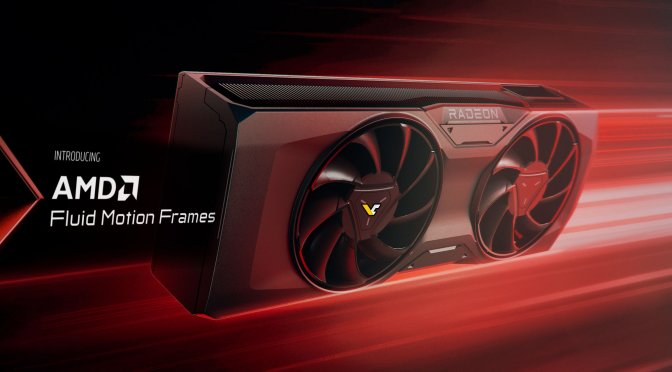
AMD has released a new beta version of its Fluid Motion Frames tech, AFMF 2. According to the red team, AFMF 2 has lower latency, higher performance and features a number of fast motion optimizations.
AMD has added two new major features to AFMF 2. These are the Search Mode and the Performance Mode. So, let’s see what they do.
Search Mode controls the frame generation smoothness by improving how “fallback” works in AFMF 2. Fallback refers to when AFMF frame generation is temporarily disabled in high-motion scenes to ensure the best interpolated image quality, which can sometimes cause jitter that impacts the smoothness of the gaming experience.
The fallback of AFMF was one of my biggest gripes with this tech. According to AMD, this has been improved so it shouldn’t be as bad as it was.
AMD claims that it has made considerable improvements in frame generation by using AI-optimization to help develop an updated algorithm. So, by setting the Search Mode to High, you will be able to reduce the fallback for improved AFMF smoothness. In theory, the games shouldn’t have those huge framerate drops now.
The other major feature of AFMF 2 is the Performance Mode. This mode comes with three settings: Auto, Quality and Performance. Quality was the setting that AFMF 1 used. The new Performance setting reduces the overhead of AFMF 2 to help make high frame rate gaming experiences more achievable on a wider range of devices.
AMD also stated that it has made notable improvements in reducing the latency added by frame generation. These improvements apply across the board when using AFMF 2, no matter the settings mode, resolution, or hardware used. Compared to AFMF 1, AFMF 2 can be more responsive by around 28%.
Finally, it’s worth noting that AFMF 2 will now work with games that use the Vulkan and OpenGL APIs.
You can go ahead and download this latest beta version of AFMF from this link.
Have fun!

John is the founder and Editor in Chief at DSOGaming. He is a PC gaming fan and highly supports the modding and indie communities. Before creating DSOGaming, John worked on numerous gaming websites. While he is a die-hard PC gamer, his gaming roots can be found on consoles. John loved – and still does – the 16-bit consoles, and considers SNES to be one of the best consoles. Still, the PC platform won him over consoles. That was mainly due to 3DFX and its iconic dedicated 3D accelerator graphics card, Voodoo 2. John has also written a higher degree thesis on the “The Evolution of PC graphics cards.”
Contact: Email
Cool tech getting cooler. I cant wait to see some comparisons between this and Lossless Scaling's 3x mode. Again cool they are making these improvements as we all get to take advantage of FSR Frame Generation but I guess them pushing Frame Gen more than the upscaling now probably means we wont see more quality boosts till RDNA 3.5/4 starts hitting consumers.
AFMF works ONLY with specific AMD GPUs, so these improvements are not for everyone.
youre right. I meant generally these improvements will spill over into the development of other suites of technology largely. I expect to see similar features on future iterations of FSR or whatever the suite will be called when the new architecture and platforms arrive.
Any progress or news you've heard regarding AFMF support on the steam deck? I'm aware of game specific mods but wonder if Valve and AMD have been working on a native option at all, as that would be amazing
AFMF and FSR 3 frame generation is supported only on hardware with VRR because it require V-Sync disabled. You don't want play PC games with V-Sync disabled on device without VRR
Only Asus ROG Ally use VRR display and support both AFMF and FSR 3 frame generation
RDNA2, RDNA3, equivalent iGPUs and portable consoles a la Steam Deck (on Windows) should be enough GPUs, no?
AFMF is only supported by AMD RDNA2 and RDNA3 GPUs.
Yeah, aparrently it’s 700-800 iGPUs and Z1 chips. RDNA2 600 chips (including Steam Deck) don’t support it I think
AFMF and FSR 3 frame generation is supported only on hardware with VRR because it require V-Sync disabled.
Many handhelds use Ryzen Z1 Extreme chip but only Asus devices support VRR so AFMF is enabled only on Asus ROG Ally.
Imagine playing on PC and turning on frame gen, to end up with twice the input latency of a $200 Nintendo Switch.
Frame generation is pathetic, the dweeb casuals defending adding input latency to get some fake frames, should go play hello kitty on mobile.
I can tell from your comment that you have never used these technologies, nor given yourself a blind test doing so. Your hate is misguided and provides a deeper reflection of your "personality".
Frame gen is fake optimization, this is why its not ideal.
its not optimization its fake frames with delay.
ok
Videogames are fake worlds with fake rendering, so I don't play them cause they're not real.
you dont get it
Sure, I may choose not to use frame gen in say Doom Eternal or Selaco. But I've had no problem using either the DLSS3 or FSR3 mods with 'fake frames' in Elden Ring to beat Melania, and that game clearly demands precise input.
It's not for every game out there, but I'll take it as an option any day even if I choose to not enable it. Choice is always a great thing for all PC gamers.
Truly spoken as someone that's on an RTX 30 card or older and never used any kind of frame gen tech whatsoever, from the FOUR variants we have today. And is simply in denial.
"fake frames" is meaningless.
if you can't tell the difference, and the game feels smoother, it's better. If input latency is that important, sure turn it off.
all video game optimizations have tradeoffs. There are no solutions, only tradeoffs.