AMD FSR 3.0 feature

AMD has just announced FSR 3.1 with Improved Upscaling Quality

AMD has just announced FSR 3.1 which will come with improved upscaling quality. This new version of FSR promises to improve image stability and reduce ghosting. And below, you can find some examples of these improvements.

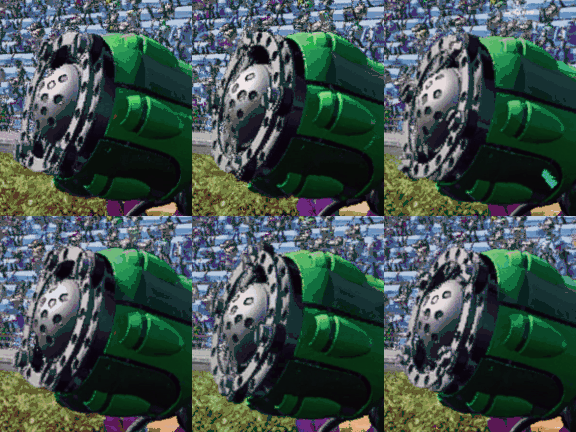
Let’s start with the comparisons. AMD shared these two GIFs. These comparisons are between FSR 2.2 and FSR 3.1 The top (left) images are with FSR 2.2, whereas the bottom (right) images are with FSR 3.1. In the first one, we get to see AMD FSR 3.1 producing a better and more stable image than before.


AMD says FSR 3.1 will make games more stable when you’re still or moving. That means fewer flickers and shimmers, and less weirdness when things are in motion. Plus, it’ll reduce ghosting and preserve more details than before.

AMD FSR 3.1 also has another cool feature. With this new version, Frame Generation will work with all other upscaling techs. Finally, PC gamers will be able to use NVIDIA DLSS 2 or Intel XeSS alongside AMD FSR 3.1 Frame Generation.

AMD has also revealed the first game that will support FSR 3.1. This game is Ratchet and Clank. And yes, alongside the visual improvements, Nixxes and AMD will decouple FSR 3.1 Frame Generation from upscaling. So yes, you will be able to use FSR 3.1 Frame Generation with DLSS 3 Super Resolution.

This is a huge improvement to FSR. So, kudos to AMD for not only improving its Super Resolution tech but also allowing PC gamers to use Frame Generation with all the other upscaling techs. This is what most of us have been asking for. And at last, we’ll finally get it.

Hopefully, the game devs will update their games to support the new FSR version. Starfield, Like a Dragon: Infinite Wealth, Avatar: Frontiers of Pandora, and The Talos Principle 2 could greatly benefit from FSR 3.1.

Enjoy and stay tuned for more!

30 thoughts on “AMD has just announced FSR 3.1 with Improved Upscaling Quality”

  1. Good news man! nowdays we have serious competition in fake blurry upscaled crappy frame field. I miss the times where it was about better and more powerful gpu, with ADDITIONAL features.

    1. If that’s the way you really feel, take heart. Things like upscaling and frame generation will only get better and more efficient.

        1. Let me guess, you have a AMD Fury GPU that does not support any of this, so you are bashing the technologies out of spite without having witness any of that.

          1. Sounds like you do have an ancient card.
            Im happy for all these technologies, even thou my desktop always has the top card, usually i dont need frame gen on 4090, but I always enable DLSS in quality mode, looks much better then native with great AA.

            But I also have LegionGO and all these frame boosting technologies are greatly appreciated on Handhelds
            Something like AMD fluid motion driver based frame gen, is insane for handhelds, on games it works fine, its free fps, its not like there is anything better than Z1E for handhelds now, it is what it is

  2. Well DAMN, those are some pretty remarkable improvements! It’s even more impressive when you take into account that this is comparing performance mode at 1080p between FSR 2.2 and 3.1, meaning that it’s upscaling from 540p. In other words, it’ll be even better at higher resolutions. And yeah, being able to use FSR FG in conjunction with other upscaling is pretty significant too. Well done, AMD.

    1. True!

      I know most people around here like to dumb on AMD, but it’s impressive what their GPU division is able to achieve with significantly less R&D money than NVIDIA.

      Still, there’s definitely room for improvement left especially with AMD’s Windows driver team, as Valve’s RADV Vulkan driver on Linux proves.

    2. It’s pretty obvious that <=1080p handheld gaming PC's were the primary development target for FSR 3.1. 🤷 I also think that's why it's taken so long for an update to FSR's upscaling component to come out (last one was FSR 2.2 all the way back in Nov 2022).

      Aka, they didn't want to ship something until they could reasonably "crack the Steam Deck nut". And if it looks acceptable on a =1440p one!

      1. Well observed!

        Although an even greater indicator that the Steam Deck played a major role in the development of FSR 3.1 is the fact that official support for the Vulkan API was added with this release, which John unfortunately didn’t include in his reporting.

        Shame on the quality of your “journalism”, John! 😀

  3. It’s good that amd has a more open tech it’s just too bad that most games won’t get them only newly released or some major games retroactively. Maybe modders could also replace dlss3 with this in games. The only issue is devs will only code to the top system specs and just say well use dlss2 and dlss3 and amd equivalents instead of proper optimization and scalability.

    1. … You can ALREADY inject FSR into basically any DLSS game. 🤷

      And just like with DLSS, it should be totally possible to manually update the FSR version used in older games to a newer release by just swapping around some files.

      That said, you still won’t be able to enable any features the original game didn’t already support though, such as say frame-gen.

      1. yeah I know and I also used the fsr3 replacer for dlss3 in cyberpunk but it’s too stressful for my system I guess I was saying they will likely use this updated version to replace dlss3 for those who don’t have 4xxx series cards. So I was using dlss2 with FSR3 FG in 77 already. That mod just negated the req for a 4 series card via reg tweak and they’ve even got a fixer for it that helps a lot with the ghosting but still too much for my system. Lossless Scaling can do a type of FG on most games just has certain reqs.

      1. Not officially but you can “force” it through modding and it doesnt look great from what a friend had shown me.

        1. Yeah, the “not looking great” part is to be expected, because FSR frame-gen relies on the GPU’s async compute capabilities, which NV’s 10-series lacks in hardware and instead relies on preemption in the driver to accomplish the task, meaning async compute is not really asynchronous on the 10-series.

          Turing (16/20-series) was a major redesign which supports proper async compute in the hardware, thus FSR frame-gen should work properly from there onwards.

          That’s also the reason why Vulkan generally runs noticeably better on newer generation GPUs, especially if the software in question makes use of more advanced features like Doom Eternal or DXVK does.

          1. This. You really don’t need a proper optical flow sensor for quality Frame-Gen like Nvidia claims you do, but you DO NEED excess compute performance if you lack such an ASIC block for doing the frame to frame comparison!

            AMD gets that extra compute performance by utilizing compute that would otherwise go unused/get wasted thanks to async compute via their highly developed Async Compute Engines (as they’ve been in AMD GPU’s since literally GCN 1/Tahiti [HD 7970/R9 280X]), Pascal otoh can’t do that as both it and Maxwell 2 only support async compute in name/useless technicality only.

            That said, I still wouldn’t expect as good FSR 3 Frame-Gen performance from Turing as RDNA 1-3 though, as despite having VASTLY better/more capable async compute than prior Nvidia architectures, it was still MILES behind AMD on that front. 🤷

        2. Yeah, the “not looking great” part is to be expected, because FSR frame-gen relies on the GPU’s async compute capabilities, which NV’s 10-series lacks in hardware and instead relies on preemption in the driver to accomplish the task, meaning async compute is not really asynchronous on the 10-series.

          Turing (16/20-series) was a major redesign which supports proper async compute in the hardware, thus FSR frame-gen should work properly from there onwards.

          That’s also the reason why Vulkan generally runs noticeably better on newer generation GPUs, especially if the software in question makes use of more advanced features like Doom Eternal or DXVK does.

  4. It could increase FPS 20 fold. I still wouldn’t care, I don’t want fake frames that introduce input lag.

    The problem below 60 fps is not just the visual stutter, it’s the input lag, and DLSS3 and FSR3.0 make this even worse.

  5. This is really cool, I hope more developers are active in adding this and updating existing fsr3 implementations.

  6. It could increase FPS 20 fold. I still wouldn’t care, I don’t want fake frames that introduce input lag.

    The problem below 60 fps is not just the visual stutter, it’s the input lag, and DLSS3 and FSR3.0 make this even worse.

      1. He’s talking about enabling FSR 3 Frame Generation with DLSS or XeSS upscaling part.

        This one:
        “AMD FSR 3.1 also has another cool feature. With this new version, Frame Generation will work with all other upscaling techs. Finally, PC gamers will be able to use NVIDIA DLSS 2 or Intel XeSS alongside AMD FSR 3.1 Frame Generation.”

  7. Hello my loved one! I want to say that this post is amazing, great written and include almost all significant infos. I would like to look extra posts like this.

Leave a Reply

Your email address will not be published. Required fields are marked *