
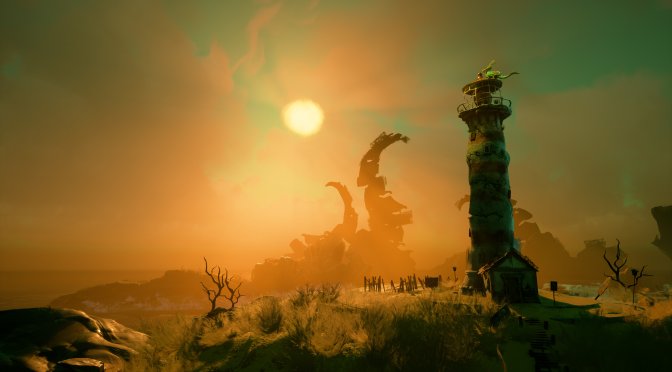
Last week, Microsoft released a new game from Double Fine, called Keeper. Keeper is an atmospheric puzzle adventure that uses Unreal Engine 5. So, let’s see whether this new UE5 game can run smoothly on a high-end GPU like the NVIDIA RTX 5090.
For these early tests, I used an AMD Ryzen 9 7950X3D, 32GB of DDR5 at 6000Mhz, and the NVIDIA GeForce RTX 5090. I also used Windows 10 64-bit, and the GeForce 581.57 driver.
Keeper does not have a built-in benchmark tool. So, for our tests, I used the following scene. This appeared one of the most demanding areas you can find early in the game.
At Native 4K/Very High Settings, the NVIDIA RTX 5090 is unable to come close to 60FPS. In fact, to get 60FPS at Native 4K without any framerate drops, you’ll have to use the Medium Settings. On an NVIDIA RTX 5090. Ouch.
The main reason behind this mediocre performance is, you guessed it, Lumen. The perforfmance gains of lowering the in-game settings are not that great. So, the only meaningful way to improve performance here is by using an upscaler.
Keeper supports AMD FSR 3.0, NVIDIA DLSS 4 and Intel XeSS 2.0. The game also supports Frame Gen for all of them.
By using NVIDIA DLSS 4 Quality Mode, we were able to get a smooth gaming experience. As I said, this is a really GPU-heavy area we are benchmarking. Other areas will run much better. Then, with DLSS 4 Frame Gen, we were able to get to 100FPS. I’ve also tried 8K and, suprisingly enough, the game was playable. This is mostly because Keeper is a slow-paced game. As such, I did not really feel the extra input latency of DLSS 4 Frame Gen.
Now, the problem with Keeper is that its visuals do not justify these huge GPU requirements. I understand why the devs chose to use Nanite and Lumen. These helped speed up development. But, as a customer, I don’t really care about such things. What I see here is something that could have been easily achieved with the older rasterized methods.
The big problem of most UE5 games is not that they use Lumen and Nanite, or how demanding these techs are. The problem is that they do not offer a fallback option. Ideally, UE5 games should offer support for Lumen and Nanite for high-end owners. For mid or low-end users, there should be an option to disable them. This means that there should be support for both Ray Tracing and Rasterization. As it is, Keeper – and other UE5 games – only support Ray Tracing (I’ve said numerous time and I’ll say it again. Lumen is a form of Ray Tracing. That’s why it’s so demanding).
All in all, Keeper is a really GPU-heavy title. While most of us understand the reason why it’s so demanding, the average gamer will be put off by its performance. This a valid complain. The devs decided to rely on UE5’s latest tech to speed up development, and that has backfired. And, let’s be honest. If the game looked like The Matrix Tech Demo (or like a CG trailer), no one would be complaining about it. But, there is nothing in Keeper that will “wow” you. This doesn’t look like a next-gen game. It’s an indie-looking game that could have been easily achieved with the older traditional rasterized techhniques!


John is the founder and Editor in Chief at DSOGaming. He is a PC gaming fan and highly supports the modding and indie communities. Before creating DSOGaming, John worked on numerous gaming websites. While he is a die-hard PC gamer, his gaming roots can be found on consoles. John loved – and still does – the 16-bit consoles, and considers SNES to be one of the best consoles. Still, the PC platform won him over consoles. That was mainly due to 3DFX and its iconic dedicated 3D accelerator graphics card, Voodoo 2. John has also written a higher degree thesis on the “The Evolution of PC graphics cards.”
Contact: Email


tech like ray tracing, in it's true form is not achievable with current hardware. We have halfbaked tracing that only tanks performance for nothing that great compared to a well done rasterized game. These morons add crap tracing and then use other crap like fake frames and upscaling for the lack of true optimization and using faketracing.
these days are truly sick days for optimization in gaming .
i am sure ai will fix it.
I hate UE5 with a passion
Devs: How demanding our game should be?
UE5: Yes!
And sadly that is due to the wrong reasons, mostly sloppy dev work/skills and sprinkle in some parts of engine issues to make the perfomance degradation complete.
Another game requiring a render farm in order to play it, yawn…
UE5 nowadays in the hands of most devs = Good screen shots, trashy and unstable performance once its time to play the game.
I rather have less flashy screenshots than a slideshow once its time to play the game. If the devs think its fair the customers should ALSO have to pay far more for additional hardware needed to offset their sloppy work on the paid title… they don't deserve ANY customers at all!
UE5 is not impressive graphics wise, it's the only engine people mistake for photorealistic because of how unoptimized it is.
It also doesn't hold up in screenshots though.
pass, I don't need Microsoft spyware
ew
https://www.youtube.com/watch?v=-010yO1Wbv0
Now there should be "Stop Unreal Engine 5 games" movement
Yes, and it needs to be some law because you can't expect FOMOtards to not buy a game.
"The big problem of most UE5 games is not that they use Lumen and Nanite, or how demanding these techs are. The problem is that they do not offer a fallback option."
And you say this as the top hardware struggle with the tech? Maybe it is just unoptimized and you can achieve better peformance with other tech. If you think the tech have potential, wait a few years for better hardware/optimization and use proven methods.
Raytracing is not the problem. There should be no fallbacks, just an optimized path for raytracing. Doom the Dark Ages and Metro Exodus Enhanced Edition demonstrate how fast Hardware based RTGI can be.
Lumen is a Software approach for Raytracing with some minor improvements on Hardware that supports it, that is why it is so slow.
Thera re plenty of other lazy and stupid dev habits – Like nanite abuse, why care to do proper LoD thats performance when the customers hardware can do that lifting WHILE in game?
What would be the minimum hardware required for an optimized raytracing?
Godfckingdammit, even a simple adventure game by Double Fine requires a 5090 to play @4K60 with DLSS???!
"~bUT iTs nEXt¬gEN gAmE…seEE..
~hoOO poOr peAsanTs caNt oFfoRd GPU…
~UnReal Foive is da BhEsht InGinE.."
– Modern audience (smh)
That's great and then with some tweaks you can run it at high settings where they matter. Sweet.
Lumen and virtual shadow maps are a god awful low quality solution designed to target weak amd hardware mainly to pretend consoles can do ray tracing properly which turned out they can't even run a solution properly engineered around them. If they had concentrated on implementing an performant ray traced solution from the start instead of software tricks it would have been in a much better state. Lumen is the worst quality rtgi out theere by a country mile.
nanite is just meshing which has been around since the rtx 2000. Just wasnt used as the consoles again can't do it and even now they can can't do it very well.
I played this game few days ago, at High Settings with Epic Textures (no need for Epic settings), 1600p DLSS Quality, with G-Sync + 60fps lock I got only occasionally some dips into 55fps but I turned off any FPS overlay and except a few very little stutter here and there with new locations, it was smooth and very colourful experience 😅.
Rog Strix G16 with Intel Ultra 9 275hx and 5070Ti laptop, so I don't think it was that bad.